
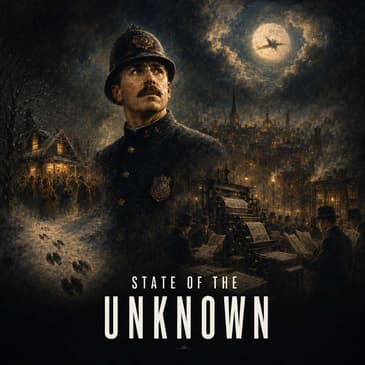

For one remarkable week in January 1909, communities across New Jersey, Pennsylvania, and Delaware were gripped by reports of the Jersey Devil, one of America’s most famous cryptid and paranormal legends.
Police officers claimed to see a strange creature moving over rooftops. Families awoke to unexplained sounds outside their homes. Residents discovered unusual hoofprints in fresh snow. Newspapers printed new eyewitness accounts almost every day as reported sightings spread from town to town, transforming an old Pine Barrens legend into a genuine regional panic.
Was a single unexplained creature responsible for the growing reports? Did fear, folklore, and sensational headlines feed one another until an entire region was looking into the darkness for the same thing? Or did something truly unexplained move through the Delaware Valley during that extraordinary week?
In this episode of State of the Unknown, join host Robert Barber as he follows the documented chronology of the 1909 Jersey Devil Panic through contemporary newspaper coverage, eyewitness accounts, police reports, and the public reaction that turned one of America’s oldest paranormal creature legends into front-page news.
In this episode:
- The first reported Jersey Devil encounters that set the panic in motion
- Patrolman James Sackville’s reported sighting and gunshots on Buckley Street
- The mysterious hoofprints that drew entire communities into the snow
- The famous Gloucester City encounter that gave newspapers their most detailed description
- How the reported creature sightings spread across three states in a matter of days
- Why the old Leeds Devil legend suddenly became the “Jersey Devil”
- What historians and researchers believe may have fueled one of America’s most famous paranormal panics
What do you think happened during the Jersey Devil Panic of 1909?
Support State of the Unknown
If you enjoy the show and would like to help support it, you can become a Sasquatch Supporter for $3 a month. Your support helps cover the costs of researching and producing the show, website hosting, distribution, and helping more people discover State of the Unknown.
Membership is completely optional, and the show remains free for everyone.
Become a Sasquatch Supporter on Patreon
🔍 New episodes every Tuesday
🌐 Visit stateoftheunknown.com for show notes and to submit your own story.
📬 Questions, theories, or story ideas? Reach out at contact@stateoftheunknown.com or @stateoftheunknownpodcast.
Some stories don’t stay buried.
We go looking anyway.
A Gunshot On Buckley Street
SPEAKER_00Patrolman James Sackville was walking his beat on Buckley Street in Bristol. It was around two in the morning. The town had gone quiet. Then he heard a sharp cry. Sackville stopped. He turned toward the sound and looked down the street. At first he saw nothing but the empty road, the dark windows and the rooftops against the night sky. Then something moved above the rooftops. It dropped low over the street before climbing again with a few heavy beats of its wings. Sackville stepped off the sidewalk for a better look. The shape climbed, dipped, then climbed again, staying just above the houses. Then it screamed. Sackville reached for his service revolver, stepped into the street, raised the gun, and fired. The shot echoed through the quiet. The shape never dropped. It climbed away, still beating its wings, the cry carrying through the darkness. Sackville kept the revolver raised until it disappeared beyond the rooftops. For a moment, the street was quiet again. Then, somewhere farther down Buckley Street, the scream came again. The strange thing about this story is that it didn't stay in the pine barrens. It moved into streets, across yards, over rooftops, past bedroom windows, and into newspaper offices. It reached people who weren't looking for folklore. They were walking home, checking on a crying child, looking out at snow in the morning, or just doing their jobs. And once the reports started coming in, it wasn't only one town reacting anymore. It was a whole region starting to look toward the dark. In
The 1909 Panic Takes Shape
SPEAKER_00January of 1909, communities across South Jersey, eastern Pennsylvania, and Delaware began reporting something strange moving through the night. Some saw a shape, some heard a scream, some found tracks in the snow. And for a short time, an old regional legend stepped out of the pine barrens and into the streets, yards, homes, and newspapers of the Delaware Valley. This is the story of the January 1909 Jersey Devil Panic. In the week an old legend became a public emergency. And this is State of the Unknown. Before
First Reports In Ordinary Places
SPEAKER_00the newspapers filled with drawings and headlines, before schools were said to close, before hunters went into the woods with guns, the reports began in ordinary places. A home. A street. In Bristol, Pennsylvania, one of the early reports came from a man named John McOwen. According to the accounts, it was around two in the morning when his infant daughter began crying. And that part of the story is almost painfully ordinary. A child wakes up, a parent gets out of bed. The house is dark and the rest of the town is asleep. McOwen got up and went toward the window. Outside, near the Delaware Division Canal, he reportedly saw something moving along the towpath. It wasn't described as a clear monster at first. It was closer to a shape in the dark. Something that looked, in one telling, a little like an eagle. But it wasn't behaving like one. It was down near the ground, moving in a strange way, hopping along the towpath. So McOwan stood there, looking out from a dark house, after being woken by his daughter, trying to understand what was moving near the canal. Not long after, another report came from Woodbury, New Jersey. This time the witness was Thak Cousins. The details shift a little depending on which version you come across. Some accounts place him leaving the Woodbury Hotel. Others make the location less certain, suggesting a hotel or maybe even a saloon. But the center of the report stays the same. Cousins stepped out into the night. The street was dark, then he heard a hissing sound. He saw something white move across the street. He later described two glowing points which he took to be eyes. Around it or behind it there was something like a white cloud, almost like steam escaping from an engine. It moved quickly, too quickly for him to make sense of it, and then it was gone. A hiss, a white shape, glowing points, steam, something fast crossing the street. That was what Cousins carried back with him from the moment. One of the most widely reported encounters involved patrolman James Sackville. Sackville was in Bristol, walking his beat near Buckley Street. A police officer out at night is supposed to be the steady person in the story, the one who moves toward the disturbance, the one people call when they don't understand what's happening. But according to the reports, Sackville heard dogs barking, and then he saw something himself. It was winged. It moved strangely, hopping like a bird. And it had a scream. That sound appears again and again in the January reports, a cry sharp enough to make people stop, turn, open windows, and step into streets. Sackville reportedly moved toward it. He didn't just watch from a doorway, he went after it. And when it lifted away from him, he raised his revolver and fired. That brings us back to the moment we opened with a patrolman standing in a quiet street at two in the morning, gun raised, watching a shape beat its wings above the rooftops. The shot didn't end the report. The thing didn't fall, it moved away. And then, somewhere farther down Buckley Street, the scream came back. By
Hoof Prints Change The Story
SPEAKER_00morning, people weren't only talking about what had moved through the dark, they were looking down at the snow. Snow changes a story like this. A sound in the night can disappear. A shape in the dark can become impossible to reconstruct. But tracks stay behind, at least for a while. In Bristol, after the night reports, residents reportedly found hoof prints in the snow. People came outside and looked at them. Two trappers were said to have examined the prints and claimed they'd never seen anything like them. One person could tell a story and walk away. A line of prints in the snow kept people standing there. Then similar reports began coming from Burlington, New Jersey. Families woke up and found tracks around their homes. In some accounts, garbage had been disturbed. The marks were described as hoof-like. Some reports said they ran in a single line as if they were made by something moving on two legs instead of four. Then the reports widened. Tracks were said to appear in Burlington, Columbus, and Rancocas. They were described in yards, across roads, and in places that made ordinary explanation feel harder for the people looking at them. Some accounts placed the marks on rooftops. Others had them going across fields or near trees. People brought dogs to follow them. A dog lowers its nose into the snow and a group follows behind. Someone points where the prints continue. Someone else looks ahead, waiting to see where they stop. In some accounts, the dogs failed to follow. In others, they refused. The tracks didn't give people a clean answer. They brought more people outside. In Burlington, steel traps were reportedly set. The Philadelphia Inquirer described the town as being in a state bordering on panic. People didn't just talk. They tried to catch something. They looked around their homes. They followed trails. They brought in dogs. Farmers and hunters reportedly went into wooded areas looking for the creature. And for a time, the ordinary winter landscape took on a different feeling. A mark in the snow wasn't just a mark. A sound outside wasn't just a sound. A dog barking at night wasn't background noise. People were watching. Then
The Gloucester City Roof Sighting
SPEAKER_00in Gloucester City, a couple woke to noises outside their home. And this time the report would give the newspapers something much more specific to print. Nelson Evans and his wife were in bed when they heard something outside. The time is usually given as around 2 30 in the morning. They were in Gloucester City, New Jersey. The house was dark. The sound was close enough to wake them. So they went to the bedroom window. Outside on the roof of a shed or outbuilding, they reportedly saw it. Not just tracks, not just a moving shape in the street, something standing there. They watched it for several minutes. This wasn't a second-long glimpse. At least as the report was later told, the Evanses had time to look. Nelson Evans described the creature as about three and a half feet tall. He said it had a head like a collie dog, a face like a horse, a long neck, wings, back legs like a crane, horse's hooves, and short front legs or paws. He said it stood or walked on its back legs. Evans reportedly opened the window. He wasn't miles away from it, he was close enough to speak through the window. And according to the account, he said, shoo. The creature turned. It made a sound, sometimes described as a bark, then it flew away. Mrs. Evans gave a similar account, and one detail from her version adds texture to the scene. She reportedly said the wings made a muffled sawing sound when they moved. Afterward, Nelson Evans went to police headquarters. In one retelling, he was described as pale or trembling. The report didn't stay inside the house. People came. In some accounts, hundreds of curious visitors showed up at the Evans home. Evans showed them the shed where the creature had been seen. People stood where he had stood. They looked at the roof. They looked at the distance from the window to the shed. And then the newspapers gave the report a body. The Philadelphia
Headlines Spread Fear Fast
SPEAKER_00Evening Bulletin published an illustration based on Evans' description. A person could open a newspaper at breakfast and see the shape. A schoolchild could hear adults talking about it. A worker could read a headline before leaving for the day and decide maybe the dark road home wasn't worth it. The reports weren't only moving from mouth to mouth anymore. They were being printed. And once they were printed, they could be carried anywhere. By then, people across the region weren't just hearing rumors from neighbors. They were seeing the reports in print. A newspaper could arrive at a kitchen table with a new town in the headline. A man could unfold it before work and read about tracks near another family's home. A parent could hear that the thing had been seen near a road their child used. And every new report gave people one more place to imagine it. In Haddon Heights, reports claimed the creature attacked or approached a trolley car. In Camden, other accounts placed it near a social club. Some stories said pets or chickens had been killed. Others put the sounds closer to people's own front doors. The details shifted from town to town, but they kept arriving in places people recognized. A trolley car in Haddon Heights, a social club in Camden, a yard outside someone's home, a doorstep, a street people had to walk after dark. In Camden and Bristol, police were among those reportedly firing at the creature. Men with badges were said to be stepping into streets with guns. Families were finding marks outside their houses. Farmers were looking toward barns and tree lines. In some places, schools reportedly closed. Some workers reportedly stayed home. Outside, ordinary life still had to continue. And every new report made people decide what felt safe enough to do next. Hunters, farmers, and armed groups went looking for whatever people believed was moving through the region. Some walked into wooded areas. Some watched roads. Some followed tracks until the trail gave them nothing else to follow.
New States Join The Search
SPEAKER_00By January 22nd, the reports had moved into Delaware. Readers there saw names of their own communities in the paper: Brandywine Village, Ellesmere, DuPont's Banks, Hollyok, Hillcrest, and Claymont. The Wilmington Evening Journal said the creature was believed to have come from Philadelphia, where it had already been frightening people for several nights. And as the reports moved, the name shifted to. Some papers called it the Leeds Devil. Others used stranger names, including Air Haas, Jabbernosk, and Grosswalk. By then, the reports had built on each other. There was the man in Bristol who saw something near the canal, the patrolman who fired at something over the rooftops, the couple in Gloucer City who watched something on a shed, in the Burlington family standing over tracks in the snow. And now readers in another state were seeing the same fear arrive in their own morning paper. As the names multiplied, one of them reached backward. Leeds Devil. For people in South Jersey, that name was already waiting. When the papers used the name Leeds Devil, they weren't inventing it from nothing. People in South Jersey already had stories about something strange in the pine barrens. Some had heard those stories from family. Some knew them as old local talk. Some may have treated them as folklore until the January reports gave the name a new place to go. Now the old story was being pulled into the present. A reader could see Leeds' devil in the newspaper and connect it to something they'd heard before. A parent could repeat the old version to a child. A neighbor could point toward the woods and say this was what people had been talking about for years. The old tradition was tied to the pine barrens, to the Leeds family, and to Leeds Point.
Mother Leeds And The Old Legend
SPEAKER_00The most familiar version is the Mother Leeds story. In that tradition, a woman with twelve children curses or rejects her thirteenth child. In some versions, she wishes the child would be the devil. In others, Mother Leeds herself is described as a witch, or the child's father is said to be the devil. The baby is born, then it changes. It grows into something winged and unnatural. Some versions say it frightens the people in the room. Some say it flies up the chimney and disappears into the pine barrens. Other versions add clergy, exorcism, or attempts to drive the creature out of the woods. These details belong to folklore, not to court records. But in January of 1909, folklore wasn't sitting quietly in the background anymore. People had tracks in the snow. They had a patrolman's gunshot. They had a couple's report from a bedroom window. They had newspaper drawings and names printed in black ink. The Leeds Devil gave all of that a familiar shape. And through those reports, conversations, drawings, and headlines, the modern Jersey devil began to take form. Not cleanly and not all at once, but piece by piece. A scream in Bristol, hoof prints in Burlington, a shape on a shed in Gloucester City, a name older than the panic itself.
Hoaxes Cash In On The Moment
SPEAKER_00Then came the exploitation. One of the most famous pieces of aftermath involves a Philadelphia area hoax, when a kangaroo was reportedly fitted with fake claws and wings and displayed as a captured jersey devil. By then, people weren't only reporting the creature, they were trying to show it, to draw it, to name it, to sell tickets to it. And when the week was over, the streets went quiet again. The tracks melted. The newspapers moved on. Workers returned. Children went back to school. But the shape remained. Wings, hooves, a long neck, and a scream moving through the night. So did the people attached to it. A patrolman firing into the dark, a couple standing at a bedroom window, in a town looking down at Prince in the snow, wondering what had passed by while everyone was asleep.
What The Public Record Proves
SPEAKER_00So, what do we actually have with the January 1909 Jersey Devil Panic? The first thing we have is a real historical event in the public record. In January of 1909, newspapers across the region were reporting that something unusual was happening. People were seeing strange shapes, finding tracks in the snow, calling police, keeping children home from school, and changing their routines because of what they believed was out there. That part isn't just later campfire storytelling. The panic itself is documented. The reports named real towns, real witnesses, and real communities that were reacting in real time. And that's what makes this case harder to dismiss outright. Not because the reports prove a creature existed, but because people at the time behaved as if something physical had entered their lives. They didn't only talk about it afterward. They went outside to examine tracks in the snow. Dogs were brought in. Steel traps were reportedly set. Police officers were said to have fired weapons. And as newspapers printed descriptions and illustrations, people across the region were given something specific to picture. That doesn't prove the Jersey Devil was real, but it does show that for at least part of that week, many people treated the reports as more than a joke. The strongest part of the case is not one perfect sighting. There isn't one account that solves everything. What makes the 1909 panic interesting is how the reports build on each other. McOwen is at the window in Bristol. Cousins sees something cross the street in Woodbury. Sackville fires at something over the rooftops. Burlington residents find tracks in the snow. Nelson and Mrs. Evans say they watch something standing on a shed outside their home. Across those accounts, certain details keep coming back. People describe wings, hoof prints, screams, strange movements, and something animal-like that they couldn't easily place. That's the part that gives the story its pull. But it's also where the uncertainty begins. The reports don't line up neatly. The creature changes depending on who's describing it. In one report, it sounds closer to an eagle. In another, it has the head of a collie or the face of a horse. Some witnesses focus on the way it moves, like a bird or a kangaroo. Others focus on the tracks, the wings, or the sound it made. And then there are the more extreme details, like blazing eyes, even fire breathing, that don't appear as consistently as the simpler reports. That variation matters because it suggests the panic may have gathered different kinds of experiences under one growing name. A
Misreads, Momentum, And Mixed Causes
SPEAKER_00strange bird, unexplained tracks, a possible hoax, or a frightened witness seeing something after dark could all be pulled into the same story once the newspapers gave people a shared image. That's one of the most important things about this case. Once a story like this starts moving, people begin interpreting uncertain details through it. A sound outside is no longer just a sound. A track in the snow is no longer just a track. A shape overhead is no longer just a bird. The simplest conventional explanation probably isn't one single thing. It's a combination. Some sightings may have been misidentified animals, large birds, cranes, or other wildlife could account for details like wings, awkward movements, harsh calls, and quick glimpses and poor light. Some tracks may have been misread, exaggerated, or deliberately made. And some reports were almost certainly shaped by newspaper momentum. A good headline could push the story farther. A dramatic illustration could give readers a body to imagine. Once the older Leeds Devil folklore attached itself to the reports, the region already had a name waiting for whatever people thought they were seeing. The kangaroo hoax matters here, but it shouldn't be used too broadly. The fact that someone later exploited the panic doesn't prove every witness lied. It proves that once the story became famous, people recognized its value. That's where the fracture line sits. The panic as a social event is strong. The creature as a physical being is much harder to establish. There were reports of tracks, but no preserved evidence that can be tested now. There were named witnesses, but many of the accounts come through newspapers, retellings, and later summaries. And while the public reaction was real, public reaction can be driven by fear, rumor, or repetition, and the power of a story people already know. So the January 1909 Jersey Devil Panic is real as history. It's real as folklore, and it's real as a moment when people change their behavior because they believed something was moving through the night. What remains uncertain is what started it. Maybe there was a creature. Maybe several ordinary events were pulled together. Maybe deliberate hoaxes and newspaper momentum did more of the work than anyone realized. Or maybe an old legend gave shape to new fear at exactly the right moment. With this case, the most honest answer may not be one explanation. It may be that several things happened at once, and for one week in January, they all moved under the same name. What
Why The Legend Still Holds
SPEAKER_00stays with me about the 1909 panic isn't just the creature. It's the way a community reacts when the unknown gets close to ordinary life. A legend in the woods is one thing. You can keep it at a distance. You can tell yourself it belongs out there somewhere, past the farms and the roads, deep in the pine barrens. But in 1909, the reports didn't stay out there. They came to people's windows, they showed up in the streets, they appeared in the snow outside homes. They reached places where people had to make ordinary decisions under unusual pressure. Whether to keep walking, whether to open the door, whether to send their children to school and whether to leave for work before daylight. That's where folklore becomes personal. It stops being only a story someone tells and becomes something people have to live around. And maybe that's why the Jersey Devil endured. It wasn't only Mother Leeds and the Pine Barons anymore. It was Sackville on Buckley Street. It was the Evanses at the bedroom window. It was Burlington residents standing in the snow. It was readers unfolding newspapers and seeing the same fear printed in ink. I don't think we need to pretend every report was accurate to understand why people remembered it. And I don't think we need to flatten it into nothing but nonsense either. For a few days in January, people across the Delaware Valley looked at familiar places differently. A rooftop wasn't just a rooftop. A towpath wasn't just a towpath. A shed, a line of tracks, a quiet street after midnight. All of it carried the possibility that something had passed close by. The world itself hadn't changed, but the way people moved through it had. And sometimes that's enough for a legend to survive.
Final Thoughts And Listener Support
SPEAKER_00This has been State of the Unknown. The January 1909 panic lasted only a short time, but it left behind something much larger than a week of strange reports. It left behind a shape people could recognize: wings over rooftops, hoof prints in the snow, a screen moving down a dark street, and a name that South Jersey never really let go of. If you've been enjoying these stories, leaving a rating or review in your podcast app really does help more people find the show. On Spotify, it's just a tap of the stars. On Apple Podcasts, you can even leave a short written review. I read them and I appreciate everyone. Thank you so much. And if you want to make sure you don't miss the next story, just hit follow so it shows up automatically when it drops. Until next time, stay curious. And if you ever hear something moving above the rooftops, maybe it's only the wind. But for a moment, you might understand why James Sackfell stopped in the street.