
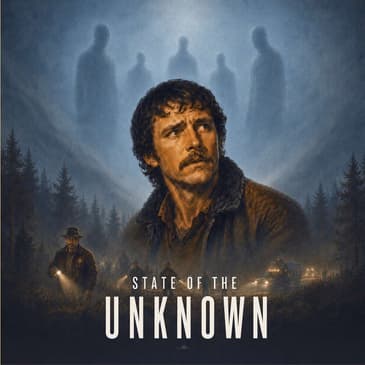

Join host Robert Barber as he explores the second half of the Travis Walton alien abduction case, one of the most famous UFO and paranormal encounters in American history.
Five days after disappearing in the Arizona wilderness, Travis Walton returned alive.
His coworkers had spent nearly a week under suspicion. Search crews had searched the forest. Investigators had tried to determine what happened on the night Walton vanished near a reported blue-white light in the woods.
But the mystery was far from over.
After his return, Walton described an extraordinary alien abduction experience unlike anything the searchers, witnesses, or investigators expected. He claimed to have awakened in an unfamiliar environment with no understanding of where he was, how much time had passed, or what had happened after the reported UFO encounter in the forest.
What followed became the foundation of one of the most famous alien abduction accounts ever reported and later inspired the film Fire in the Sky.
Was Walton describing a genuine encounter with something unknown? Was there another explanation for the missing time and the memories he later shared? Or does the lasting power of the case come from the questions that still surround it decades later?
This episode follows Walton’s account of the missing days, the experience he described after waking, and the events leading to his return.
This is the story of the five days Travis Walton said were taken from him and the account that transformed a wilderness disappearance into one of the most enduring UFO and alien abduction claims in American history.
Topics Covered
• The Travis Walton alien abduction case
• The reported alien abduction experience
• The five missing days
• The aftermath of the 1975 Arizona UFO encounter
• The memories Walton later described
• The events that inspired Fire in the Sky
• Alien abduction claims and witness testimony
• The return of Travis Walton
• The continuing debate surrounding the case
• UFO history and abduction reports
• Skeptical and believer interpretations
• The human experience of confronting the unknown
SEO Keywords
Travis Walton, Travis Walton abduction, Travis Walton account, alien abduction, alien abduction story, Fire in the Sky, Fire in the Sky true story, UFO encounter, UFO sightings, Arizona UFO case, 1975 UFO incident, alien encounter, missing time, UFO witness, UFO history, paranormal encounter, paranormal podcast, UFO podcast, State of the Unknown, Robert Barber
Support State of the Unknown
If you enjoy the show and would like to help support it, you can become a Sasquatch Supporter for $3 a month. Your support helps cover the costs of researching and producing the show, website hosting, distribution, and helping more people discover State of the Unknown.
Membership is completely optional, and the show remains free for everyone.
Become a Sasquatch Supporter on Patreon
🔍 New episodes every Tuesday
🌐 Visit stateoftheunknown.com for show notes and to submit your own story.
📬 Questions, theories, or story ideas? Reach out at contact@stateoftheunknown.com or @stateoftheunknownpodcast.
Some stories don’t stay buried.
We go looking anyway.
Waking Up In A Bright Room
SPEAKER_00Travis Walton opened his eyes and didn't know where he was. He was lying on his back. The room around him was bright, but it didn't feel like daylight. It was quiet in a way that made every movement feel too loud. He tried to sit up. His body hurt. His head felt heavy. For a moment he thought he might be in a hospital. Then he saw them. There were figures near him. They were close enough that he could make out their heads, their eyes, and the way they stood around him. Travis stared at them, trying to force the scene into something that made sense. It didn't. He then pushed himself up harder. The figures moved. Travis panicked. He swung at the closest one and forced himself off the surface beneath him. His feet hit the floor and he backed away, looking for anything he could use to keep them from getting closer. The figures didn't rush him. They stepped back. Then they left the room. Travis stood there alone, breathing hard, waiting for them to come back. Nothing moved. He looked around the room, searching for a door, a window, anything familiar. There was a way out, but it didn't lead outside. By the time Travis Walton was found, the first part of the story was already difficult enough. A logging crew had come out of the Arizona woods without him. Six men said they'd seen a light near the road, watched Travis walk toward it, and then watched something strike him before they fled. For nearly five days, searchers looked for him. His family waited. Law enforcement questioned the men who came back. Then Travis called from a phone booth. He was alive. That should have made the story simpler. A missing man had come back. But Travis didn't return with an ordinary explanation. He returned with an account of waking somewhere he didn't recognize, surrounded by figures he couldn't understand. The search was over. The missing time was not.
Found Alive After Five Days
SPEAKER_00This episode begins where the first one couldn't go. Travis is no longer a missing man in the woods. He's the one person who can describe what he believed happened during the days no one could find him. This is the story of Travis Walton's account, the missing time behind one of America's most argued over UFO cases. And this is State of the Unknown. In Walton's account, the next clear memory after the light in the woods was pain. He said he became aware slowly, with his body reacting before his mind had fully caught up. He was lying on a hard raised surface. There was light above him, and the room around him was bright, though it didn't feel like any place he expected to be. He was no longer in the clearing, near the truck, or anywhere that felt connected to the forest road. At first, Travis tried to place the room inside something familiar. If he'd been hurt, maybe someone had found him. Maybe he'd been taken somewhere for help. Maybe this was a hospital room or some kind of emergency room, and he was waking up after an accident. That explanation would have been comforting because it was ordinary. But the room didn't fit it. The air felt wrong. Walton later described it as hot, humid, and stale. He was thirsty. His body felt weak and his head was heavy. Then he noticed his clothes. He was still dressed in the work clothes he'd worn in the woods. His boots were still on. His shirt and jacket had been pushed up, exposing his chest and abdomen, and there was something across his body. In his account, it was a smooth, curved object positioned over him. He didn't understand what it was for. He didn't know who had put it there. He only knew he'd woken up under it in a room he didn't recognize. The hospital explanation started to fall apart. If doctors had found him, someone should have been talking to him. There should have been voices, footsteps, or some familiar movement of people working around a patient. But the room was quiet, too quiet. And as Travis became more awake, the situation became harder to force into anything normal. He was alive, he was conscious, but he was somewhere he didn't understand, and no one had told him why.
Three Silent Beings Up Close
SPEAKER_00The figures were already around him. At first Walton said he tried to understand them as medical workers. That was the easiest explanation available. If he was injured and if he was lying on a raised surface in a bright room, then the figures near him had to be doctors or nurses. His mind reached for that answer. Then his vision cleared, and in Walton's account, the hospital idea broke. The figures didn't look like doctors. They didn't look like anyone he expected to see leaning over him. They were short, pale, and close. Their heads seemed too large for their bodies, and their eyes were large enough that Travis couldn't make the scene fit the world he knew. He later described three beings around him. They didn't explain themselves. They didn't speak. If someone had said anything, even something he couldn't understand, there would have been a voice in the room, a command, a warning, some sign that the figures wanted something from him. Instead, Travis was awake, hurting, and staring at figures that seemed to be staring back at him. Then fear moved faster than thought. He pushed himself up, the figures moved, and Travis swung at the closest one. In his account, this wasn't a strong, controlled attack. His body was weak, he was unsteady. It was panic from a man who had opened his eyes in the wrong place and suddenly believed he was surrounded. He forced himself off the surface beneath him. His feet hit the floor, and the curved object that had been across his body fell away. The sound broke the silence of the room. Travis backed up until he reached a bench or counter. He looked for anything he could use to keep the figures away from him, and his hand found a thin, transparent cylinder. It wasn't much, but it was something. He grabbed it and tried to make it into a weapon. He shouted, he threatened them. He held the object offensively and tried to keep them from coming closer. The being started toward him with their hands extended. Then they stopped. They didn't rush him or force him back down. They turned and left the room. For a moment, Travis was alone. The room stayed bright and unfamiliar. The opening they had gone through was still there. Travis stood where he was, breathing hard, listening for movement beyond the door. Nothing came back. So he started looking for a way out.
The Hallway And The Star Chair
SPEAKER_00Walton said he knew he had to leave the room. The beings had gone through an opening, but Travis didn't want to follow them. He moved toward the doorway and looked out in the space beyond it. There was a narrow hallway and it curved away from him. A hallway should have given him direction. This one only bent out of sight. The beings had gone one way, so Travis went the other. At first he moved carefully, then he began to run. He was weak and frightened, but the room behind him was worse than the unknown ahead. He passed openings along the way. In a normal place, an open doorway might mean a room, an office, or a way outside. Here, every opening made him choose. He could keep moving or he could risk stopping. He could pass a possible exit or he could enter another room and find himself trapped. He slowed near one of the openings and went inside. It was a round room with a domed ceiling. There was a chair in it, a high backed chair. Travis stayed back at first. He needed to know whether someone was sitting there. He circled carefully, checking around the sides and then behind it. The chair was empty. The room was quiet. Travis moved closer. The surfaces around him seemed to darken and points of light appeared. Walton compared them to stars. When he moved away, the effect faded. When he came closer again, the points were turned. He was frightened, but he was also desperate. If the chair was part of the place, maybe it had controls. Maybe one of those controls opened a door. Maybe there was some way to make the room give him an exit. He saw a lever, a screen, and buttons. He tried some of them. Lines moved on the screen, but nothing useful happened. No door opened. No outside air came in. No voice answered him. Then he sat in the chair and moved the lever. The points of light seemed to shift around him, and the feeling made him disoriented. Whatever he had touched, it wasn't helping him in any way that he can control. So he stopped. He got out of the chair and searched the room again. He looked for markings, switches, seams in the walls, anything that might tell him how to leave. Nothing made sense. He kept moving around the room, trying one surface and then another, afraid that one wrong movement might make everything worse. Then he heard something and turned toward the doorway.
A Human-Looking Escort Appears
SPEAKER_00Someone was standing there. The figure in the doorway looked different from the beings Travis had seen in the first room. In Walton's account, this one looked human. Tall, strong, wearing a helmet and a tight blue suit. Travis ran toward him and began asking questions. Where was he? What was happening? Who were they? The figure didn't answer. Travis had found someone who looked like he might speak, someone who might understand him, someone who might tell him where he was and why he'd been brought there. But the figure stayed silent. Then he took Travis by the arm and led him away. In Walton's account, the movement was firm, but not violent. Travis was guided out of the round room and down the hallway. He kept trying to speak, but the figure didn't respond. They entered a small enclosed space. A door opened, they stepped inside, and the door closed behind them. Travis stood in a narrow space with the human-looking figure beside him, still trying to understand whether he was being rescued, moved, or taken somewhere worse. Then another door opened and the environment changed. There was bright light and fresh air. After the stale heat of the first rooms, the change would have been immediate. Travis was still inside the account he couldn't understand, but the air itself was different. The figure led him down a short ramp into a much larger room. Walton later described it as huge, almost like a hangar. From there he said he could see the object he believed he had come out of. Nearby he saw other smooth, craft-like objects. He had left the first room, he had left the hallway. Now he was in a larger space and he still couldn't see a way home. The human-looking figure led him across the room and through another set of doors.
The White Room And The Mask
SPEAKER_00Eventually Travis was brought into a white room. There were other human-looking figures inside. In Walton's account, there were two men and one woman. The room had a table and a chair, and again, Travis found himself being moved toward a surface instead of being given answers. He asked more questions. No one answered. The figures moved him toward the table. This time, he resisted. He had already woken up once on a raised surface with something across his body. He had already come awake surrounded by beings he didn't understand. Now he was being moved toward another table in another room, and he still had no explanation. The figures pushed him back. A mask-like object was placed over his mouth and nose. Travis tried to fight it, but his strength began to leave him. The room faded. Everything went gray, then black. The next
Dropped On A Road Near Heber
SPEAKER_00thing Travis remembered, he was outside. In Walton's account, he woke up on cold pavement west of Heber. He was lying on his stomach with his head on his forearm, and the cold air helped bring him back to consciousness. The first room had been hot and stale. This was night air. This was pavement. This was the real world pressing against his body. He lifted his head. Nearby he saw a light go out beneath a curved, gleaming surface. He wasn't sure whether he had seen a light shut off or some kind of opening close. Then he saw a rounded silvery disk hovering above the road. The object rose. Walton said it moved upwards silently. There was motion, a rush of air, and then it was gone. Travis was left on the road. He got to his feet unsteadily in the night air. He was still wearing the exact same clothes he'd gone into the woods with five days earlier, his heavy work jacket, his denim shirt, his boots. They were dirty, but they were real, a sudden anchor back to the life he knew. His body was weak and he was trying to recognize where he was. Then the place began to make sense. He was near Heber. That recognition didn't explain what had happened, but it gave him direction. He was back somewhere human, somewhere with roads, buildings, phones, and people who might know him. For listeners familiar with the movie Fire in the Sky, one detail is worth noting. The film shows Travis returning without his clothing. Walton's account was different. He said he was still wearing the same clothes he had been wearing when he disappeared five days earlier. With the night air hitting his face, he started moving. He ran toward Heber and reached a building near the service station area. He knocked, but no one answered. The road was quiet and the building stayed closed, so Travis kept going. He found telephone booths at the Exxon station and got inside one of them. From there, he called the operator and gave the number for his sister's house. At the other end, his brother-in-law Grant Neff answered. It was after midnight. For Grant, the call must have seemed impossible. Travis had been missing for days. The search had already taken on a grim weight. People had wondered whether he was dead. The men from the crew had been questioned. The story had been repeated, doubted, argued over, and still Travis had not come home. Then a voice on the phone said it was Travis. Grant thought it might be a cruel joke, but Travis kept talking. In Walton's account, he was panicked and weak. He asked for help. He said something like, They brought me back. Grant and Duane Walton drove to Heber. When they reached the phone booth, Duane opened the door and found Travis slumped inside. He helped him up and got him into the truck. Travis tried to explain what had happened, but the words didn't come easily. He could only get out pieces of it: white skin, large eyes, figures around him. The fragments made sense to him because he had just lived through them, but not to the people trying to understand what he was saying. At first, Travis thought only a few hours had passed. That was part of the shock. He remembered walking toward the light. He remembered waking in the room. He remembered panic, movement, the hallway, the figures, and then the road near Heber. But in his mind, the missing time didn't feel like five days. Then Duane told him how long he'd been gone. That changed the return. He was no longer only trying to explain a terrifying sequence of memories. He was trying to explain why those memories didn't account for the time everyone else had lived through. Now Travis was back, but the missing time had come back with him. So where
Memory, Evidence, And What We Can’t Check
SPEAKER_00does that leave Travis Walton's account? The first thing to separate is the disappearance from the missing time story. The disappearance hit outside witnesses. Six men came out of the woods without Travis and gave a shared account of what they said happened near the clearing. Searchers looked for him, law enforcement became involved. Family members waited. That part of the case happened in public space, with other people reacting while Travis was gone. The account we covered tonight is different. This part depends mainly on Travis. The room, the beings, the hallway, the human-looking figure, the white room, the mask, and the return to the road all come through Walton's own reported memory. That doesn't mean the account should be thrown away. It does mean it has to be handled differently from the crew's account or the search timeline. What makes it compelling is the physical shape of the story. Travis's account isn't just a vague claim that something strange happened. It has movement. He wakes up, he reacts, he tries to defend himself. He leaves one room and moves into another. He meets a figure that looks human and still can't get an answer. Then he loses consciousness and wakes on a road. That sequence gives the missing time a shape. What weakens the case is also clear. The most extraordinary details can't be independently checked. There's no outside witness inside the room with Travis. There's no confirmed record of the beings, the controls, or the larger space. The account comes from what Walton later said he remembered. That matters because memory, especially after fear and confusion, is not the same thing as a record. A person can be sincere and still have memory shaped by fear, by time, and later retelling. That's not an accusation. It's part of the problem when a case depends on one person's memory of an extraordinary event. The medical and physical aftermath also has to be handled carefully. There are reports about Travis's condition after he returned and some later discussion about possible marks or physical effects. Those details are part of the case and they shape the way people talk about it, but they don't independently verify the onboard account. The polygraphs are another piece people often reach for. A polygraph is a test that measures physical responses while someone answers questions. It's often called a lie detector, but the name makes it sound more certain than it is. A polygraph doesn't read a person's mind, it doesn't prove what happened in the woods, and it doesn't prove what happened during the missing time. Supporters point to those tests because they suggest the crew was not simply inventing a murder cover up. Skeptics challenge the meaning of the results and the way they've been used in public arguments. The test became Part of the case's reputation, but they don't solve the central question.
Hoax Theories And Fire In The Sky
SPEAKER_00The cleanest skeptical reading is that the disappearance and return were part of a hoax or a staged event. Skeptics have pointed to possible motives, including pressure around the logging work, publicity, and money. Those ideas became part of the public debate because the story was so extraordinary, and because the timing created suspicion from the beginning. But a motive theory is not proof. It gives skeptics a framework. It does not, by itself, explain why the men stayed with the story that put them under suspicion, why Travis returned in the condition described, or why the account continued to follow him for decades. There's also the question of what happened once the story entered popular culture. The 1993 movie made the Travis Walton case much more widely known, but it shouldn't be treated as a source for what happened. It dramatized and reshaped the account for film. For many people, the movie became the version they remembered, even when it didn't match Walton's own reported experience. That leaves two versions in public memory. There's the reported case, the crew, the missing days, Travis's account, and the investigation around it. Then there's the cultural version, the images people remember, the fear they associate with the story, and the way the case became part of American UFO folklore. Those versions overlap, but they are not the same. What the second half of the Walton story leaves us with is a man's reported memory of the missing time, a return that deepened the mystery instead of closing it, and a public argument that has never really stopped.
Helplessness At The Heart Of It
SPEAKER_00What stands out to me about Travis Walton's account is how small Travis feels inside it. That may sound strange because this is one of the most famous UFO abduction stories in American culture. It has the pieces people expect: the light, the missing time, the beings, the return, the debate. But when you strip away the reputation of the case, the reported experience itself is built around helplessness. A man wakes up and doesn't know where he is. He tries to turn the room into something familiar. He tries to make the figures into doctors. He tries to use objects around him to defend himself. He tries to find an exit. He tries to ask questions. Over and over, the human response is simple. Understand, survive, get home. That's why the account still has weight, even if you don't accept every part of it. If Walton's story is true, then the most unsettling part isn't only that something unknown took him. It's that contact with the unknown didn't come as a revelation. It didn't come with answers. It came as confusion, pain, fear, and silence. There's no grand explanation in the room. There's no speech that makes the experience meaningful. There's only Travis trying to move through it. And honestly, this is the part where I stopped thinking about UFO cases and start thinking about how I would react. People sometimes talk about the idea of aliens as if it would automatically be this incredible moment of discovery. Maybe it would be. But if I woke up in a strange room and saw figures standing around me, I don't think I'd be thinking about discovery at all. I'd probably be scared out of my mind. I'd be looking for a way out, looking for something to defend myself with, trying to get back to someplace familiar. And that's one thing I've always found interesting about Walton's account. If it's true, his reaction doesn't sound like wonder. It sounds like someone trying to survive something he can't understand. Exactly how I imagine I would react to. And if the story is not true, then it tells us something about how powerful a missing person case can become once it's tied to a story people can't easily accept. A man disappears, he returns. The explanation he gives is so strange that it becomes larger than the person giving it. That's the human consequence. Travis Walton didn't just come back from five missing days. He came back into a life where those five days would be questioned, defended, dramatized, doubted, and remembered by strangers. The case lasted because it sits in a difficult place. There are too many people involved to make it feel like a simple private fantasy. There are too many unverified details to make it feel settled. And there is too much human pressure around the disappearance to dismiss it as just another strange story. For me, the heart of the Travis Walton case is not whether the listener can solve it. It's the image of return without resolution. A man in a phone booth after midnight. A family member opening the door. A voice trying to explain five missing days with fragments of a place no one else could see. The disappearance ended. The uncertainty came home with him. This has been State of the Unknown. The Travis Walton account remains one of those stories where the return doesn't make the case easier. It makes it harder. Maybe Travis Walton woke somewhere no human being was ever meant to wake. Maybe memory, fear, and circumstance created a story that became too powerful to escape. What remains is the image Travis carried back: a bright room, silent figures, a search for a way out, and a phone booth on a quiet Arizona road after midnight.
Ratings, Reviews, And Closing Thoughts
SPEAKER_00If you've been enjoying these stories, leaving a rating or review in your podcast app really does help more people find the show. On Spotify, it's just a tap of the stars. On Apple Podcasts, you can even leave a short written review. And thank you to everyone who's been leaving comments and reviews lately. I read them all, and hearing what stood out to you, what questions you had, or what theories you're considering is one of my favorite parts of doing this show. If you want to make sure you don't miss the next story, just hit follow or subscribe in your podcast app so it shows up automatically when it drops. Until next time, stay curious. And who knows, maybe the next light over the road is only a passing car. Or maybe someone is being brought back.