
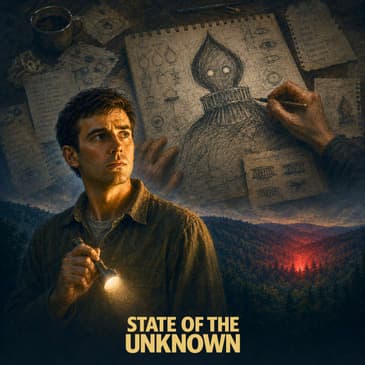

In September of 1952, a group of boys in Flatwoods, West Virginia looked up from a football game and saw something bright cross the sky—beginning a UFO and unexplained creature encounter that would become one of the most famous cases in American paranormal history.
It appeared to come down beyond a nearby hill.
What happened next became the legend of the Flatwoods Monster, also known as the Braxton County Monster or the Phantom of Flatwoods.
Join host Robert Barber as he explores this famous West Virginia paranormal encounter. The reported sighting began when the boys ran to Kathleen May, who agreed to follow them toward the place where the mysterious object seemed to have landed. Gene Lemon joined the group with a flashlight, and together they climbed the hill in the fading light.
Near the top, they reported a red glow, a strange odor, and then something in the dark.
Moments later, Gene Lemon raised his flashlight.
What the witnesses said they saw became one of the most famous cryptid and unexplained creature sightings in American history.
The group fled back toward town. Soon, the report reached local authorities, newspapers, and the wider public. Kathleen May’s description became the basis for the famous Flatwoods Monster sketch, an image that helped turn one frightening hilltop encounter into an enduring piece of UFO and paranormal folklore.
Was the Flatwoods Monster a close encounter with something truly unknown? Was it a meteor, a barn owl, and fear reshaping what the witnesses saw in the dark? Or did Gene Lemon’s flashlight reveal something that has never been fully explained?
This episode follows the reported story first, then separates what holds up in the Breakdown.
This is the story of the Flatwoods Monster, the 1952 West Virginia UFO and creature encounter that created an American monster legend.
Topics Covered
- The 1952 Flatwoods Monster encounter
- The Braxton County Monster
- The Phantom of Flatwoods
- Kathleen May and Gene Lemon
- The reported 1952 UFO sighting over Flatwoods, West Virginia
- The climb toward the Fisher farm hill
- The red light, strange odor, and reported creature sighting
- The famous Flatwoods Monster sketch
- 1952 UFO culture and Air Force interest in strange sky reports
- The meteor and barn owl explanations
- How a local encounter became American paranormal folklore
SEO Keywords
Flatwoods Monster, Braxton County Monster, Phantom of Flatwoods, Flatwoods West Virginia, West Virginia monster, West Virginia cryptid, 1952 UFO sighting, UFO encounter, creature encounter, cryptid encounter, unexplained creature, paranormal encounter, UFO folklore, American monster legends, Kathleen May, Gene Lemon, Fisher farm, Flatwoods Monster sketch, Project Blue Book, barn owl explanation, meteor explanation, paranormal podcast, UFO podcast, cryptid podcast, creature encounter podcast, State of the Unknown, Robert Barber podcast
Support State of the Unknown
If you enjoy the show and would like to help support it, you can become a Sasquatch Supporter for $3 a month. Your support helps cover the costs of researching and producing the show, website hosting, distribution, and helping more people discover State of the Unknown.
Membership is completely optional, and the show remains free for everyone.
Become a Sasquatch Supporter on Patreon
🔍 New episodes every Tuesday
🌐 Visit stateoftheunknown.com for show notes and to submit your own story.
📬 Questions, theories, or story ideas? Reach out at contact@stateoftheunknown.com or @stateoftheunknownpodcast.
Some stories don’t stay buried.
We go looking anyway.
Flashlight Beam In The Dark
SPEAKER_00Gene Lemon was near the front of the group when the red light came back through the trees. He had the flashlight in his hand, and the others were close behind him on the hill. The ground under his feet was uneven, and each step pushed him farther away from the road, farther from the houses below, and closer to the place where the boys said something had come down. The dog moved ahead of him, pulling toward the dark. Gene followed it, sweeping the flashlight over the grass, the fence line, and the low brush around him. The beam caught pieces of the hill in quick flashes, a branch, a patch of weeds, the edge of a tree. Nothing stayed in the light long enough to feel settled. The smell reached him before he saw anything clearly. It was sharp and heavy, strong enough to make him slow down. Jean lifted the flashlight higher and searched past the dog toward the red glow ahead of them. He could hear the others behind him, but his attention was on the hill in front of him now. The dog stopped. Jean stopped with it. For a second, the only thing moving was the flashlight beam as he turned it through the dark, trying to find what the dog had seen. The light passed over the brush once, then came back. That was when Jean caught the eyes. They were reflecting from the darkness ahead of him, bright in the flashlight beam, too steady to be a trick of the trees. Jean held the light there and tried to make the shape around them come into focus. The beam climbed higher. The eyes were still there. The beam kept climbing, and Gene realized he was still looking up.
How Flatwoods Rumors Travel Fast
SPEAKER_00In a small town, strange things don't stay private for long. A few kids can see something in the sky, run home, and within minutes, an ordinary evening can turn into a group of people climbing a hill in the dark. Flatwoods, West Virginia wasn't a place built for spectacle. It was a small Braxton County community tucked into the hills where the school, the houses, and the back roads were close enough for a story to move quickly from one yard to the next. On September 12, 1952, a light crossed the sky. The boys who saw it thought it had come down nearby. And before the night was over, people in Flatwoods would be trying to explain what a flashlight had found on the hill. Tonight, we're going to Flatwoods, West Virginia in 1952 to a case built around children, a mother, a flashlight, a hilltop, and a figure that became one of the most recognizable monsters in American paranormal history. This is the story of the Flatwoods Monster, the encounter that turned a small West Virginia town into UFO folklore. And this is State of the Unknown.
The Fireball That Starts The Search
SPEAKER_00It was September 12th, 1952, when the light was already starting to fade around Flatwoods. Near the school area, a group of boys were outside doing what kids do when there's still enough daylight left to stay out a little longer. They were running, throwing the ball, and trying to hold on to the last part of the day before they had to go home. Then something crossed the sky. In the accounts that became part of the Flatwoods story, the boys saw a bright object or fireball moving overhead. It didn't drift slowly away. It appeared to come down beyond a nearby hill, close enough that the boys believed something had landed or crashed somewhere near the Fisher farm. The ball game stopped. The boys looked toward the hill. The place where the object disappeared wasn't somewhere far off in the sky. It was over there, past the familiar ground around town, close enough to run toward. So they ran. They left the school area and headed toward the place where they thought the object had come down. On the way, they reached Kathleen May's home. Kathleen was the mother of two of the boys, and the way the story is told, the children came to her with the kind of urgency adults recognize right away. They'd seen something come out of the sky. It had gone down nearby. They wanted to know what it was. Kathleen May listened. She could have told them to stay inside. She could have decided they'd seen a meteor or a plane and left it at that. Instead, she went with them. Gene Lemon joined the group too. He was older than the boys, a young National Guardsman, and he had a flashlight. In local versions of the story, the family dog Richie went to. The group formed quickly: a few children, a mother, a young man with a light, and a dog moving toward a hill where something had reportedly fallen from the sky. Flatwoods was still around them, but they were leaving the familiar part of it. They moved away from the houses, away from the road, and toward the darker ground beyond town. There was no monster yet. There was a light in the sky, a hill ahead of them, and a group of people walking toward the place where the boys said it had come down. The closer they got to the hill, the less the evening felt like a game or a rumor. They weren't standing on the school lawn anymore looking up. They were moving uphill in the direction the boys had pointed out. The ground was rougher. The light was weaker, and the familiar parts of town were falling behind them. Jean Lemon moved near the front with the flashlight. Once the group left the open ground, that beam was the only thing making the hill readable. It moved over grass, caught the fence line, and reached into the trees and brush ahead. The others followed close behind him. Kathleen May was with the boys, and in the traditional local version, the dog moved ahead of the group, alert and pulling toward the dark. They weren't waiting for something to come to them. They were going to the place where the object seemed to have landed. The hill wasn't far away, but it felt farther in the dark. Behind them, Flatwoods was still visible in pieces. A porchlight, a house, a road cutting through the community below. Ahead of them, the ground became harder to read. The farther they climbed, the less certain anyone could be about what the boys had actually seen. A light in the sky can feel close when it isn't. Anyone who has watched a meteor or an aircraft at night knows distance can sometimes become difficult to judge. But nobody in the group had come this far to turn around because something might have been farther away than it looked. The boys still believed something had come down. And the adults were now curious enough to find out whether they were right.
Red Glow Odor And Glowing Eyes
SPEAKER_00Near the top of the hill, they reportedly saw red light. In some versions it pulsed. In others, it glowed near or just beyond the place where the object was believed to have come down. The exact placement shifts depending on the account, but the group was now close enough to see light ahead of them on the hill. Then came the smell. Witnesses later described it in different ways. Some versions called it metallic. Others described it as a sickening mist or a rotten egg odor. However, it was described afterward, the smell was strong enough for the witnesses to notice and remember it. It wasn't only something they could see now, they could smell it. The red light stayed ahead of them, partly hidden by the trees. Then the dog pulled forward and stopped. Near the top of the hill, something pulled the group's attention toward the trees or brush. The versions don't all begin that moment the same way. Some say there was movement. Some say eyes appeared first. Others describe a reflection or light before the full figure came into view. Jean Lemon turned the flashlight toward it. The beam moved across the hill and settled on what witnesses said they saw. Two bright eyes, then a shape around them. The eyes weren't close to the ground. They weren't looking out from a bush or from somewhere near the fence line. Jean kept raising the flashlight, trying to bring the rest of the figure into view. The shape seemed far taller than a person. The head rose into a pointed outline, unlike anything he expected to find on that hill. The face appeared red in the beam. Beneath it was a darker form that looked wrong against the trees behind it, large enough that Gene couldn't make immediate sense of what he was seeing. The smell was still in the air. The boys were behind him and the dog was somewhere ahead, and for a few seconds nobody moved. Then the figure moved. Some accounts say it floated. Others say it glided. Some say it came toward the group without the kind of walking motion they expected. The reported sound changes too. In one telling, it's silent. In another, there's a hiss or a shriek. Jean's flashlight had found a figure in the dark, and now that figure was no longer only something they were looking at. It was coming toward
The Figure Moves And They Run
SPEAKER_00them. The search ended there. They turned and ran. The group fled back down the hill toward town. They'd climbed up together following a report from the boys. They came back with adults now inside the same experience. In local versions, the dog ran with them, remembered as terrified, tail down, trying to get away from whatever had been on the hill. The boys were shaken. Kathleen May and Gene Lemon were now part of the same account that had started with children pointing toward the sky. By the time they returned, the report had changed. It wasn't only the boys saying something had crossed the sky. Kathleen May had gone up the hill. Jean Lemon had carried the flashlight. The group had seen the red light, smelled something strange and run from the figure they said appeared in the beam. Afterward, some witnesses reportedly felt sick. Accounts described nausea, throat irritation, vomiting, or burning eyes. The exact symptoms and who experienced which ones vary, but illness became part of the way the event was remembered.
Illness Reports And Official Searches
SPEAKER_00The hill followed them back. The encounter didn't stay contained inside the walk home. People wanted details. What had they seen? How large was it? Where exactly had it been standing? The answers weren't always identical. The group agreed on the broad shape of the experience, but once witnesses begin describing a frightening moment, details rarely stay perfectly aligned. What one person notices first may not be what another remembers most clearly. That didn't stop the story from spreading. If anything, the uncertainty made people talk about it more. By the next morning, the account had moved beyond families who had been on the hill. Local newspapers picked it up. Reporters started asking questions. Investigators wanted to know whether something unusual had actually come down near Flatwoods or whether the entire event could be traced back to something more ordinary. The witnesses were no longer simply remembering the encounter. They were being asked to explain it. Kathleen May and Gene Lemon reported the incident to local authorities. The account moved from family and neighborhood conversation into official hands. Authorities searched the area after the report. Depending on the version, they either found nothing that explained the encounter or they found limited signs such as trampled grass, skid marks, or a lingering odor. Those details would later become part of the argument over what happened. But at the time, the movement was more immediate. People went back to look. The hill was no longer just the place the boys had pointed to. Adults had climbed it. Witnesses had fled from it. Local authorities had to search it because the report couldn't stay inside one house. By the next day, the encounter had started moving beyond the people who were there. Phones rang, reports were written, neighbors talked. The story moved through Flatwoods with a shape people could repeat. A fireball, a hill, a group of witnesses, and a towering figure in the flashlight beam.
The Sketch That Made It Famous
SPEAKER_00Once the report moved beyond Flatwoods, the creature needed a shape people could see. That's where the drawing enters the story. Kathleen May's description became the basis for the famous Flatwoods monster sketch. The image showed a towering figure with a pointed, spade-like head shape, glowing eyes, and a body that looked different from the usual flying saucer stories Americans were already reading about in newspapers. That image traveled. It appeared in newspapers and books and later in television, artwork and games. For many people, the Flatwoods monster became recognizable through that shape. The pointed head, the red face, the long body, and the strange, almost mechanical silhouette. This was 1952 during one of the busiest periods in American UFO culture. The timing mattered. Americans had spent the previous several years reading stories about flying saucers. Reports were appearing across the country. Newspapers printed witness accounts. Radio programs discussed strange objects in the sky. Earlier that same summer, sightings around Washington, D.C. had drawn national attention and forced public responses from the Air Force. People were already looking up. That doesn't prove the Flatwoods witnesses saw something ordinary. It doesn't prove they saw something extraordinary either, but it does help explain why a report from a small West Virginia community didn't stay local for long. The country was paying attention to stories like this. Flatwoods arrived at exactly the moment people were ready to hear it. People were already watching the sky. Newspapers were running stories about strange lights and flying saucer reports. The Air Force was being pulled into questions about what people were seeing overhead. Flatwoods entered that atmosphere with something more than a light in the sky. It had children running home, a mother and a young man climbing a hill and a creature people could draw. Over time, the names multiplied. The Flatwoods Monster, the Braxton County monster, the Phantom of Flatwoods. It knew her local branding, Braxy. Braxton County didn't forget it. The creature appeared in museum displays, tourism signs, and local storytelling. What started as a frightening report on a hill became something visitors could drive toward on purpose. A witness description became a sketch. The sketch became an image people recognized. The image became part of the place. And even after the explanations, the museum displays, and the pop culture versions, the question still returns to one moment on the hill. By then, the encounter no longer belonged only to the people who had climbed the hill. It belonged to the town, to the newspapers, and to the image people kept drawing afterward. But every version still had to answer the same question. What was standing in Gene Lemon's flashlight beam?
What The Case Strongly Supports
SPEAKER_00So here's what holds up. What's strongest here is the basic human sequence. Children saw something bright cross the sky and appear to come down near a hill. They ran to an adult. A group formed quickly and went to look. Near the hilltop, they reported a light, an odor, and a strange figure. They fled, reported the encounter, and the story quickly reached local and national attention. That sequence gives the case a clear shape. It's attached to a specific date, a small community, named witnesses, and a chain of actions. The reactions also matter. The group behaved as if they'd seen something that frightened them badly. The story didn't begin as a tourism campaign or a piece of local branding. It began with children running home, adults going with them, and witnesses reportedly coming back shaken. The physical symptoms are harder to judge, but they belong to the history of the case. Reports of nausea, throat irritation, vomiting, or eye irritation became part of the aftermath. They don't prove what the witnesses encountered, but they show that the event was remembered as more than a quick scare in the dark. The setting helps explain both the fear and the uncertainty. Flatwoods was a small West Virginia community, close enough for children to run home, but rural enough that a hilltop in the dark could become disorienting fast. A flashlight, a dog, and a few people climbing through the low light are very different from a controlled observation.
Meteor And Barn Owl Explanations
SPEAKER_00The common skeptical explanation splits the case into two pieces. The object in the sky may have been a meteor. A meteor is a piece of space rock or debris that burns brightly as it enters the Earth's atmosphere. Depending on the angle, a bright meteor can appear to come down much closer than it actually does. That could explain the fireball. The creature is often explained as a barn owl. The owl explanation usually points to the eyes, the tree line, and the height illusion. A barn owl perched in a tree, seen from below in a dim light, could look much taller and stranger than it really was. The flashlight would catch the eyes first. Branches, shadows, and fear could fill in the rest. That explanation works in pieces. It gives us a possible light in the sky, a possible animal on the hill, and frightened witnesses in bad viewing conditions. What it doesn't fully settle is the whole experience the witnesses described. They didn't only report eyes in a tree, they described a red light, a strong odor, a towering figure, movement toward them, and illness afterward. Some of those details may come from panic, misperception, or later retelling, but those details. Are why the case stayed alive. The witness descriptions also vary. The creature's height changes depending on the source. The body has been described as green, metallic, armor-like, or dress-like. The sound changes too. Some versions say the creature was silent. Others include a hiss or a shriek. Those differences matter because they show how unstable details can become once a frightening event turns into legend. The investigation details are also uneven. Some accounts say authorities found nothing. Others mention lingering odor, skid marks, or trampled grass. Those claims should be handled carefully because they're not reported the same way across sources. The famous drawing is both a strength and a complication. It gave the creature a lasting identity. Without that image, the Flatwoods monster might not have become nearly as recognizable. But an image can also freeze a story in place. Once people see the drawing, later memory and pop culture begins circling around it. So where does that leave the case? It may have begun with a meteor and an owl. It may have begun with something the witnesses truly could not identify. But either way, the case leaves us with the same human image. Children and adults and a young man with a flashlight running back toward town with a story they couldn't leave behind.
How A Scare Becomes A Symbol
SPEAKER_00What I find interesting about the Flatwoods monster is that it lives in a very strange place between fear and identity. If you strip the case down to the simplest skeptical version, it sounds almost easy. A meteor passes overhead. A group of frightened people goes looking. A barn owl sits in a tree, catches the flashlight, and for a few seconds everything becomes bigger and stranger than it really is. That explanation might be right. But even if it is, I don't think it fully explains why this case stayed with people. Because the Flatwood story isn't only about what was on that hill. It's about what happens when a small group of people walk towards something they don't understand, sees something that scares them, and then has to carry that moment back into the world they know. The boys had to tell people what they saw. Kathleen May had to live with being one of the adults who went up there. Gene Lemon had to be remembered as the one who raised the flashlight. And the town had to decide what to do with a story that sounded impossible, but came from people who were real. That's the part I keep coming back to. A lot of monster stories become almost harmless once they're turned into mascots, toys, games, and roadside attractions. The fear gets softened. The creature gets a nickname. The thing that once made people run becomes something you put on a sign. But underneath all of that, there's still a knight on a hill. There's still a group of witnesses all standing in the dark. There's still a flashlight beam moving upward when it should have stopped. Maybe it was an owl. Maybe it was a meteor and fear and timing. Maybe it was something stranger than either of those. But the question the Flatwoods monster leaves behind isn't only what they saw. It's how one moment on a hill became part of the identity of a place. Because whatever Gene Lemon's flashlight found that night, Flatwoods never really put it down.
Ratings Reviews And One Last Warning
SPEAKER_00This has been State of the Unknown. The Flatwoods monster remains one of those cases where the explanation may be simple, but the story refuses to feel small. Maybe it was a meteor, an owl, and a frightened group of people seeing too much in the dark. Maybe something unusual really did come down near that hill in 1952. What remains is the image that stayed with the witnesses and the town, a flashlight pointed into the trees, a pair of eyes reflecting back, and a figure that seemed too tall to be standing where it was. If you've been enjoying these stories, leaving a rating or review in your podcast app really does help more people find the show. On Spotify, it's just a tap of the stars. On Apple Podcasts, you can even leave a short written review. I read them and I really do appreciate everyone. And if you want to make sure you don't miss the next story, just hit follow in your podcast app so it shows up automatically when it drops. Until next time, stay curious. And if you ever see something bright fall behind a hill, maybe let someone else hold the flashlight.