
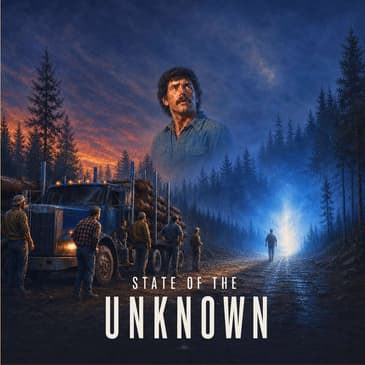

Join host Robert Barber as he explores the disappearance of Travis Walton, the 1975 Arizona UFO encounter that became one of the most famous alien abduction cases in American paranormal history.
On November 5, 1975, Travis Walton and six fellow loggers were driving home through the Apache–Sitgreaves National Forest in Arizona when they reported seeing a strange blue-white light in the woods. According to the witnesses, Walton left the truck and walked toward what they believed was a UFO. Moments later, something happened that sent the crew fleeing down the road.
When they returned, Travis was gone.
What followed was no longer just a strange UFO encounter. Searchers entered the forest. Law enforcement became involved. Questions spread through the community. As the days passed, suspicion began to fall on the men who had been with him.
Five days later, Travis Walton reappeared.
Was this the beginning of one of the most extraordinary alien abduction claims ever reported? Was there another explanation for what happened in those woods that night? Or did six witnesses see something they could never fully explain?
This episode follows the reported events surrounding Walton’s disappearance, the UFO witness accounts, and the search that followed.
This is the story of Travis Walton and the five days that turned a logging crew’s UFO sighting into one of the most enduring mysteries in UFO and paranormal history.
Topics Covered
• The Travis Walton disappearance
• The Travis Walton alien abduction case
• The 1975 Arizona UFO encounter
• The Apache–Sitgreaves National Forest
• The logging crew witness accounts
• The reported UFO and blue-white light in the woods
• The search for Travis Walton
• Law enforcement involvement
• Public suspicion and investigation
• Witness testimony and credibility
• The events leading up to Walton’s return
• UFO history and alien abduction claims
• The human consequences of a missing-person mystery
SEO Keywords
Travis Walton, Travis Walton disappearance, Travis Walton abduction, alien abduction, alien abduction case, UFO encounter, UFO sighting, Arizona UFO sighting, Apache–Sitgreaves National Forest, 1975 UFO case, logging crew witnesses, missing person mystery, UFO investigation, witness testimony, alien encounter, UFO history, paranormal encounter, paranormal podcast, UFO podcast, State of the Unknown, Robert Barber
Support State of the Unknown
If you enjoy the show and would like to help support it, you can become a Sasquatch Supporter for $3 a month. Your support helps cover the costs of researching and producing the show, website hosting, distribution, and helping more people discover State of the Unknown.
Membership is completely optional, and the show remains free for everyone.
Become a Sasquatch Supporter on Patreon
🔍 New episodes every Tuesday
🌐 Visit stateoftheunknown.com for show notes and to submit your own story.
📬 Questions, theories, or story ideas? Reach out at contact@stateoftheunknown.com or @stateoftheunknownpodcast.
Some stories don’t stay buried.
We go looking anyway.
The Light On The Forest Road
SPEAKER_00Mike Rogers was driving the logging crew out of the woods when the men beside him started looking toward the trees. The road was narrow and the day was almost gone. They'd been cutting timber, and now all seven of them were packed inside the truck, heading back toward town. Then something ahead caught their attention. Mike slowed down and stopped the truck. Through the trees there was a glow where there shouldn't have been one. Not headlights or a campfire, something brighter than that, sitting low over the clearing near the road. The men leaned toward the windows. That's when Travis Walton opened the door. Mike watched him step down and move toward the light. Nobody else followed. Travis kept walking, leaving the road behind him, crossing the open ground while the others stayed inside and stared. Then the light changed. It came down from the object and struck Travis before anyone could understand what they were seeing. His body jerked backward, and for a second, nobody moved. Then the cab erupted. Men shouted over each other. Mike hit the gas. The tires grabbed the dirt, and the clearing fell away behind them. They left Travis there. For a few minutes, all they could do was drive. Then the fear started to turn into something else. Mike slowed the truck, turned it around, and headed back. When the headlights reached the clearing again, the glow was gone. The object was gone. And so was Travis. By the time the truck came out of the woods, there was no way to leave the story back in the trees. There was a missing man. Six men had returned from the forest without the seventh, and the explanation they brought back was almost impossible to accept. They said they watched Travis Walton step out of the truck, walk towards something they couldn't explain, and disappear from the place where he should have been. Before the movie, before the interviews, and before the name Travis Walton became part of American UFO history, there was a truck coming out of the woods with one seat empty. Travis Walton was gone. Tonight, we're looking at the first half of one of the most famous alleged alien abduction cases in American history. The part that came first was immediate and physical. A man was missing, and the only explanation came from the men who left the woods without him. This is the story of the Travis Walton disappearance, the missing man in the Arizona woods. And this is State of the Unknown.
Setting The Scene In 1975 Arizona
SPEAKER_00On November 5th, 1975, Travis Walton was part of a logging crew working in the forests of eastern Arizona. The men spent their day cutting timber in the Sitgreaves National Forest near Heber. It was rough country, filled with pine trees, narrow roads, and long stretches of forest where you could drive for miles without seeing much of anyone. By late afternoon, the workday was over. Mike Rogers gathered the crew and the men climbed into the truck for the drive home. Rogers was behind the wheel. Travis Walton rode with them. The others were John Goulet, Ken Peterson, Steve Pierce, Dwayne Smith, and Alan Dallas. The men settled into the cab and started the trip out of the woods. It wasn't unusual for the ride home to be quiet. The crew had spent the day working. They were tired. The sun was getting low and the forest was already beginning to darken around them. The truck followed the narrow road through the trees. Pines stood close on both sides. The last daylight filtered through the branches, and every turn looked a little like the one before it. The men were heading home. Nothing about the drive suggested that anyone would remember it. No one was looking for a story, and no one was expecting one. The truck rolled deeper into the fading light. Branches passed the windows, and the road kept bending through the forest. Then someone noticed something through the trees. At first it was only a glow, a patch of light where there shouldn't have been one. The kind of thing that makes people look twice before they say anything. A few more heads turned toward the windows. The glow stayed there. It wasn't moving like headlights. It didn't look like a campfire. And it wasn't in a place where any of the men expected to see lights at all. As the truck continued down the road, the glow became harder to ignore. A few of the men shifted closer to the windows. The road curved again. The light was still there. Closer now. Bright enough that nobody in the truck could pretend they hadn't seen it. Mike Rogers slowed down. Whatever was out there, it was close. The truck came closer to the clearing. From inside the cab, the men tried to make sense of what they were seeing through the trees. In the reported account, the light was low, bright, and near the road. Later descriptions would give the object a clearer shape and sharper details. But in those first moments, the men were still trying to understand why there was a glow in the woods at all. Rogers slowed or stopped. The crew looked out. The road, the clearing, and the trees gave them only a partial view, the kind where your mind keeps trying to match what it sees with something familiar. Maybe headlights, maybe a fire, maybe equipment from another crew. But the men said it didn't fit. In their account, what they saw was a bright object hovering near the clearing. It was close to the ground, though not on it, and the light coming from it pulled every eye in the truck toward the same place.
Travis Walks Toward The Glow
SPEAKER_00Then Travis Walton opened the door. He stepped down from the cab and moved toward the clearing. He left the road behind him and walked across the open ground toward the object. Some versions say the men shouted for him to come back. Whether those words were clear or confused, the picture is the same. Travis was outside. The rest of the crew was not. A few seconds earlier, all seven men had been together in the truck, looking through the windows from the same place. Now Travis was in the clearing, moving closer, and six men were behind him, watching the distance grow. From where they sat, they could see him approach the light. They could see the object. They could see the space between him and the truck getting wider. Then, according to the crew, the object reacted. A light or beam came from it and struck Travis. It happened fast. The men said Travis's body jerked or was knocked backwards. And in that instant, they didn't have the time to sort out what they'd seen. They didn't have an explanation ready for it. They had a man on the ground and a bright object in the clearing. Then, panic took over. Inside the truck, everything broke loose at once. Men shouted. Mike Rogers hit the gas. The truck lurched away from the clearing and back down the forest road. The crew's own account leaves them with a terrible human fact. They drove away. They left Travis behind. It's easy, from a safe distance, to imagine what people should have done. Someone should have jumped out. Someone should have gone to Travis. Someone should have checked whether he was breathing. But the men in the truck later described fear taking over before thought could catch up. The truck moved away from the clearing. The light in the trees dropped behind them. The men were no longer looking at the object. They were looking at each other, at the road, and at the consequences of what had just happened. A few minutes passed and Rogers slowed down. Whatever had happened in the clearing, Travis was still back there. If he was injured, he needed help. If he was dead, they couldn't leave him in the woods. And if there was some other explanation, driving away would only make everything worse. So Rogers turned the truck around. The drive back must have felt different from the drive out. They weren't curious anymore. They weren't trying to identify a strange light through the trees. They were returning to the place where they believed they'd seen a man struck down. The headlights reached the clearing. The object was gone. So was the glow. And Travis was gone. If Travis had been lying on the ground, injured or dead, the men would have had something to run toward, something to lift, check, carry, or explain. Instead, the men came back to absence. No Travis calling from the brush, no body on the ground, no clear path to follow. Just the clearing, the road, the trees, and six men who had to decide what to do next. They looked for him. They called out. The details vary from one retelling to another, but the results don't. Travis Walton wasn't there. The men had left the woods with seven people in the truck. Now only six were coming out. Once the crew had reported what happened, other people had to enter the woods after them. The men were no longer alone with the story. They had to bring it to someone outside the truck, outside the fear of the clearing, and outside whatever had sent them speeding down that road. That first contact with law enforcement didn't happen in some calm office after everyone had slept on it. It happened that night. The crew came into Heber carrying a story that sounded impossible, and Deputy Chuck Ellison was one of the first officers pulled into it. He met the men after the report came in, and by then the shock still hadn't worn off. In later accounts, the crew was described as shaken. Some of them were visibly upset. Inside the cab, panic could be panic. But now the men had to say it out loud. They had to tell an officer that Travis had gotten out near a clearing. They had to describe the light. They had to explain that something had struck him. Then they had to admit the part that would follow them through the rest of the case. They drove away. Sheriff Marlon Gillespie and Deputy Kenneth Copeland became involved, and the men had to repeat the account again. The story didn't become easier the second time. It probably became worse because every retelling brought them back into the same place. Travis had been outside the truck. They had been inside it, and now he was missing. That night,
The Beam And The Panic Escape
SPEAKER_00officers and some of the crew went back toward Turkey Springs. The woods that had already gone dark now had headlights and flashlights moving through them. The clearing was no longer just the place where the men said they had seen the object, it was the search area. They looked through the trees, they searched the ground around the road, they tried to find some sign of Travis. If he had crawled away injured, there should have been some direction to follow. If he had been hiding or confused, someone might have heard him. If there had been a struggle, there might have been marks, disturbed ground, something. But the search didn't give them a clean answer. The men had come back to an empty clearing, and now the officers were standing in the same problem with them. The search continued until after midnight before it was paused until morning. But pausing a search doesn't pause the disappearance. Travis was still out there somewhere, or he wasn't. And every hour that passed made both possibilities harder to sit with. Around the same early morning hours, Travis's family had to be told. Deputy Copeland and Mike Rogers went to see Travis's mother, Mary Walton Kellett. That detail would become one of the things people argued about later, because in a missing person's case, even grief can become something people try to interpret. But in the moment, the practical problem was still there. Mary had to contact her family. Travis's brother Duane had to be reached. The news had to move from officer to mother, from mother to son, from one house to another, while Travis himself was still nowhere to be found. By morning, the search had to begin again. People went back into the Turkey Springs area. The woods were searched in daylight now with more eyes and more ground to cover. The concern was no longer only what the crew said they had seen, it was also the cold, the distance, and the fact that Travis had not come home. He had been working in the woods, not prepared to spend the nights alone in them. If he was injured, every hour mattered. If he was lost, the forest was large enough to hide him. Searchers covered the area and still found no Travis, no body, no clear sign of a fight, no simple trail leading away from the clearing. And with every failed search, attention turned back toward the men who had last seen him. The crew had to answer questions because investigators had no choice but to ask them. Had there been an argument? Had Travis been hurt some other way? Was the story about the object covering something that had happened in the woods? Those were not abstract questions. Those were the questions that come when a man is missing and the only witnesses give an explanation that sounds impossible. Mike Rogers was in a difficult position. He was the crew boss. He'd been driving the truck. He was also one of the people insisting they needed to keep looking. In the days after the disappearance, Rogers and Duane Walton pushed back when they felt the search was not enough. They went to the sheriff's office and complained that the search had been stopped too soon. Rogers was not only being questioned, he was pushing for the search to continue. Duane was not waiting quietly either. His brother was missing and he wanted the search to continue. Another search was organized. Accounts describe more searchers going back into the area and a helicopter being brought in to help cover the ground from above. From the air, the forest would have looked different. Roads, clearings, slopes, and timber stands could be scanned in a way searchers on foot couldn't manage. But even with more people and more effort, the results stayed the same. No Travis. The days began to stretch. By then, the story was no longer staying inside law enforcement. Word moved through Heber, Snowflake, and the surrounding communities. People heard that a young logger was missing. They heard that the men with him were telling a UFO story. They heard that police were searching the woods. Some people believed the crew. Some people did not. And some probably did what people often do when a story is too strange to accept all at once. They waited for the next piece of news. That next piece didn't come from Travis. It came from more questions. Reporters began paying attention.
Returning To An Empty Clearing
SPEAKER_00UFO investigators started circling the case while Travis was still missing. The story was becoming public before anyone knew whether it was a rescue, a crime, a hoax, or something no one could name. For the crew, the pressure kept tightening. They had already told their story to officers. They'd gone back to the scene. They had watched the search continue without finding Travis. Now the same account had to stand up while the outside world started looking in. By November 10th, the questioning had moved into another form. Members of the crew were given polygraph examinations. A polygraph is a lie detector test. It doesn't prove truth the way people often want it to, but in that moment, the purpose was not simply to ask whether the men had seen a UFO. The men were being asked whether they had harmed Travis, whether they knew where his body was, and whether the story from the clearing was covering a crime. By then, the questions were no longer only about the light in the clearing. Six men had come out of the woods with an impossible explanation, and for days there had been no Travis to answer for himself. So the case kept turning back on them. Travis had walked toward a bright object in the clearing. A light had struck him. They had driven away, and when they came back, he was gone. But with Travis still missing, every part of it carried another question underneath. For days, searchers went into the woods. Families waited for news. Officers questioned the men who came back. And Travis Walton was still gone. As the search continued, time became its own pressure. One night missing is frightening. Two days missing changes the way people talk. After several days, the possibilities begin to narrow. Every hour makes survival harder to imagine, and every failed search makes the crew's story sound either more impossible or more suspicious. By then, Travis Walton had been missing for nearly five days. During that time, the case sat in a strange space between a crime investigation and a UFO report. The crew's account was unusual enough to draw attention, but the practical question was still simple. Where was Travis? Then the phone rang. After days without him, a call came through from the Heber area. In the story as it's usually told, Travis was alive and calling for help from a phone booth connected to Heber or Heber Overguard. That phone booth would later become part of the case's geography, one of those physical places that turns a story into something people can stand beside. In that moment, though, it was a voice on the line after days of absence. Travis was alive. His family went to get him, and for the people who had spent days searching, questioning and waiting, the news changed
Reporting The Impossible To Police
SPEAKER_00everything. The search was over. The possibility that Travis had died somewhere in the woods no longer hung over every conversation. For his family, there was finally something they had not had for days. Certainty. For the crew, there was relief too. Whatever they believed had happened in that clearing, Travis was no longer missing. He was alive and able to speak for himself. That call changed everything in the most immediate way. Searchers no longer had to look for a body in the woods. The crew no longer had to live with the possibility that their panic had left track. Dead in the clearing. Law enforcement no longer had the same missing person emergency it had before. But the return didn't close the case. It changed the question. For several days, the question had been, where Travis Walton was. Now he was back. And the question became, where had he been? So where does that leave the disappearance itself? Travis Walton was missing for nearly five days. The men who came back without him gave an explanation that was almost impossible to accept. And when he returned alive, that explanation didn't get any easier to sort through. A seven-man crew was working in the Arizona woods. One man didn't come back with the others. The remaining six said they saw a bright object, watched a light strike Travis, and fled in panic. They returned to the clearing and said he was gone. A search followed. Travis remained missing for almost five days. Then he came back alive. That's the disappearance story. What makes it harder to dismiss quickly is that this didn't begin as one person telling a private story after the fact. It began with several men coming out of the woods and giving an explanation that put them in a dangerous position. If they were trying to make themselves look innocent, the story they told didn't do that cleanly. They admitted they fled. They admitted they left Travis behind. They gave investigators a version of events that sounded unbelievable at the exact moment when they needed to be believed. That doesn't prove the object was real, and it doesn't prove Travis was taken, but it does explain why this part of the case has always had weight. The crew's account created risk for the crew themselves. The strongest grounded fact is that Travis Walton was missing and later returned alive. The strongest reported elements is the crew's shared account of what happened at the clearing. The missing person timeline is one thing. The crew's explanation for it is another. The object, the beam, and the exact physical sequence in the clearing are all reported claims. They come from the men in the truck. The descriptions have been retold many times, and some details shift depending on the source. The safest version is also the simplest. The crew said they saw a bright object or light. Travis approached it. A light struck him, and when they returned, he was gone. The case gets weaker when people try to make every detail too precise. The more specific the object becomes, the more every measurement and visual feature has to be defended. The same is true of the timing. Some accounts give a rough amount of time between the crew fleeing and returning to the clearing, but that moment happened under stress and fear and in the dark. The exact timing matters less than the sequence. They fled. They came back. Travis wasn't there. The cleanest skeptical reading is that the crew's story may have been a cover. That possibility was there from the start because Travis was missing and the men were the last known people with them. Later skeptics would point to the logging contract and the possibility that the crew had a reason to invent something dramatic. If the job was under pressure or behind schedule, then an extraordinary story could have created an excuse or distraction. That theory shaped how people interpreted the case, but it doesn't
Night Search Through Turkey Springs
SPEAKER_00settle it. A motive theory isn't proof. It gives skeptics a framework, but it still has to account for the men sticking to a strange and risky story, the search, the pressure on the crew, and Travis's eventual return. The polygraphs also become part of the public argument, though they need to be handled carefully. A polygraph or lie detector test measures physical responses while a person answers questions. It doesn't read minds and it doesn't prove truth in the way that people often want it to. Supporters of the Walton case have long pointed to those tests as important. Skeptics have challenged the conditions and what the results really show. The polygraphs became part of the case's reputation, but they don't resolve the disappearance. What the first part of the story gives us is pressure. A remote road, a crew of witnesses, a missing man, and a story no one could easily accept. And then, after almost five days, a phone call. The return call confirms that Travis is alive. It doesn't explain the missing time. It leaves open the question that would make the case famous. What happened while he was gone? What stands out to me about the Travis Walton case is how different it feels when you don't start with the aliens. Most people know the title, the movie, or the basic shorthand. A man says he was abducted by a UFO. That version is easy to file away as belief or disbelief. You either accept it or you reject it and then move on. But the first part of the story is harder to flatten. Six men come out of the woods without the seventh. That's the part I keep coming back to. Before anyone could debate the inside of a craft, before anyone could argue over hypnosis, polygraphs, or movie scenes, there was an empty place in the forest where Travis Walton was supposed to be. There were men who had to live with the fact that they drove away. There were officers trying to treat an impossible story like a real missing person's case because a real person was gone. That's where the human consequence lives. The unknown isn't only in the light above the clearing. It's in the space between panic and responsibility. It's in the moment when fear makes people run, and then conscience makes them turn around. And it's in the fact that the same story that might explain what happened also makes the people telling it look suspicious. This part of the Travis Walton story doesn't give us enough to decide anything. That would be too easy and honestly too fast. What it asks is whether we can sit with the first problem honestly. A man disappeared. Then, days later, he came back alive. And if the crew's account is true, then the most unsettling part may not be the object itself. It may be how little control anyone had once it appeared. Travis made one choice. The crew made another. Then everything else had to live inside the space those choices left behind. The family waiting, the officers searching, and six men trying to explain why they came back without him. The disappearance had an ending. The story did not. This has been State of the Unknown. The Travis Walton disappearance remains one of those cases where the first mystery is not what he later described. It's what happened in the woods before he ever came back. Maybe the crew saw something extraordinary. Maybe fear, pressure, and confusion built a story that became larger than the men inside
Family Notified And Daylight Searches
SPEAKER_00it. What remains is the image that started it all: a truck on a forest road, a light in the trees, and six men returning to a clearing where their friend was gone. In the next episode, we'll follow that part of the story only Travis Walton could tell. What he said happened while he was missing. If you've been enjoying these stories, leaving a rating or review in your podcast app really does help more people find the show. On Spotify, it's just a tap of the stars. On Apple Podcasts, you can even leave a short written review. I read them and I really too appreciate every one. And if you want to make sure you don't miss the next story, just hit follow in your podcast app so it shows up automatically when it drops. Until next time, stay curious. And who knows, maybe the next light you see through the trees is just someone turning onto a back road. Or maybe it's something waiting in the clearing.