
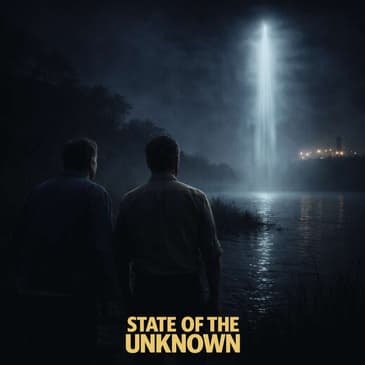

In October 1973, two shipyard workers walked into a Mississippi sheriff’s office late at night and claimed they had been taken against their will. What followed was documented by law enforcement, investigated by federal agencies, and quietly recorded when the men believed they were alone.
This episode examines the Pascagoula Incident through police reports, firsthand testimony, and a secret audio recording that captured the men’s reactions in real time. It’s not a story about proof or belief. It’s a story about what happens when an extraordinary claim refuses to fall apart under scrutiny.
What happened on the riverbank that night remains unresolved. But the record it left behind is real.
Support State of the Unknown
If you enjoy the show and would like to help support it, you can become a Sasquatch Supporter for $3 a month. Your support helps cover the costs of researching and producing the show, website hosting, distribution, and helping more people discover State of the Unknown.
Membership is completely optional, and the show remains free for everyone.
Become a Sasquatch Supporter on Patreon
🔍 New episodes every Tuesday
🌐 Visit stateoftheunknown.com for show notes and to submit your own story.
📬 Questions, theories, or story ideas? Reach out at contact@stateoftheunknown.com or @stateoftheunknownpodcast.
Some stories don’t stay buried.
We go looking anyway.
The station was quiet when two men came through the door late that night. Not the kind of quiet where nothing is happening, but the kind where every sound carries. Footsteps, breathing, the scrape of a chair somewhere deeper in the building. One of the men stopped just inside the entrance. He was young, visibly shaken, breathing hard, his hands clenched and unmoving at his sides. He didn't look at the desk. He didn't look at the deputies. He stayed where he was, close to the door. The other man kept walking. He was older, slower. He reached the desk and rested his hands on the edge of it, pressing down as if grounding himself there. He took a breath, then another. A deputy asked what brought them in so late. The man didn't answer right away. He glanced back towards the door, toward the younger man who hadn't moved. Then he faced forward again, his jaw tight, his voice measured like he was choosing every word carefully. He told the sheriff that they had been taken. What you just heard happened in a single night, but it didn't end there. Some parts of the story would be challenged, others would remain unresolved. Within hours, what these two men reported would stop being handled quietly. The sheriff's office would make calls it didn't usually make. People outside the county would start paying attention, and decisions would be made that ensured what happened next would be preserved, whether anyone believed it or not. Tonight, we're looking at a reported encounter from 1973 when two co-workers walked into a Mississippi Sheriff's office and claimed they had been taken against their will. Their report was documented by law enforcement and secretly recorded in the hours that followed. This is the story of the Pascagoula incident. Let's get into it. Charles Hicks had spent most of his life working at the shipyard in Pascagoula. It was steady work, physical and repetitive, the kind that leaves you tired in a way that feels earned. Calvin Parker was younger, reserved. He lived locally and kept to himself. People who knew him later described him as anxious by nature, uncomfortable in crowds, and not someone who handled stress well. They knew each other casually. That night wasn't planned far in advance. They decided to drive out to the river, find a quiet spot, and fish for a while. It was late in the evening when they parked near the water. The area was familiar, a stretch of shoreline locals had visited for years. Nothing about the place felt unusual to them at the time. They set up along the bank and talked while they waited. Cars passed occasionally on the nearby road. The river moved slowly, dark and calm. By all accounts, nothing happened right away. There was no sudden disruption, no moment where either man later said they felt afraid or unsettled. What they described afterward didn't begin with panic. It began with silence. The deputy asks them to start from the beginning. Charles Hickson answers first. His voice stays steady, but it's clear he's working to keep it that way. He pauses often, rubbing his hands together, looking down as he talks. They were standing along the riverbank, fishing. The water was dark and still. A few cars passed on the road behind them, far enough away that they barely registered. Hickson says the first thing that caught his attention was a sound. It was mechanical, a steady whirring that filled the air around them without any clear source. The kind of sound you expect from machinery, not from an open stretch of river. He stops talking for a moment, then says that's when the light appeared. Blue, bright enough to wash over the shoreline and throw long shadows across the ground. It came from above the water and moved towards them. The deputy asks how close it got. Hickson says close enough that the light became the only thing that either of them could focus on. Close enough that he could see Parker's expression change as it approached. That's when Parker begins to speak. His voice is shaky. He says his body stopped responding. He knew what was happening, but he couldn't move or speak. He says it felt like control had been taken away from him. Hicks says the same thing happened to him. They describe leaving the ground. Their bodies rose straight up without any sense of effort or resistance. They say they were taken inside something. They talk about movement around them, shapes passing close by, a sensation of floating without any clear sense of direction. The deputy asks how long this lasted. Neither man can answer. They remember a moment where everything went dark, and then they were back on the riverbank, standing upright. Hicks said the first thing they did was look at each other because neither of them knew how much time had passed. Parker says his legs wouldn't stop shaking. He kept turning back towards the river, watching the sky. They didn't talk about what to do next. After leaving the riverbank, Hicks called his wife from a payphone. He told her something had happened, something he couldn't explain. Then they got back into the car and drove straight to the sheriff's office. When the deputy asks why they came in instead of going home, Hicks answers without hesitation. He says whatever happened out there didn't feel like something they could handle on their own. The sheriff didn't interrupt while they spoke. He just watched them instead. Parker stayed rigid in his chair, arms tight against his sides, his eyes fixed on the floor. Every few seconds, his leg jolted, like his body was still trying to run without him. Hickson sat closer to the desk, leaning forward as he talked, answering questions carefully, repeating details when asked, and never raising his voice. Neither man tried to embellish anything. They didn't speculate. They didn't argue with each other. When one of them couldn't remember something clearly, he said so. The deputy asked them to walk through it again, slower this time. Hicks did most of the talking. Parker added small corrections here and there, nodding when Hickson described things the same way he remembered them. The sheriff asked practical questions. How long were you out there? Where exactly were you standing? Did either of you drink anything? Did you take anything? The answers were consistent. No alcohol, no drugs, no argument between them, no reason for either man to invent what they were saying. When Parker finally spoke up on his own, his voice cracked. He said he didn't understand why it happened to them. He said he'd never been in trouble before. He said he didn't want to be there, but he didn't know where else to go. The room stayed quiet after that. The sheriff stepped out briefly, then came back in. He asked them to stay seated. He asked another deputy to bring water. Parker didn't touch it. Hickson drank slowly, his hands still shaking. At no point did the sheriff tell them he believed them. At no point did he accuse them of lying. He didn't try to resolve the story. Instead, he made a decision. They weren't sent home, they weren't put together in a holding cell. They were kept where they were, separated just enough to observe, just enough to wait. Whatever those two men had walked in with that night, the sheriff wasn't ready to dismiss it. And he wasn't ready to let it leave with them. The deputies moved them into a smaller room just off the main office. It wasn't an interrogation room. The lighting was flat and unremarkable, and there was no mirror on the wall. Just a table, a couple of chairs, and a door that closed with a dull, final sound. Parker sat down hard, like his legs had finally given up on him. He folded forward, elbows on his knees, staring at the floor. His breathing stayed fast and uneven, even after several minutes had passed. Hicks remained upright. He rested his forearms on the table and looked toward the wall, his jaw clenched, his eyes unfocused. No one spoke for a moment. Then Parker whispered that he didn't want to be there anymore. Hicks told him they had to stay. He said leaving wouldn't make it go away. He said whatever happened by the river was still following them, at least in his head. Parker shook his head. He said he couldn't feel his arms right. He said his body still felt wrong, like it wasn't fully back where it belonged. Hicks reached out and put a hand on Parker's shoulder. Parker flinched, then didn't pull away. They sat like that, talking in low voices, circling the same questions without answering any of them. Why them? Why now? Why there? They didn't know how long they'd been alone. They didn't know that someone had come back into the room after they sat down. They didn't notice the tape recorder placed quietly on the table, close enough to pick up every word. The door closed again, and the machine was left running. That recording wasn't made as evidence. The men in that room didn't know it existed. They weren't being questioned. They weren't trying to convince anyone. They believed they were alone. What the recorder captured wasn't a statement. It was a moment where whatever composure they'd been holding on to finally broke. You can hear it in the pauses, in the way their voices rise and fall, in the way they circled the same details without trying to organize them. They weren't building a story. They were trying to understand what had just happened to them. When the deputy returned and shut the recorder off, the room didn't snap back to normal. It stayed heavy. The quiet lingered longer than it should have. From that point on, the sheriff's office treated the situation differently. Calls were made, not to dismiss the report, but to document it. Word spread quickly inside the department that something unusual had just walked through the door. The men were separated and interviewed again, this time more carefully. Their accounts were compared side by side. Details were checked, timelines were questioned. The stories didn't change. They described the same sequence, the same light, the same loss of control, the same return to the riverbank with no sense of how long they'd been gone. By the early hours of the morning, the sheriff knew this wasn't something he could handle quietly or alone. Whatever had happened on that riverbank had already outgrown the station. And once the tape was secured, the story stopped being just a claim. It became a record. By the time the sun came up, the situation had moved beyond the sheriff's office. The tape was secured, written statements were logged, and the decision was made to bring in people with resources the county didn't have. Calls went out early that morning. Not to reporters and not to anyone looking to make noise, but to agencies that handled things that didn't fit neatly into a local report. Representatives from the Air Force were notified. So were scientists and specialists consulted by the Air Force. The reasoning was straightforward. If something had been in the sky over the river that night, then it fell under federal interest. Within hours, Air Force personnel and federal investigators arrived at the sheriff's office, some in uniform, others in plain clothes. They didn't announce themselves publicly. They asked to see the men separately. They asked to review the tape. They wanted the timeline from the beginning, again, without the others in the room. The questions were precise. What direction did the light come from? How fast did it move? Did it make contact with the ground? Did either man lose consciousness? They weren't looking for a story, they were trying to rule things out. Radar data was checked, flight paths were reviewed, known aircraft in the area were accounted for and eliminated. Weather conditions were examined and dismissed as a cause. Nothing matched what the men described. What stood out wasn't a single detail, it was consistency. Separated interviews produced the same sequence, the same timing, the same movements, the same point where control was lost. The younger man, Calvin Parker, was struggling under the attention. He didn't want to repeat himself. He didn't want to be examined or recorded again. At one point, he asked to be left alone entirely. Hicks continued answering questions, but even he began to tire. The repetition wore on him. The more they were asked to recount the experience, the more real it seemed to become. This wasn't calming things down, it was cementing them. Word spread quickly outside the building. By midday, reporters were calling, then arriving. The men were photographed leaving the station. Headlines started forming before any official statement was made. The sheriff tried to keep control of it, but the case no longer belonged to him. Once federal agencies became involved, the situation shifted from a local report to something larger. Something that would be examined, challenged, and debated long after the men involved wanted distance from it. For Hicks, that attention became unavoidable. For Parker, it became unbearable. Within days, Parker withdrew almost completely. He stopped speaking publicly about what had happened. He refused interviews. He tried to return to a life where his name wasn't tied to a single night on a riverbank. Hickson continued to talk, not because he wanted attention, but because once the story was out, silence felt like surrender. Investigators came and went. Tests were proposed and abandoned. Explanations were suggested and discarded. Nothing settled the case. What remained were records, interviews, the tape, and two men who never changed their account, even as the world around them tried to decide what to do with it. By the end of the week, the Pascagoula incident was no longer just an event. It was a question that refused to stay contained. Once the men were separated and their statements recorded, the Pascagoula incident stopped being just a dramatic claim and became something that could be examined. Now, this is where it helps to slow down and take a look at what actually holds up under scrutiny. First, consistency. Charles Hicks and Calvin Parker were interviewed independently. They were questioned multiple times by different people and at different points in the night and the days that followed. Their accounts didn't grow more detailed or theatrical with repetition. They described the same sequence of events, the same sensations, and the same outcome. There were no major contradictions introduced when they were kept apart. That doesn't prove that what they described happened the way they believed it did. But consistency under separation is one of the first things investigators look for when determining whether a story collapses under pressure. In this case, it did not. Second, the recording. It is not evidence of an abduction. It doesn't confirm what happened on the riverbank. What it does capture is how the men spoke when they believed no one was listening. There's no attempt to persuade, no clear narrative arc, no effort to make the story sound impressive or frightening. What you hear instead is confusion, fear, and repetition. They circle the same moments, struggle to put words to what they experienced, and react emotionally in ways that are difficult to sustain intentionally. That matters because it removes one common explanation: performance for an audience. Third, motive. Neither man sought attention before or after the incident. Calvin Parker actively avoided publicity and later described the attention as overwhelming and distressing. Charles Hicks maintained his account for the rest of his life, but he did not attempt to escalate it into a broader campaign or turn it into a personal platform. There was no clear financial incentive, no book deal at the time, no attempt to control the narrative through the media. Whatever happened didn't improve their lives. Again, that doesn't confirm the event, but it does weaken the argument that the report was created for personal gain. Fourth, alternative explanations. Investigators and researchers have proposed several possibilities over the years. Response, shared hallucination, environmental factors, psychological stress, misinterpretation of an unusual but mundane event. These explanations are not unreasonable. They're exactly what should be considered in a case like this. The difficulty is that none of them fully account for all aspects of the report. Panic doesn't explain the level of agreement under separation. Shared hallucination doesn't easily explain the audio recording or the timeline gaps. Environmental explanations struggle to account for the described loss of motor control and the return to the riverbank without awareness of elapsed time. That doesn't mean those explanations are wrong, it means they're incomplete. And that brings us to the final pressure point. Time. False reports tend to degrade, details shift, stories sharpen, motivations evolve. Over time, cracks appear. In the Pascagoula case, the core account stayed the same, not because it was reinforced publicly, but because it was repeated privately in interviews that were not meant for an audience. That doesn't resolve the mystery, it defines it. So where does that leave us? If you remove sensational retellings, if you set aside later embellishments, if you focus only on what was documented early and examined directly, you're left with two men who experienced something they couldn't explain and described it in a way that resisted collapse. Whether that experience involves something external, psychological, environmental, or something else entirely is still an open question. What makes Pascagoula different is not that it offers an answer. It's that when subjected to the kinds of scrutiny that usually dismantle extraordinary claims, the core of the story remains standing. And whatever did happen on that riverbank did not behave the way that false stories usually do. What makes the Pascagoula case linger isn't the claim itself. It's what happens when you take the men seriously for even a moment. That tape doesn't prove an abduction. It doesn't explain what happened on the riverbank. What it does is remove one of the easiest exits. It becomes much harder to say that they were putting on a performance or chasing attention. What you hear instead is confusion, fear, and two people trying to make sense of something that just broke their understanding of the world. And that's where disbelief often steps in. Not because the story is too strange, but because belief would require something most people don't want to give up: certainty, predictability, the idea that the boundaries of the world are fixed and well understood. If you accept that these men were sincere, then the next question becomes uncomfortable. If they weren't lying, what does that say about how complete our explanations really are? That doesn't mean you have to jump to a conclusion. It doesn't mean you have to decide what they encountered. It just means sitting with the possibility that something happened which doesn't fit neatly into the categories we rely on to feel safe. That's a hard place to stay. It's much easier to dismiss the story outright, to label it a hoax, a misunderstanding, or a moment of panic. Those explanations restore order. They close the door and let the world make sense again. But the reason this case hasn't faded is because it resists that closure. There was no confession, no unraveling of the story, no moment where the pieces snap back into something familiar. What remains is a documented report, a recording that captures raw reaction rather than rehearsed claims, and a question that never quite settles. Whether you believe what happened on that riverbank was extraordinary or not, the reaction to this case reveals something very ordinary about us. We don't just judge stories based on evidence. We judge them based on what believing them would demand of us. And sometimes, disbelief isn't about what we think happened. It's about what we're afraid might be true. This has been State of the Unknown. The Pascagoula incident doesn't leave behind proof in the way people usually expect. One that was recorded, preserved, and listened to by people who had to decide what they were hearing in real time. Before I go, I just want to say this. Lately, a lot of you have been leaving ratings, reviews, and very thoughtful comments on Spotify, Apple, and other apps too. I see them, and I don't take any of it for granted. Knowing people are listening this closely and engaging with the stories the way you are genuinely means a lot to me. If you've already done that, thank you. And if you ever feel like doing it on whatever app you listen on, it really does help more people find the show. And if you have a story you think belongs here, you could reach me anytime at state of the unknown.com slash contact. Until next time, stay curious. Stay unsettled. Because sometimes the most unsettling part of a story isn't what was said, it's what happens once it's been recorded.