
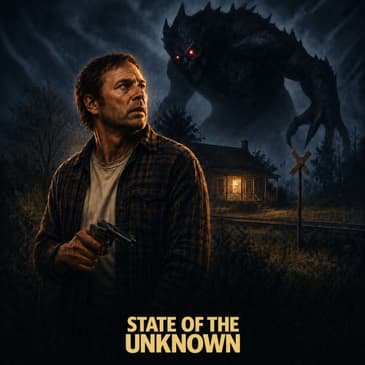

Join host Robert Barber as he examines the Enfield Horror, also known as the Enfield Monster or Enfield Creature, one of Illinois’ strangest reported cryptid encounters.
In April 1973, Henry McDaniel reported hearing scratching at the front door of his home in Enfield, Illinois. When he went to investigate, he said he saw something outside that he couldn’t identify: a grayish creature with large pink eyes, an awkward body, and three legs.
That encounter became the beginning of one of the most bizarre unexplained creature sightings of the 1970s. Within days, the story spread through the small town. Police were called to McDaniel’s home. Unusual tracks were reportedly found near the house. Neighbors gathered. A ten-year-old boy’s frightening story became part of the local legend. Radio reporters traveled to Enfield. Armed outsiders arrived hoping to photograph or confront the creature, and the case quickly grew from one man’s reported sighting into a town-wide disturbance.
In this episode of State of the Unknown, Robert looks at the reported Enfield Horror encounter, the famous three-legged creature description, the alleged tracks, the WWKI radio crew’s abandoned barn sighting, the disputed child encounter, the monster hunters who came to town with guns, and the skeptical explanations that followed, including the missing kangaroo theory, the wild ape theory, and other possible animal explanations.
More than fifty years later, the Enfield Horror remains one of the most unusual American cryptid stories of the 1970s. Was something strange moving through Enfield, Illinois? Was Henry McDaniel describing an unknown animal, a misidentified creature, a rumor that grew through fear and media attention, or something that still hasn’t been fully explained?
Support State of the Unknown
If you enjoy the show and would like to help support it, you can become a Sasquatch Supporter for $3 a month. Your support helps cover the costs of researching and producing the show, website hosting, distribution, and helping more people discover State of the Unknown.
Membership is completely optional, and the show remains free for everyone.
Become a Sasquatch Supporter on Patreon
🔍 New episodes every Tuesday
🌐 Visit stateoftheunknown.com for show notes and to submit your own story.
📬 Questions, theories, or story ideas? Reach out at contact@stateoftheunknown.com or @stateoftheunknownpodcast.
Some stories don’t stay buried.
We go looking anyway.
Police Response And Strange Tracks
How The Story Starts To Spread
Calls, Casts, Hunters, And Headlines
Second Sighting And Radio Escalation
Armed Outsiders And Real Consequences
Sorting Evidence From Legend
Why The Reaction Still Haunts
SPEAKER_00The scratching came from the front door, and Henry McDaniel stopped inside his house to listen. It was after nine at night in Enfield, Illinois, late enough that a sound at the door didn't belong there unless someone had walked up to the house. But this didn't sound like a knock. It was lower than that. Closer to the wood, like something was scraping against the outside of the door. Henry moved toward it and slowed down as he got close. The house was quiet around him, and when the sound came again, it was still right there on the other side. For a few seconds it could still be ordinary. A dog on the porch, some animal nosing around, something that had come too close to the house and would run off once he checked. So Henry went to the door and looked outside. The shape near the house didn't turn into anything he recognized. It was grayish in the dark, low and awkward, and the body didn't look right for the way it was standing. His eyes went to its face first. The eyes were pink and wide, catching the light in a way that made them look too large for whatever was in front of him. Then Henry saw the legs. There were three of them set under the body in a way that made him keep looking because his mind couldn't make the shape fit. He was still inside his own house, but whatever this was had been close enough to scrape at the door. The only thing between them was the doorway, the porch, and a few feet of dark. Henry stepped back and reached for his pistol. The movement was quick now, more reaction than decision. The thing was still outside the house when he raised the gun, aimed at the shape near the door, and fired. That's the moment most people remember from the Enfield horror story. Henry McDaniel inside his own home, a scratching sound at the door, and something outside that didn't match anything he expected to see. But the Enfield case doesn't stay with the creature. It moves through the people who heard about it, the officers who responded to it, the neighbors who gathered near the house, and the strangers who eventually came looking for it. That's what makes this story different. It isn't only about what Henry McDaniel said was outside his door. It's about how quickly one report became something a town had to react to. Because in Enfield, the fear didn't end when the creature disappeared into the dark. That was when everyone else started moving toward it. This is the story of the Enfield horror, the Illinois creature case that turned one man's report into something an entire town had to answer. And this is State of the Unknown. On the night of April 25th, 1973, Henry McDaniel was inside his home in Enfield, Illinois when he heard scratching at the front door. At first, it could have been ordinary. A dog near the porch, an animal against the wood, maybe someone outside the house. McDaniel went to check, expecting something he could understand. What he said he saw didn't fit. McDaniel described a grayish creature near the house. It was roughly four and a half to five feet tall, with a body that looked wrong to him, large pink eyes and three legs. That last detail became one of the parts remembered most because it made the description hard to place. It wasn't simply a strange shape in the dark. In McDaniel's account, the body was standing on three legs. McDaniel fired at it, and after the shot, the creature reportedly hissed like a wildcat. Then it moved away from the house, bounding toward the brush and the railroad tracks. In the version most often told, the movement was fast and strange, with the creature covering distance in long jumps. McDaniel had opened the door because of a scratching sound. Minutes later, he was saying something gray, pink-eyed, and three-legged had been outside his home. His wife reportedly called the state police, and officers came to the property. Once police were there, attention turned to the ground around the house. Unusual tracks were reportedly found near the home. Officers later described them as dog like, but with six toe pads. McDaniel had a description of the creature, and now there were marks near the house that people connected to what he said he had seen. By then, neighbors had begun gathering near the McDaniel home. Around 50 to 75 residents were reported to have come to the area after the disturbance. A strange report at one house had pulled people out of their homes and into the street. And now the story was no longer just Henry McDaniel standing at his door. It was a neighborhood around his house, police on the scene, tracks on the ground, and a question spreading through Enfield all before the night was over. McDaniel's report was strange enough on its own, but it didn't stay at his front door. In the version that spread through early reports and later retellings, a 10-year-old boy who lived near McDaniel's home had seen the creature before McDaniel did. Later versions often identify him as Greg Garrett. According to that part of the story, the boy was outside near the bushes when the creature appeared. The reported encounter was more physical than McDaniel's first sighting. The boy said the creature jumped from the bushes, stepped on his feet, and tore his tennis shoes. He reportedly ran home frightened. That piece of story gave Enfield another point of fear. McDaniel had described a creature near his house. The boy's version placed it near a child, close enough to touch him, close enough to leave him running home. Other reports began attaching themselves to the case. Some local residents were said to have seen something strange. School children reportedly claimed they had seen a similar creature near the school ballpark. A sighting at one home had become talk of something moving through shared spaces near places people knew and children used. McDaniel himself reportedly said there may have been more than one creature. If that was true, then the thing outside his door wasn't a single animal passing through. It suggested the possibility that whatever he had seen wasn't alone. Then came the line that helped move the Enfield horror out of ordinary animal territory and into the larger world of 1970's strange encounter stories. McDaniel reportedly said the creatures were, quote, not from this planet. He was not just describing a frightening animal. By the time those details were circulating, Enfield had more than one single report. It had a man who claimed a creature scratched at his door, police who had responded to it, tracks that had been noticed, a child's reported encounter, school area claims, and a witness saying there might be more than one. That first night didn't close the story down. It had opened it up. Once the story got out, Henry McDaniel's house had become the center of attention in a way he likely never expected. After the first newspaper coverage, he reportedly received a large number of phone calls. By the end of that first wave, the number was said to be in the hundreds. People wanted to know what he saw. Some wanted to offer explanations. Others wanted to connect his report to other strange events. One call was described as coming from a government representative. According to the report, that caller told McDaniel the incident resembled other cases going back to 1967 and connected those cases with UFO sightings. His front door was still the starting point, but now someone on the phone was placing it beside other unexplained events. The tracks near the house continued to draw attention as well. An anthropologist reportedly examined them and said they were not kangaroo tracks. Plaster casts were reportedly made and sent for examination. The creature itself had disappeared into the brush and toward the tracks, but the marks left behind were something people could point to, collect, and send away. Meanwhile, local hunters reportedly searched the area. If there was an animal, someone wanted to find it. If there was a creature, someone wanted to see it. And each search kept the question alive because every search carried the possibility that the creature might still be somewhere near Enfield. As the media attention widened, newspaper and radio reports carried the Enfield story beyond the town, and the case began taking on a life outside the people who had actually been there. A report became a headline. A headline brought callers. Callers brought theories. Theories brought strangers. It started at McDaniel's home, then moved to the neighbors and police. After that came phone calls, the tracks, the hunters, and the regional press. By then, the question was no longer only what Henry McDaniel saw. It was how long Enfield could stay calm while more people began acting as though the creature might still be out there. On May 6, 1973, the story returned to Henry McDaniel. According to the reports, McDaniel saw the creature again around three o'clock in the morning near the railroad tracks. Those tracks were already part of the first night. The creature had reportedly bounded away toward that area after McDaniel fired at it. Now, days later, McDaniel was saying it had appeared there again. This second sighting kept the case from fading into a single strange night. Whatever McDaniel believed he saw on April 25th, he now believed he had seen it again. After that second sighting, McDaniel contacted WWKI, a radio station out of Kokomo, Indiana. That brought a new group into the case. A news director and three companions traveled to Enfield, and with that, the search moved beyond local residents and police. The WWKI group went near McDaniel's home, and according to their report, they saw an ape-like creature standing in an abandoned barn. McDaniel's report had already drawn attention. Now outsiders said they had seen something too. The group reportedly recorded vocalizations. They also reportedly fired at the creature before it ran off. The Enfield story now had a second scene with a gunshot, a second claim of a creature being seen near McDaniel's property, and a new setting away from the front door. Then McDaniel gave a live radio interview on WGN in Chicago. By that point, the case had crossed another threshold. It wasn't just being talked about in Enfield, it was being broadcast across the Midwest by one of the region's major radio voices. What began at one front door had become something the whole region could hear about. And once that happened, the town didn't just have to deal with the fear of whatever might be outside. It had to deal with people coming in because they had heard about it. After the report spread, armed outsiders began coming into Enfield. Five young men from outside the community arrived after hearing about the creature. According to the story, they said they came to photograph it and that they brought shotguns and rifles for protection. That detail brings the case into a different kind of danger. Whether the creature was real or not, the guns were real. The people arriving in town were real. And the fear from residents was no longer only about what might be hiding in the brush. Residents complained about gunfire, and White County authorities arrested the five men, and they were charged with hunting violations, fined, and released. That's where the Enfield story becomes grounded in documented consequence. The creature was still unproven, but the reaction to the creature had now produced arrests. Local concern turned toward the possibility that someone might get hurt. Enfield residents reportedly worried that monster hunters could accidentally shoot a person. That concern is easy to understand. A small town had become the destination for armed strangers looking for a creature described in newspapers and on radio. In that atmosphere, any movement in the dark could become a target. Shortly after the events, researchers from Western Illinois University arrived and began interviewing residents. By then, the case had already gathered several layers. McDaniel's first sighting, the child's reported encounter, the tracks, the phone calls, the second sighting, the WWKI Barn report, the media attention in the armed men who came looking for the creature. The researchers arrived after the story had already spread, but while the events were still fresh enough for people to remember how the town reacted, their work would later become one of the most important attempts to sort the Enfield horror into what was documented, what was reported, what was repeated, and what couldn't be pinned down. The case didn't end with a captured animal. It didn't end with a confirmed creature. It didn't end with a confirmed kangaroo, a confirmed ape, a confirmed bear, or a public lab result that settled the tracks. It ended with the way that many of these cases end. With the town that had lived through the disturbance, witnesses who said they saw something, newspapers that carried the story outward, explanations that never fully satisfied everyone, and a creature that disappeared back into uncertainty. The Enfield horror is one of those cases where the reaction is easier to document than the creature. The strongest foundation is the sequence of public events. Henry McDaniel's report was published. Police were called to his home. Tracks were reportedly observed. Neighbors gathered. The story spread through newspapers and radio. McDaniel received many calls. A radio crew traveled to Enfield. Armed outsiders later arrived, and five men were arrested on hunting violations after residents complained about gunfire. Western Illinois University researchers then came to the area and interviewed residents. Those pieces give the case a factual frame. They don't prove the creature existed, though, but they do show that the report produced a real response. The creature description comes mainly through McDaniel's reported account. The core details are the grayish color, the large pink eyes, the three legs, the odd body shape, the hissing sound after the shot, and the movement away from the house toward brush and railroad tracks. Those are the details that should stay closest to the story because they appear in the early reporting and became the center of the case. Some details are famous but weaker. The 10-year-old boy's encounter is one of the biggest examples. In the traditional version, the boy said the creature jumped from the bushes, stepped on his feet, and tore his tennis shoes. That belongs in the story because it is part of how the Enfield legend spread. But later, according to the Western Illinois researchers, the boy and his parents reportedly said that part was a practical joke, so it should not be treated as confirmed. The schoolchildren near the ballpark and other local reports are also softer. They help show how the story moved through the town, but they're not as solid as McDaniel's direct report or documented public reaction around the case. Some reports appear to have them come secondhand, including claims McDaniel relayed about what others had seen. The tracks are important, but they don't solve the case. Police reportedly saw unusual tracks and described them as dog-like with six toe pads. An anthropologist reportedly said they were not kangaroo tracks, as had been claimed, and plaster casts were reportedly sent for examination. The problem is that no confirmed public lab results appeared to identify what made them. So the tracks are useful story material, but they're not proof. The WWKI barn encounter is also complicated. The radio group reportedly said they saw an ape-like creature in an abandoned barn, recorded vocalizations, and fired before it ran off. That's a major escalation in the story because it brings in outside witnesses connected to media. But the description of an ape-like creature doesn't line up neatly with McDaniel's three-legged creature, and I could not confirm a surviving authenticated recording or analysis. The skeptical explanations also belong here rather than in the main story. The kangaroo theory became one of the most repeated explanations, especially after an Ohio resident reportedly connected the creature to a missing kangaroo and offered a reward. The ape theory appeared through comments connected to reported wild ape sightings. A bear was also suggested in some coverage. None of those explanations appear to have conclusively solved the case from the material reviewed. The biggest issue with Enfield is that the case grew quickly through media attention, local fear, rumor, and outside curiosity. That doesn't mean every witness was lying. It also doesn't mean every reported detail deserves equal weight. The better way to handle it is to separate the layers. There's the documented public event, police response, press coverage, community reaction, arrests, and research interviews. There are the firsthand or near firsthand claims, McDaniel's sightings and the WWKI group's reported barn encounter. There's the traditional legend, the boy's shoe story, the not from this planet line, the repeated creature description, and the idea that more than one creature may have been present. And there are the unresolved pieces, the tracks, the missing lab result, the unclear recording, and the lack of a captured or identified animal. That's where the Enfield horror sits. It's not a clean proof case. It's a reported encounter that became a documented social event with enough strange details to remain memorable and enough weak points to keep the question open. What interests me about the Enfield horror isn't only the creature description, although that's obviously the part people remember. Three legs, pink eyes, scratching at the door, hissing after the shot. Those details are strange enough to keep the case alive. But the part that stays with me is how fast one man's report turned into a town problem. Henry McDaniel said something was outside his door. Police came, neighbors gathered, tracks were noticed, and children's stories entered the mix. Then callers started connecting the case to other strange reports. Radio people showed up, and armed men came into town looking for whatever everyone was talking about. That's a very human chain of events. A frightening report becomes a conversation. The conversation becomes a rumor. The rumor becomes a search. The search brings danger of its own. And in that sense, the Enfield horror has two mysteries sitting on top of each other. The first is the obvious one. What did Henry McDaniel see outside his house? The second is harder to shake. What happens to a small town when enough people start acting like the unknown is real? Because by the time armed strangers were walking into Enfield with guns, the creature almost didn't have to appear again. The story had already changed the behavior of real people in real places. That doesn't prove the monster was real. It also doesn't make the story meaningless. It leaves the case in that uncomfortable space where the evidence doesn't close the door, but the reaction tells you something serious happened there. Maybe not the thing people imagined. Maybe not the thing Henry McDaniel thought he saw. But something reached that front door, and the question never fully left town. This has been State of the Unknown. The Enfield horror remains one of those cases where the reported creature is strange, but the human reaction may be even stranger. A sound at a door became a police call, then a local disturbance, then a regional story, then a reason for armed outsiders to come looking for something in the dark. And more than 50 years later, the case still has the same problem at its center. There are reported sightings, there are tracks, there are disputed details, there are possible explanations, but there is no final answer that makes every piece fit. If you've been enjoying these stories, leaving a rating or review in your podcast app really does help more people find the show. On Spotify, it's just a tap of the stars. On Apple Podcasts, you can even leave a short written review. I read them and I appreciate everyone. And if you want to make sure you don't miss the next story, just hit follow so it shows up automatically when it drops. Thank you for listening. Until next time, stay curious. Because sometimes the strangest part of a story isn't what came out of the dark, it's what people did once they believed it was there.