
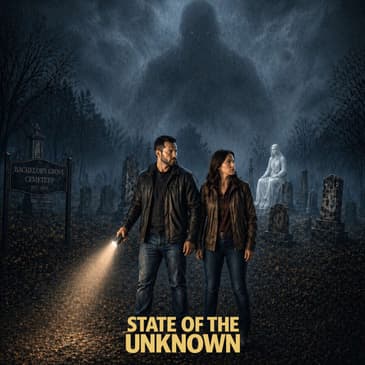
Bachelor’s Grove Cemetery has a reputation, and it didn’t come from stories alone. Visitors have reported seeing figures moving between the headstones, unexplained lights in the trees, and one photograph that captured something no one could explain.
Join host Robert Barber as State of the Unknown examines the documented history of Bachelors Grove Cemetery in Illinois, one of the most well-known haunted cemeteries in the United States. From eyewitness accounts of ghost sightings to paranormal investigations and the famous “Madonna of Bachelors Grove” photograph, this episode breaks down what witnesses say they experienced—and what still hasn’t been explained.
Located in Midlothian, Illinois, Bachelors Grove Cemetery has been the subject of decades of reports involving apparitions, shadow figures, phantom vehicles, and unexplained phenomena. Investigators, photographers, and visitors have all described similar encounters, raising questions about whether these experiences can be explained by environmental factors, psychological influence, or something else entirely.
If you’re interested in real paranormal cases, haunted locations, ghost sightings, and documented supernatural encounters, this episode explores one of America’s most talked-about haunted cemeteries through a grounded, evidence-based lens.
🎧 Topics covered:
- Bachelors Grove Cemetery Illinois history
- Madonna of Bachelors Grove ghost photo
- Haunted cemeteries in the United States
- Documented paranormal investigations
- Eyewitness ghost sightings and encounters
- Unexplained phenomena and supernatural reports
Support State of the Unknown
If you enjoy the show and would like to help support it, you can become a Sasquatch Supporter for $3 a month. Your support helps cover the costs of researching and producing the show, website hosting, distribution, and helping more people discover State of the Unknown.
Membership is completely optional, and the show remains free for everyone.
Become a Sasquatch Supporter on Patreon
🔍 New episodes every Tuesday
🌐 Visit stateoftheunknown.com for show notes and to submit your own story.
📬 Questions, theories, or story ideas? Reach out at contact@stateoftheunknown.com or @stateoftheunknownpodcast.
Some stories don’t stay buried.
We go looking anyway.
The Photo That Shouldn’t Exist
SPEAKER_00They take the picture without thinking much about it. It's just a quick shot across the cemetery. Headstones, open ground. The kind of quiet you notice when no one's moving through it. Nothing stands out at the time. It's later. Going back through the images that they notice something that shouldn't be there. In one of the frames, there's a woman sitting on a gravestone. She's seated upright, her figure clear in the image, turned slightly forward, hands resting in place like she's been there for a while. The air around her is open, with nothing that would have blocked the view. She isn't blurred or distorted. She looks like she belongs there. But no one remembers seeing her at any point while they were there. And no one can explain how she got there. The cemetery sits just outside Chicago, set back in a stretch of forest preserve land far enough off the road that you don't pass it unless you're looking for it. It's small and hasn't been used for burials in nearly a century. The graves are old, some are damaged or missing entirely, and parts of the ground have sunk or shifted enough that the whole place feels uneven. For a long time it sat largely undisturbed. Eventually, more people started showing up after hearing about it to see for themselves whether any of it was real. And once that started, the same kinds of reports began coming back. People described figures moving between the headstones, unexplained lights, and phantom cars near the road. By then, accounts like that were just one part of a much larger pattern. I'm your host, Robert Barber. By the time people started going out to the cemetery at night, the stories were already there. Most of what's said about this place now comes from those stories. But that's not what this is. This isn't about every version that's been passed around. It's about what people actually reported seeing when they went out there and what kept coming back the same way. This is the story of Bachelor's Grove Cemetery and the accounts that built its reputation. Let's get into it. The cemetery itself goes back to the mid-1800s. At that point, Chicago was still developing into a major city, expanding outward from a growing industrial center. Beyond that core, much of the surrounding area was still rural, made up of scattered farms, small homesteads, and communities tied more to land and family than to any central town. Cemeteries like this existed out of necessity. They were local and practical, usually maintained by the same people who used them. Bachelor's Grove followed that pattern. It was small, set apart from any main road, and tied to a relatively small number of families in the area. Burials were spread across simple plots marked by headstones that reflected the people who lived nearby. There wasn't anything unusual about it. That started to change as the area around it developed. Fewer burials took place there. Families moved away, and smaller cemeteries like this were used less and less. By the early 1900s, burials had slowed to a near stop, with the last confirmed burial believed to have taken place sometime in the 1920s. Without regular use, maintenance faded. Headstones were left exposed to the elements. Sections of the ground began to sink and shift, and the cemetery was no longer actively managed. Set back from the road, partially obscured by the surrounding land, it became the kind of place people passed without a reason to stop. For a long time, that's all it was. A place people passed without any reason to stop. That started to change in the 1960s and 70s, after the land became part of the forest preserve and the cemetery was left to sit on its own. With no one maintaining it and no regular visitors, it started to draw people in for different reasons. Cars would pull off along the road, people would head into the trees, and the cemetery became a spot where locals went to hang out, drink, or just see it for themselves. What happened out there didn't stay there. People went back with something to say, and someone else would hear about it, get a rough set of directions, and go looking for it themselves. People passed along how to get there, what road to take, where to pull over, where the opening in the trees was. Cars would line the roadside, and from there it was a short walk in, following ground already worn down by other people doing the same thing. People described a headstone coming into view off to one side, then another farther in. And after that, more of them as the ground opens up, uneven and scattered. Some leaning, some broken, others sitting lower where the earth is shifted around them. Once inside, sound drops off. What carries is close footsteps, a branch brushing against clothing. What people described often followed a similar pattern. They move between the markers, watching where they step, but their attention drifts away from a path out toward the headstones. Off to one side between two markers, something shifts. Just for a moment, long enough to notice, then it's gone. They stop, look back to the same spot. Nothing there. A small point of light appears low to the ground. It holds for a second or two, steady enough to focus on, then fades before there's time to figure out what it was. Near the road, headlights cut through the trees. For a moment it looks like a car is sitting just beyond the edge of the cemetery. They keep watching, waiting for it to move. But it doesn't. And then it's gone. No sound, no movement, nothing pulling away. They leave with something specific. Where they were standing, what direction they were facing, what stood out. What people came back describing wasn't always the same, but certain details kept coming up again and again. A woman in a white dress came up more than anything else. People described seeing her between the headstones, sometimes at a distance, sometimes close enough to make out the shape of her dress. Standing still or moving slowly across the ground. In some accounts, she wasn't alone. She's described as holding something in her arms, like she was carrying a child. That detail didn't show up every time, but it showed up enough that people kept repeating it. Other things came up too, even if they didn't match as clearly. Lights low to the ground, appearing and disappearing without a clear source. Not headlights, not flashlights, something that didn't behave like anything they could explain in the moment. And then there were the reports that didn't fit as easily. Some talked about a house that wasn't supposed to be there. A two-story structure near the edge of the property, with light in the windows like someone was inside. The accounts followed the same pattern. Someone would see it from a distance, start toward it, and it would be gone before they got close enough to reach it. There had been a house in that area decades earlier, which gave people something to point to, but that didn't match how it was being described. Not something remembered, something people said they were seeing. Not everything people described fit into those patterns. Other reports came up less often, but never really disappeared. Figures near the pond, shapes that didn't match a person at all. Shadows crossing the ground where nothing was there to cast them. Even along the road outside the cemetery. Vehicles appearing briefly, then gone before there was time to make sense of it. Those details got passed along with the directions, and the next person went out there looking for the same thing. That's how it kept going. At that point, it was still just people talking. But it didn't stay that way. By the early 1990s, the cemetery already had a reputation for people going out there at night and coming back with the same kinds of stories. Figures moving between the headstones, lights with no clear source, and something about the place that didn't feel right after dark. Those accounts were still coming back, but everything depended on what someone said they had seen, and that's what drew the attention of a group that had started looking into cases like this more seriously. The Ghost Research Society was based in the Chicago area and focused on documenting reports of paranormal activity. They visited locations where accounts kept repeating, took photographs, and tried to capture something that didn't depend on someone remembering it later. Bachelor's Grove kept coming up, and not just once or twice. The same details were showing up across different visits, and it was close enough for them to keep going back. They didn't plan to go out there for just one night. They went back more than once, investigating different parts of the cemetery, taking photos and treating it like something they needed to document instead of just reacting to it in the moment. On one of those visits, they took a series of photographs across the grounds, and nothing stood out at the time. The cemetery looked the way it always did: headstones, open ground, and uneven terrain. They weren't stopping to review each shot as they took it. They were working in the area the same way they had on previous visits, taking photos, noting where they were, and going to the next spot. The photograph only became significant later. When they went back through the images, it was one frame in a larger set. The rest of the photograph showed exactly what they expected: empty sections of the cemetery, headstones, open ground. Then they came across one image that would end up being referred to as the Madonna of Bachelor's Grove. It didn't match the others. At first, nothing seems off. Then the figure starts to stand out. The photograph shows a section of the cemetery from ground level, and in it, there's a woman sitting on one of the graves. She's positioned clearly, turned slightly forward, with her hands resting in place in the angle and lighting to match everything else in the image. She isn't distorted or out of place, and she doesn't look like something caught in motion or only partly visible. She looks like someone who was there the entire time. That's where it stops adding up. No one was sitting there. No one mentioned seeing anyone in that position. Nothing about it made the group stop or take a second look. If someone had been there, they would have been seen. If someone had walked into that position, there would have been movement, noise, something that would have drawn attention. None of that was reported. And there's nothing in that photograph that suggests a reflection, a shadow, or anything in the background that could account for the shape. It still reads as a full figure. No one reported seeing her while the photo was being taken, and no one involved in the investigation remembered anyone sitting in that location at any point during the visit. The space around her is open, with nothing that would have blocked the view or hidden someone from sight, and the figure appears fully formed, sitting in a spot that should have been visible the entire time. That's what makes the image difficult to dismiss. It isn't a blur or shadow. It's a person sitting in a place where no one had been at all. Once the image was shared, it didn't stay with the group. Before that, everything depended on reported accounts. Now there was something others could look at. That changed how the cemetery was talked about. Those who had already been there started comparing what they saw to the image. Others went out there specifically because of it, looking for the same kind of figure, the same kind of presence in the same part of the cemetery. It gave those reports something solid to point to. They used it in presentations and case discussions, and from there it started getting picked up by other investigators and local paranormal groups. People who were already familiar with the cemetery saw it, talked about it, and passed it along. After that, it started showing up in other collections, books on regional hauntings, similar publications, and eventually in wider circulation as more people came across it and connected it back to the cemetery. By the time it reached a wider audience, it wasn't just an image. It was tied to a place that already had history behind it. Before that, the story depended on what someone said they had seen. Now there was something people could compare their experience to, and that changed how those accounts came back. After that, people started going out there with something specific in mind. Locals who had heard about it and investigators who went out specifically because of it, looking for a figure like the one in the photograph, paying attention to the same areas, watching for something that matched what they had already seen in the image. People kept coming back saying the same kinds of things were still happening. What they described began lining up in a way that's difficult to ignore. Not just being shapes or movement, but where they were standing, what direction they were facing, and where something appeared in relation to the headstones around them. Those same details kept coming back across different visits. At that point, it wasn't just about the photograph anymore. It's a place where something was captured once, and it kept showing up the same way after that. The cemetery didn't stay the same. The attention pulled more people out there, and that brought problems with it. Damage, trespassing, enough activity that the area started to be watched more closely. Access started to get more limited as the area was monitored more closely and steps were taken to control the traffic coming in. But people still went anyway. And even with fewer people getting in, the same kinds of reports kept coming back. The location didn't change, and whatever was being described out there didn't change either. The photograph referred to as the Madonna of Bachelor's Grove is what most people point to first because it gives something visual to focus on. And there are ways to question it. Film can produce unexpected results, double exposures, light leaks, images that don't always come together cleanly when they're developed. Under the right conditions, that kind of thing can happen. That could explain a figure showing up where no one remembers seeing one. But when you look at this one closely, it doesn't behave like that. A double exposure usually leaves something behind, overlap, uneven lighting, parts of one image cutting through another. Here, the figure holds together. The lighting across her lines up with the rest of the scene, and there isn't anything in the background that seems to be blending into her or breaking her apart. It reads as one complete image. Another possibility is that someone was actually there and just wasn't noticed. That's the simplest explanation, and it works in a lot of cases. But that doesn't really fit here. The space around the figure is open. There's nothing there that would have hidden someone from view. For someone to be sitting in that position, they would have had to walk into it, sit down, and stay there long enough for the photograph to be taken without drawing attention. No one reported that happening, and no one remembered anyone in the area at any point during the visit. So the photograph doesn't settle anything. And it isn't the only thing that people point to. The reports themselves raise the same kinds of questions. Lights appearing low to the ground can be explained in some cases. Reflection, distant headlights, even natural causes under the right conditions. Figures are harder to pin down. In a place like this, where people are already expecting to see something, it doesn't take much for a shape or movement to register as something more than it is. That kind of expectation can carry a lot of weight, especially when people are going out there already knowing what's been reported. Because the descriptions didn't just happen once, they kept coming back in the same areas with the same kind of details, even as more people went out there over time. And when you line that up with the photograph, the one piece of this that doesn't rely on memory, it doesn't resolve anything. It leaves you in the same place. There isn't one explanation that accounts for everything without leaving something out. It's a marked piece of ground where people are buried, and that's where their story ends. Families visit for a while, then less often. Headstones weather, names fade, and eventually most of the people buried there don't have anyone left who remembers them. That's the point of it. You put something to rest, and it stays that way. Bachelor's Grove doesn't line up with that. It stopped being used in the early 1900s. By the time people started going back out there decades later, there weren't immediate family members visiting those graves anymore. It wasn't being maintained the way an active cemetery is. It was overgrown, pulled back into the surrounding woods, easy to miss unless you already knew where it was. So the people going out there weren't there for a burial, and they weren't there to visit someone they knew. They were going out there at night to see if something would happen. That matters. Because if something is being seen out there, if those reports are real in any sense, it isn't tied to someone coming back to visit. It isn't tied to grief or memory or a recent event. It's tied to the place itself. That's where it gets harder to explain. Because cemeteries aren't where anything is supposed to happen, they're where things are finished. The events that matter, the parts of someone's life that would leave something behind, they don't take place there. The cemetery comes after all of that. So if something is showing up at a place like that, it raises a different kind of question. Why there and why still? Why a cemetery that hasn't been used in decades, where most of the people buried there no longer have anyone connected to them in a direct way? Why does anything keep appearing in the same area in the same way, long after everything tied to it should have moved on? You can look at the photograph and question how it was taken. You can look at the reports and question what people think they saw. But that doesn't really get around the part that stays consistent. That location doesn't change. The pattern doesn't change. And whatever people are describing, it keeps getting tied back to the same piece of ground. At some point, it stops being about whether one photograph can be explained or whether one person got something wrong. It turns into a question about the place itself. And that's the part that doesn't settle. Because if nothing is supposed to be there anymore, then what are people still walking into? And maybe that's not something the living ever gets to know. This has been State of the Unknown. The story of Bachelor's Grove Cemetery doesn't end with a single explanation for what happened. It involves a place that had already been left behind, people who went there expecting nothing, and a photograph that captured something no one remembers seeing. After that, the reports didn't stop, and what people described didn't drift away from that moment. Over time, the story has been passed around, added to, and shaped by how people talk about it. But what remains is what was originally reported, and the fact that it doesn't resolve cleanly. Whether you see this as misidentification, coincidence, or something else entirely, there isn't a single explanation that accounts for every part of it. If you've been enjoying these stories, leaving a rating or review in your podcast app really does help more people find the show. On Spotify, it's just a tap of the stars. On Apple Podcasts, you can leave a short written review. I read them all and I appreciate everyone. And if you want to make sure you don't miss the next story, just hit follow so it shows up automatically when it drops. If there's a case you think I should cover, you can message me directly at State of the Unknown Podcast on Instagram, Facebook, Threads, or TikTok. Until next time, stay curious because sometimes what's in the ground doesn't always stay there.