
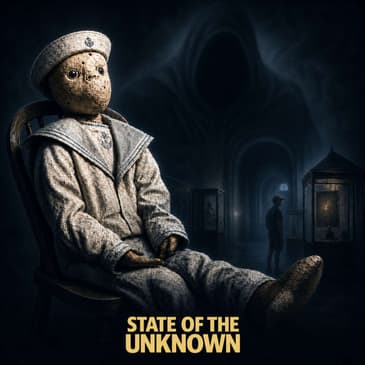

Robert the Doll is one of the most famous haunted objects in the United States.
For decades, the doll has been connected to stories of movement, strange sounds, changing expressions, camera malfunctions, visitor misfortune, and apology letters sent by people who believe they disrespected him.
But before Robert became a museum exhibit in Key West, he was connected to Robert Eugene “Gene” Otto, the Otto home, and a private story that later grew into public legend.
In this episode of State of the Unknown, join host Robert Barber as we look at what is documented, what has been reported, and what remains unclear in the story of Robert the Doll.
This is not about proving Robert is haunted.
It is about how a real object became the center of a legend that people still respond to today.
This episode examines the history of Robert the Doll, his connection to Gene Otto and Key West, Florida, and the claims that followed him from the Otto home to Fort East Martello Museum. Reports include claims of footsteps, giggling, movement, changing facial expressions, malfunctioning cameras, visitor misfortune, and apology letters written to Robert by people hoping to break the curse.
Robert remains one of the most widely known haunted dolls in American paranormal history, often discussed alongside haunted objects, cursed artifacts, museum hauntings, and supernatural folklore.
This episode focuses on the documented timeline, reported claims, and the ongoing ritual of visitors writing apology letters to Robert the Doll.
Support State of the Unknown
If you enjoy the show and would like to help support it, you can become a Sasquatch Supporter for $3 a month. Your support helps cover the costs of researching and producing the show, website hosting, distribution, and helping more people discover State of the Unknown.
Membership is completely optional, and the show remains free for everyone.
Become a Sasquatch Supporter on Patreon
🔍 New episodes every Tuesday
🌐 Visit stateoftheunknown.com for show notes and to submit your own story.
📬 Questions, theories, or story ideas? Reach out at contact@stateoftheunknown.com or @stateoftheunknownpodcast.
Some stories don’t stay buried.
We go looking anyway.
A Photo Without Permission
SPEAKER_00The room is quiet. The kind of quiet where you can hear footsteps from the next room over. A couple stops in front of the glass case. The man reads the sign first. It's short. Ask permission before taking a photograph. Show respect. He lets out a small laugh and looks over at her. Permission? She's already looking past it into the case. It's a doll, she says. What's it going to do? He leans in and taps the glass once with his knuckle, just enough to make a dull sound. Hey, he says, close to the case. You mind if I take your picture? Nothing. He pulls out his phone, raises it to the glass, and snaps a photo. Then another, angling it slightly this time. Hold on, he says, checking the screen. Let me get one without the glare. She leans in behind him. It's ugly, she says. Look at the face. He lowers the phone and smiles. Nothing, he says. Told ya. He taps the glass again as they turn away. They finish the museum without talking about it again. Outside, the heat hits them as soon as the door opens, and by the time they're back in the car, the picture is just another thing on his phone. A few days later, the first problems show up. Not a voice in the room, not something you can point to, a missed flight, a phone that dies at the wrong time, a reservation that isn't there when they arrive. The kind of things you deal with and move on from. But then there's another, and another. By the time they're back home, the picture is still on his phone, and the sign is still in their heads. She's the one who says it first. Do you think this is because of that doll? He doesn't answer right away. He knows exactly which moment she means. The tapping, the picture, the way they stood there and laughed. A few days later, he sits down and writes the letter. He apologizes for the picture, for what he said, for knocking on the glass. Then he sends it back to the place they walked through without thinking twice. Meanwhile, in Key West, it becomes one more letter and a stack of apologies just like it. Long before Robert sat behind glass at Fort East Martello, his story was already tied to a house in Key West and a boy named Gene Otto. That's where the older version of the story begins. Not with visitors, not with apology letters, not with anyone standing in a museum trying to decide whether to take a picture. It begins with Gene, the Otto home, an adult that stayed close enough to him that people remembered the connection long after childhood should have left it behind. And from there, Robert's story starts moving toward the thing he eventually becomes. I'm your host, Robert Barber. This isn't about proving Robert the Doll is haunted. It's about what can actually be followed, what's been reported over time, and why a story like this keeps going long after the original events have ended. This is the story of Robert the Doll, the haunted toy people still apologize to. And this is State of the Unknown. Let's get into it. Sometime around the early 1900s, a doll was made. We don't have an exact date and we don't have a complete record of where it came from, but we do know what it looked like. It was handmade, about 40 inches tall, stuffed with wood wool, also called Excelsior, and dressed in a sailor suit. From the beginning, this was not the kind of object that would disappear into a room. It wasn't a small toy that could be tossed in a drawer or forgotten about on a shelf with other childhood things. Once it was in a room, you'd notice it. It had a face that people could look at, a body large enough to take up space, and a presence that made it feel different from something ordinary sitting in the background. At some point, that doll ends up in Key West, connected to a boy named Robert Eugene Otto. Robert Eugene Otto goes by Gene. The doll is named Robert. In the version of the story that's most often told, Robert doesn't simply appear in Jean's life. He's given to him, sometimes by a household servant. In some tellings, attach something darker to that moment. In those versions, the doll comes into the house with resentment behind it, with revenge behind it, or even with voodoo tied to the household. That part is where the story starts to blur. The available record doesn't confirm exactly when Gene received Robert, who gave him to Gene, or the full circumstances of how the doll entered Gene's life. But the legend gives the doll an origin with intent behind it. And once that version takes hold, Robert is no longer just a strange-looking toy. He arrives with a warning already attached. What can be followed more clearly is the connection between Gene Otto and Robert. The first reported claim comes from Gene's childhood. According to stories attached to the Otto family, Gene blamed misbehavior on the doll. If something went wrong, the line usually connected to him was, I didn't do it, Robert did. On its own, that doesn't prove anything paranormal. Kids blame imaginary friends, siblings, pets, or anything else that gives them a way out of trouble. That part is easy to understand. But with Robert, the claim doesn't stay as a throwaway childhood excuse. It becomes the first place where the doll is treated as if it can act. Gene is not only remembered as playing with Robert, he's remembered as pointing to Robert when something went wrong, treating it like it was another little boy that was responsible for mischief. And once that idea exists inside a house, it changes how people look at the doll. They can laugh it off, they can ignore it, and they can treat it like childhood imagination. But if the pattern keeps happening, they can also start watching the doll differently. People close to the Otto family later describe the relationship between Jean and Robert as intense. That doesn't tell us exactly what happened inside the house, and it doesn't give us every conversation or every reaction from the family, but it does tell us that Robert was remembered as more than a toy that quietly faded into the background. At this point, there's no museum. There are no visitors, no warnings about pictures, and no apology letters being sent after the fact. There's Gene Otto in Key West, a large handmade doll, and a reported pattern where when something happens, the blame doesn't stay with the boy. It gets passed to Robert. Gene grows up, and for most childhood objects, that's where the story usually ends. Toys get packed away or left behind as everything else starts to take priority. Even when they're kept, they usually lose their place in a person's life. They become something remembered from childhood, not something that stays close. Robert doesn't follow that pattern. As Gene moves into adulthood and builds a life in Key West, he becomes known as an artist and Robert remains connected to him. We don't have a detailed record of where the doll was kept during every stage of Gene's adult life, or how often he was part of Gene's daily routine, but Robert doesn't disappear from the account. If the doll had faded out there, the story would have stayed contained to childhood. It would have been an odd memory about a boy who blamed things on a doll, something people might repeat later as a strange detail from Gene's early life. Instead, the connections carry forward. When something remains present that long, past the age when most childhood attachments are left behind, it starts to take on a different weight. Robert is no longer part of a childhood claim. He becomes part of the adult Gene Otto's story as well. Then in 1974, Gene passes away. The person at the center of the story is gone. The house is no longer his in the same way. The doll could have been stored, discarded, passed along, or forgotten with everything else left behind after someone dies. But that's not what happens. That same year, Myrtle Reuter purchases the auto home, and Robert is still there when the house changes hands. Now the doll is no longer only connected to the person who grew up with him. He's in a space where other people are going to live around him, move past him, hear stories about him, and eventually add their own accounts to what's already been said. From that point on, Robert's story is not only about Gene, it's about what happens when other people encounter the doll after Gene is gone. After Gene Otto's death, the story doesn't stop. The house belongs to someone else now, and the people inside it begin having their own experiences. Tenants who moved into the house describe hearing footsteps in the attic above them at times when no one is supposed to be there. That account is no longer coming from Gene's childhood or from someone remembering the way he acted around the doll. It's coming from people inside the house after Gene is gone, reacting to something they say they heard above them. Then there's the story of the plumber. He's not connected to the family, and he's not there because of Robert. He's inside the house to do a job, hears something that shouldn't be there, and ends up leaving with a completely different understanding of the space than the one he walked in with. He hears giggling, searches the rooms, finds no one, and then notices that the doll is no longer where he remembers seeing it. By then, Robert is no longer just part of a childhood story. The claims are reaching people who don't have Jean's history with the doll. Malcolm Ross, a local reporter, later says Robert's expression appeared to change while people were talking about him. That account brings the focus directly onto the doll. It's not a sound from the attic or laughter from somewhere else in the house. People are looking at Robert, talking about Robert and Gene, and Ross says the doll's face seemed to change in front of them. Myrtle Reuter's account carries the story forward from inside the home. She's not passing through. She lives with the object after Gene's death, and she describes Robert moving around her house and refers to the doll as haunted. At that point, the story has moved beyond a single person's attachment. Jean is gone, but the accounts continue around the same object, with different people in different roles at different points in time. About six years after Myrtle purchases the auto home, she moves to Von Pister Street and takes Robert with her. That move pulls Robert away from the auto home. If the story were tied only to the house, that change would weaken it. The location changes, the environment changes, the old rooms are left behind. But Robert moves with her. The focus stays on the object, not the place. We don't have confirmed reports from the Von Pfister Street location, so that part of the record stays limited. But Robert leaves the original house, stays important enough to be kept, and remains part of the story as it moves forward. By the time Robert leaves private life entirely, the pattern is already there. Different people, different moments, and the same doll at the center. In 1994, Myrtle Reuter donates Robert to the Key West Art and Historical Society in Fort East Martello Museum. Robert enters museum custody and is placed on public display at Fort East Martello Museum, located at 3501 South Roosevelt Boulevard in Key West, Florida. Before this, Robert's story lived mostly in private spaces. It was tied to a family, a house, tenants, workers, and people connected in some way to the Otto home. Once he enters the museum, strangers can come see him for themselves. They can stand in front of the display, hear the story, and decide how seriously to take it. Robert's story has now become public. Once he's on display, the claims continue in a new form. Cameras and electronic devices reportedly malfunction around him. Some visitors claim they experience trouble after disrespecting Robert or photographing him without permission. Now the reports are no longer only about people living near the doll or working inside the house. Visitors are saying their interaction with Robert followed them after they left. That connection is not confirmed, but the belief becomes part of what happens next. People stand in front of the display, make a choice about how to treat him, and later some of them connect what happened in their lives back to the visit. Robert becomes something people can test. A visitor can walk up to the display and treat it like any other museum stop. They can hear the warning, glance at the doll, and decide the whole thing is part of the show. They can take out a phone, smile at the idea of asking permission, and take the picture anyway. Or they can hesitate. They can stand there a little longer than they expected, looking at Robert through the glass, wondering whether it's worth joking about. Maybe they still don't believe the story. Maybe they think the whole thing is ridiculous. But even then, the warning changes the moment because now they have to decide how they're going to act in front of him. In the house, the claims came from people already inside the environment. In the museum, people choose to approach him. They stand in front of the display and decide whether to ask permission, whether to take a photo, whether to joke about him, or whether to be careful. Robert is no longer only a doll with a strange past. He becomes something people interact with. They don't just hear the story, they step into it. And for some visitors, that doesn't end when they walk out of the museum. The apology letters are where Robert's story moves into its strangest public form. The earlier claims are about what Robert may have done: moving across a room, making sounds, changing expression, affecting electronics, or bringing trouble to people who disrespected him. But the letters are different. They're not just claims about Robert. They're evidence of what people do afterward. Visitors leave the museum and later some of them write back. The museum continues receiving letters addressed to Robert. Some are apologies from people who believe they disrespected him, photographed him without permission, or treated the story like a joke before something went wrong in their own lives. Corey Convertido, curator and historian for the Key West Art and Historical Society, reportedly says the museum receives about one to three letters every day. And she also said the museum has received more than a thousand letters in total. That doesn't prove that Robert is cursed, but people are still writing. They take the time to address a doll. They apologize to him. They ask in their own way for whatever they believe started after the visit to stop. That's an unusual thing for a museum object to draw out of people.
unknownMs.
Museum Display And The Warning Sign
Letters, Evidence, And Human Pattern-Seeking
Final Thoughts And How To Support
SPEAKER_00Convertito also says she's not had a bad experience with Robert and doesn't know whether he's haunted. Now she can say that, and still the letters keep coming. Robert remains on permanent display. Claims continue. The haunting remains unconfirmed, and the apology letter ritual keeps going. By the end of Robert's story, the question isn't only whether he moved across a room. It isn't only whether a camera failed or whether someone had bad luck after taking a picture. The question is why people still write to him is if he can receive an apology at all. Now the pieces have to be separated. Robert the Doll is a real object connected to a real person. Robert Eugene Otto lived in Key West and passed away in 1974. That same year, Myrtle Reuter purchased the Otto home, and in 1994, she donated Robert to the Key West Art and Historical Society, where he remains on display at Fort East Martello Museum. The physical details are consistent. Robert is a large handmade doll, about 40 inches tall, stuffed with wood wool and dressed in a sailor suit. He was never something small or easy to ignore, which matters because people aren't reacting to an abstract idea. They're reacting to something they can stand in front of. The claims come from multiple points in that timeline. Gene reportedly blamed misbehavior on the doll. People close to the family later described the relationship between Gene and Robert as intense. After Gene's death, other reports followed from people who had no connection to his childhood. Tenants described footsteps. A plumber described hearing giggling and finding the doll in a different place. A reporter described Robert's expression appearing to change. Myrtle Reuter described the doll moving in her home. Those accounts stay part of the story, but they don't confirm a paranormal cause. What they do show is that the focus stays consistent. The same object remains at the center of every report, even as the people around it change. That pattern continues once Robert enters the museum. Visitors have claimed cameras malfunction or that something went wrong after they ignored warnings or took photos without permission. The museum continues to receive apology letters from people who believe their actions around the doll led to something happening afterward. That doesn't establish a curse. What it establishes is behavior. People are still responding to Robert as if he can affect them, even after they've left the museum. Museum. That's the strongest through line in this case. Not proof that the doll is haunted, but proof that the story continues to shape how people act. There are also parts of the story that remain unclear. The exact origin of the doll is not confirmed. Who gave Robert to Gene is also not confirmed. The more dramatic origin stories, including the voodoo explanation or the idea of a curse placed on the doll, don't hold up as verified accounts. So the grounded version of the case looks like this. A real object became tied to a child. The child treats it as if it can act. The object stays with him into adulthood. After his death, other people report experiences around it. The doll changes hands, then becomes a museum exhibit, where visitors continue interacting with it and adding their own responses to the story. That's enough to sustain the case. What it doesn't do is close it. The question of whether Robert is actually responsible for what people claim remains unsolved. What bothers me most about Robert the doll is not that I can prove he moves. I can't. And honestly, that's not the part that stays with me. The part that stays with me is what people keep doing after they've already left the museum. A person can walk into Fort East Martello, look at Robert through the display, laugh at the story, take a picture, ignore the warning, and go home. Then something bad happens. Maybe it's coincidence. Maybe it's the kind of bad luck that would have happened anyway. But once Robert is in that person's mind, the visit becomes part of the explanation. Whatever people experience, it was actually enough that the irrational, a doll in a glass case causing harm or misfortune because you took its picture suddenly becomes possible. That feels very human to me. We connect events, we look for patterns, we try to figure out why a day went wrong or why a bad stretch started when it did. Most of the time, the answer is probably ordinary. Bad things happen without a haunted doll behind them. But Robert gives people somewhere to put that fear. If someone believes the trouble started after they disrespected him, an apology letter gives them something they can do. It gives them a way to respond. It gives them a way to feel like the situation can be repaired. That doesn't prove the curse is real, though. But it does show Robert has power in another sense. He's become a place where people put fear, guilt, coincidence, and uncertainty. That's why the apology letters are the strongest part of the case to me. They don't prove Robert is haunted. They show that people are still entering into a relationship with him. A doll sits in a museum case, and people who never knew Gene Otto, never lived in the Otto home, and never saw Robert anywhere outside the museum, still write to him like he can receive an apology. There's something unsettling about that. Maybe the haunting, if that word belongs here, is not only about whether the doll moves. Maybe it's about what happens when enough people treat an object like it can listen. The open question is not whether every claim around Robert is true. The better question is why the story keeps working. Why does this doll still make people careful? Why do people still ask permission? Why do they still apologize? And why, after all these years, does Robert still sit behind glass while the letters keep coming? This has been State of the Unknown. Robert the Doll is one of those cases where the facts and the legend have to stay separate, even though the story needs both. The object is real. The people connected to him are real, the museum display is real, and the letters are also real. The haunting is the part that we can't confirm. Maybe that is part of why the story is lasting. Robert doesn't need everyone to believe. He only needs enough people to wonder what might happen if they don't. If you've been enjoying these stories, leaving a rating or review in your podcast app really does help more people find the show. On Spotify, it's just a tap of the stars. On Apple Podcasts, you can leave a short written review. I read them and I appreciate everyone. And if you want to make sure you don't miss the next story, just follow in your podcast app so it shows up automatically when it drops. Until next time, stay curious. Because sometimes the things we mock are the things we end up apologizing to.