
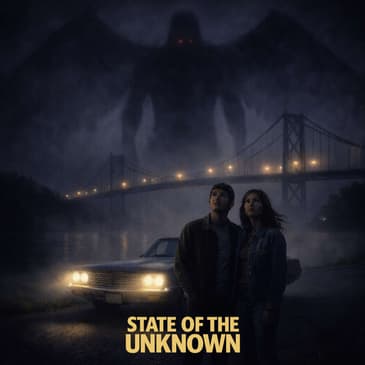

In November 1966, residents of Point Pleasant, West Virginia began reporting encounters with a tall, winged figure near the McClintic Wildlife Management Area, known locally as the TNT Area. Police documented statements. The local newspaper recorded names. Witness descriptions were consistent: a figure six to seven feet tall, wings folded behind its back, and red eyes reflecting in headlights.
Sightings continued for more than a year.
On December 15, 1967, the Silver Bridge collapsed during rush hour traffic, killing forty-six people. The official investigation concluded that the disaster was caused by a fractured eyebar, an internal structural crack that could not be detected through routine inspection.
There is no official finding linking the Mothman sightings to the bridge collapse. Yet the timing created a lasting association in the community. Reports stopped soon after the disaster.
In this episode, host Robert Barber examines the original police reports, the Indrid Cold encounter, the engineering findings behind the Silver Bridge collapse, and the tension between documented mechanical failure and repeated witness accounts.
Support State of the Unknown
If you enjoy the show and would like to help support it, you can become a Sasquatch Supporter for $3 a month. Your support helps cover the costs of researching and producing the show, website hosting, distribution, and helping more people discover State of the Unknown.
Membership is completely optional, and the show remains free for everyone.
Become a Sasquatch Supporter on Patreon
🔍 New episodes every Tuesday
🌐 Visit stateoftheunknown.com for show notes and to submit your own story.
📬 Questions, theories, or story ideas? Reach out at contact@stateoftheunknown.com or @stateoftheunknownpodcast.
Some stories don’t stay buried.
We go looking anyway.
Traffic is tight across the Silver Bridge. It's late afternoon, December 15, 1967. Cars are packed in both directions over the Ohio River, barely moving, inching forward only a few feet at a time. The heater's running. The windshield is starting to fog at the edges. You can feel the steady vibration of the engine through the steering wheel. Then the vibration changes. It gets rougher, more uneven. The truck in front of you dips at the rear, like the pavement under its tires just shifted. A deep metallic groan rolls through the steel above, loud enough that you feel it through the frame of your car. The lane ahead isn't level anymore. It's starting to slope, and the hood of your car tilts forward as the front end begins to sink. Horns start blaring up ahead, one after another, and you can hear brakes locking somewhere to your left as the steering wheel jerks hard in your hands. Outside, people start screaming. And then the bridge drops. During rush hour traffic, the suspension bridge connecting Point Pleasant, West Virginia to Gallapolis, Ohio collapsed into the Ohio River. Forty-six people died. What follows isn't about turning that tragedy into spectacle. It's about understanding what this town was already experiencing in the months before it happened. The official cause would later be traced to a fractured eye bar in the suspension chain, a small crack in a single piece of steel that, once it failed, brought the rest of the structure with it. In the days and weeks after the collapse, divers worked the river, engineers examined twisted steel, and families waited for confirmation. But when people in Point Pleasant looked back at the 13 months leading up to that afternoon, many of them remembered something else. Because the bridge wasn't the first unusual thing the town had been talking about. Those reports began in November of 1966. I'm your host, Robert Barber. In 1966, residents of Point Pleasant, West Virginia began reporting encounters with a large winged figure near an abandoned munition site outside town. Police took statements. Newspapers ran the story. Thirteen months later, the Silver Bridge collapsed. This is the story of the Mothman of Point Pleasant in the months leading up to the bridge.
SPEAKER_01:Let's get into it.
SPEAKER_00:On November 15, 1966, two young couples were driving outside Point Pleasant near the McClintock Wildlife Management Area. Most people still called it the TNT area. Back in World War II, it had been used to store munitions in concrete bunkers scattered through the woods. By the 60s, it was mostly quiet. Gravel roads, abandoned domes, and patches of trees. The kind of place people drove at night because it was dark and out of the way. They were heading down one of those roads when their headlights caught something near one of the concrete buildings. At first they thought it was a man, but as they got closer, they could see it was taller, around six or seven feet, and there was something rising behind its back. Later they told police it looked like wings folded along its body. When it shifted, the wings spread wide, wider than the road itself. What stood out most were the eyes. The headlights reflected red off them, not glowing on their own, but just catching the light. They didn't stop. As they drove past, the figure moved and lifted off the ground. They said it rose above the road and glided behind them without flapping its wings. They accelerated. It stayed with them for close to a mile. They could still see it in the rearview mirror, and when they reached the edge of town, it was gone. That first sighting happened on November 15th, 1966. The very next night, the couples went to the police. They told officers they had seen something large near the old munitions buildings at the McClintock Wildlife Management Area. They described it as taller than a man, with wings folded behind it and eyes that reflected red in their headlights. They said it followed their car and kept pace with them as they drove back toward town. Deputy Millard Halstead drove out to the site that same evening to look around for himself. He didn't report finding a creature standing there, but he did say he saw what appeared to be a large bird lift off near one of the buildings and disappear into the dark. By November 17th, the local paper had run the story, and within days more people began coming forward. A volunteer fireman reported seeing a large winged figure near the TNT area later that week. Two residents said they saw something flying low over Route 62 in the days that followed. One man claimed he watched a shape rise straight up into the air before vanishing. As November moved toward December, the reports didn't fade. They spread. Sightings were being described alongside roads outside town and in nearby communities. Descriptions weren't identical, but the size, the wings, and the red reflections kept coming back in account after account. By the end of the month, teenagers were driving out to the TNT area at night hoping to see something for themselves. Families talked about it at work and at home. And once the name Mothman appeared in print, it stuck. What had started as a single late-night encounter in mid-November was now a running story as winter settled in. And it continued into 1967. On November 2nd, 1966, about two weeks before the first TNT area sighting, a man named Woodrow Derenberger was driving home along Interstate 77 near Parkersburg. It was early evening. He was alone in his car. He later said a vehicle approached from behind at high speed. It passed him, then pulled in front of him and slowed down until he had to break. Derenberger described it as metallic and elongated, shaped differently than a normal car. He said it wasn't fully resting on the pavement. He claimed the object came to a stop ahead of him. A door opened, and a man stepped out. Derenberger said the man appeared to be around six feet tall, with dark hair and dark clothing. He described him as smiling the entire time. According to Derenberger, the man communicated without moving his mouth. He introduced himself as Indrid Cold, and he said it as if it were the most ordinary thing in the world. Derenberger said the figure told him he meant no harm and was simply exploring the area. After several minutes, the object lifted away and disappeared. Derenberger reported the incident the following day. Newspapers picked it up. In the weeks that followed, he claimed additional encounters. He said he saw the same figure again. He said he was shown images of another place. He said the contact continued. This was happening in early November. By mid-November, the TNT area sightings began. As December approached, both stories were circulating in the same region. Residents were reading about a winged figure near the munitions site and a man who said he had met someone who didn't seem human. The events weren't identical, but they were unfolding at the same time. As November turned into December, the sightings didn't fade. More people began describing similar things near the McClintock Wildlife Management Area. Drivers said something lifted off near the road when their headlights approached. A few mentioned red reflections in trees along Route 62. Through the winter of 1966 and into early 1967, the reports continued. Some said they saw a winged figure perched on rooftops. Others claimed something kept pace with their car along dark stretches of highway. The details varied, but certain elements kept showing up. The size, the wings, the eyes catching light. By early 1967, residents were calling the Point Pleasant Register often enough that reporter Mary Heyer began taking the calls herself. People described what they believed they had seen. She wrote it down. Some accounts ran in the paper, while others stayed in her notes. The conversations were happening in public. At the same time, other stories circulated too. Some residents said they received strange phone calls where no one spoke. A few described men in dark suits who asked questions about sightings and then left without explaining who they were. There were also reports of unusual lights along rural roads outside town. Not everyone believed any of it. Some dismissed it as a rumor. Others treated it as something strange but local. By the spring and summer of 1967, the name Mothman wasn't just a headline. It was something people associated with the town itself. The sightings continued through the fall. No physical evidence was recovered and no confirmed photographs surfaced. But the reporters didn't disappear. And as 1967 moved toward winter again, attention began to shift. Because in December, something happened that changed what people remembered most. On December 15, 1967, at 5.04 PM, the Silver Bridge collapsed during rush hour traffic. It connected Point Pleasant, West Virginia to Galapolis, Ohio, and carried steady traffic across the Ohio River every day. That afternoon, vehicles were backed up in both directions. When the structure failed, cars and trucks fell with it. Forty-six people died. In the days that followed, divers searched the river in freezing conditions while crews pulled twisted steel from the water. Engineers examined the wreckage. The official investigation determined that the collapse began with a fractured eye bar in the north suspension chain. The crack measured roughly one-tenth of an inch, smaller than a fingernail. It had developed inside the steel and was not visible during routine inspections at the time. When that single component failed, the load shifted suddenly to the remaining structure. The bridge was not designed with redundancy. Once the chain gave way, the rest followed in seconds. That became the final engineering conclusion. But in Point Pleasant, the collapse didn't exist in isolation. It happened 13 months after the first reports near the TNT area. It happened after a year of sightings, conversations, and local coverage about something unusual moving through the region. For some residents, the timing felt significant, but for others, it was coincidence layered onto tragedy. The bridge failed because of a structural flaw, but memory doesn't always separate engineering from atmosphere. And once the collapse became part of the town's history, the earlier reports were remembered differently. In the days after the bridge fell, Point Pleasant wasn't talking about sightings. It was talking about recovery. Divers were still in the river. Families were identifying vehicles pulled from the water. Funerals were being scheduled. Federal investigators were on site examining twisted steel and reviewing inspection records. For a while, that was all anyone focused on. And during that time, the Mothman reports that had filled the previous year began to thin out. Fewer calls came into the paper. Fewer accounts surfaced from the TNT area. Some residents later said the sighting stopped after the collapse, while others said people simply stopped looking. There was no official connection drawn between the bridge failure and the earlier reports. But when people looked back on that year, they didn't separate it into two neat categories. They remembered it as one stretch of time that never quite settled. A year of strange reports, followed by a bridge that came down. While Point Pleasant was still dealing with the aftermath of the collapse, the earlier reports didn't simply fade into the background. They were being revisited. John Keel had already spent time in the region during the height of the sightings in 1966 and 1967. He had interviewed residents who said they saw something near the McClintock Wildlife Management Area. He'd been in contact with Mary Heyer at the Point Pleasant Register, who kept notes from callers throughout that year. He compared dates, locations, descriptions. He looked for overlap. Keel wasn't treating the sightings as a simple creature story. He was interested in why unusual reports seemed to cluster, why certain areas experience concentrated waves of strange accounts, and why those waves sometimes surround moments of disruption. In his view, the winged figure, the strange lights along rural roads, the phone calls some residents described in the encounter Woodrow Derenberger reported were all occurring within the same narrow window of time in the same geographic area. That convergence, to him, mattered. When he published the Mothman Prophecies in 1975, he didn't present a neat explanation. He suggested that what happened in Point Pleasant might reflect a broader pattern, that anomalies sometimes surface around communities during periods of stress or change. By the time the book reached a national audience, the collapse of the Silver Bridge was already inseparable from the earlier reports in public memory. The events had fused together, not through engineering analysis, but through narrative. And once that fusion happened, the story stopped belonging only to Point Pleasant. The engineering report closed the case on the bridge. That part is settled. What isn't settled is how the year before it feels. For 13 months leading up to December of 1967, people in the same region were reporting something unusual. Police took statements. The local paper logged calls. Mary Heyer kept notes. Residents described a winged figure near the McClintick Wildlife Management Area or the TNT area. Woodrow Derenberger described an encounter on a highway with someone who called himself Indrid Cold. Those accounts existed before the collapse. After the bridge fell, something changed. When tragedy hits, people look backward. We scan the months before it for signals we might have missed. We search for warning signs because randomness feels harder to live with than meaning. That's where prophecy takes root. Not because there's evidence a creature caused the structural failure, but because the human mind connects events that cluster close together in time. Sightings in late 1966, strange encounters, newspaper coverage increasing, then a catastrophic collapse in December of 1967. Once those events share a timeline, they stop feeling separate. In amplification matters. When the first reports were printed, more people came forward. When John Keel published the Mothman Prophecies in 1975, the story expanded beyond West Virginia. The creature and the collapse fused into a single narrative in public memory. Engineering explains how the bridge failed. Psychology explains why the year feels connected. What neither explanation resolves is what those early witnesses believed they saw. You can argue misidentification. Sandhill cranes live in the region. In low light, their wingspan can look unfamiliar. You can argue expectation shaping memory. You can argue stories reinforcing other stories. All of those explanations are plausible. But something was reported repeatedly before the tragedy. The bridge collapse has a measurable cause. The rest depends on interpretation. And that's where the tension remains. The thing about this case is that it forces you into a position. You don't really get to stay neutral. If you're skeptical, there are clean explanations available. Like a large bird in low light. Or a small town where stories spread once the newspaper starts printing them. A man who had an experience that felt real to him, but maybe wasn't physical in the way that he understood it. Those explanations make sense. In the bridge? That explanation is solid. A fractured eye bar. A design that didn't allow for redundancy. Steel failed and the structure followed. There's nothing mystical about metallurgy. But here's what doesn't disappear. The sightings were reported before the collapse. They were written down. Police responded. A newspaper logged the calls. This wasn't something invented afterward to cope with tragedy. And the descriptions? A tall figure, wings folded behind it, red reflections and headlights, all showed up more than once.
unknown:That doesn't
SPEAKER_00:Prove a creature existed. But it does mean people believe they saw something. And then there's injured cold. You can dismiss that one entirely. Lots of people do. But it happened in the same region, in the same narrow window of time, just weeks before the first TNT reports. That's what lingers. Not prophecy and not proof, just proximity. When unusual reports stack up inside a short stretch of time, and then there's something catastrophic that happens, the human mind wants a thread to connect them. Sometimes there is one. Sometimes there isn't. The bridge failed because of steel. That part is measurable. But that doesn't automatically erase the year that came before it. For more than 12 months, residents believed something unusual was moving through their town. Maybe it was misidentification. Maybe it was suggestions spreading through a community. Maybe it was something we don't yet have language for. I don't know. What I do know is that we like the world to feel closed and explained. And sometimes it just isn't. Point Pleasant had documented anomaly and documented engineering existing at the same time. One can be reduced to a fraction of an inch inside a piece of steel. The other still sits open.
SPEAKER_01:And that is uncomfortable.
SPEAKER_00:This has been State of the Unknown. The events in Point Pleasant are part of the historical record. Documented sightings, documented engineering failure, and documented loss. What those events mean is still open to interpretation. If you've been enjoying the podcast, leaving a rating or review in your podcast app really does help more people find it. On Spotify, it's just a tap of the stars. And on Apple Podcasts, you can even leave a short written review. I read them all and I appreciate everyone. If you know of a case that would make a great episode, you can tell me about it at state of the unknown.com slash contact. Until next time, stay curious, stay unsettled, because the world doesn't wait for us to understand it.