
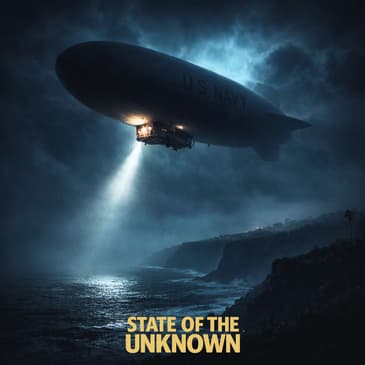

The L-8 Ghost Blimp is one of the strangest unsolved aviation mysteries of World War II — a Navy patrol airship that returned from a mission over the Pacific with its engines running and its crew missing.
In August of 1942, a U.S. Navy patrol blimp lifted off from Naval Air Station Treasure Island for what should have been a routine anti-submarine patrol along the California coast.
Hours later, the aircraft drifted inland over Daly City.
The engines were still running.
The controls were still set for flight.
But the control cabin was empty.
The blimp, known as L-8, had returned from its mission without the two officers flying it.
Earlier that morning, Lieutenant Ernest Cody and Ensign Charles Adams radioed that they were investigating a suspicious oil slick near the Farallon Islands, a possible sign of a Japanese submarine operating off the West Coast during World War II.
That transmission would be the last confirmed contact with the aircraft.
In this episode, join host Robert Barber as he examines one of the strangest aviation mysteries of the war: the case of the L-8 Ghost Blimp, a patrol airship that continued flying after its crew disappeared.
Investigators searched the ocean west of San Francisco for days.
They never found the men.
So what actually happened aboard the L-8 that morning?
Did the crew fall while investigating the oil slick?
Did something go wrong during the patrol?
Or is there another explanation for how two trained Navy officers vanished from an operational aircraft?
This is the story of the L-8 Ghost Blimp.
Support State of the Unknown
If you enjoy the show and would like to help support it, you can become a Sasquatch Supporter for $3 a month. Your support helps cover the costs of researching and producing the show, website hosting, distribution, and helping more people discover State of the Unknown.
Membership is completely optional, and the show remains free for everyone.
Become a Sasquatch Supporter on Patreon
🔍 New episodes every Tuesday
🌐 Visit stateoftheunknown.com for show notes and to submit your own story.
📬 Questions, theories, or story ideas? Reach out at contact@stateoftheunknown.com or @stateoftheunknownpodcast.
Some stories don’t stay buried.
We go looking anyway.
A Blimp Lands Without Crew
SPEAKER_00Late in the morning on August 16, 1942, a Navy patrol blimp drifts inland over the hills south of San Francisco. People notice it because it's flying too low over Daly City, sliding across rooftops while losing altitude. Patrol blimps fly this coastline every day during the war, but something about this one doesn't look right. The aircraft is moving slowly, and the small control cabin hanging beneath the blimp is swinging closer to the ground. Inside that cabin should be two officers from Naval Air Station Treasure Island. Lieutenant Ernest Cody and Ensign Charles Adams lifted off earlier that morning on a routine anti-submarine patrol along the California coast. As the blimp drifts towards Bellevue Avenue, the cabin scrapes across a hillside and the airship's fabric envelope catches power lines. The aircraft jerks sideways and settles against a slope with the large gray balloon sagging behind it. Residents run toward the aircraft, expecting to find two Navy officers still inside. One of the first people to reach the blimp climbs up on the cabin and pulls open the door. The controls are still set for flight. The engines have been running moments earlier. The radio equipment is still in place. The two parachutes hang inside the cabin where the crew left them. But the seats are empty. The patrol blimp has come back from its mission. The men flying it have not. The aircraft came down in Daly City, just south of San Francisco, on the morning of August 16th, 1942. Inside the control cabin should have been two officers from the Naval Air Station Treasure Island, Lieutenant Ernest Cody and Ensign Charles Adams. But when residents reached the blimp and opened the cabin door, the seats were empty. The aircraft had returned from its patrol without its crew. And this was not a routine flight. In the summer of 1942, the West Coast was on constant alert for Japanese submarines. That morning, Cody had radioed that the L8 had spotted something unusual in the water off of the Faryland Islands, an oil slick. Then the radio went silent. A few hours later, the blimp drifted inland and landed in Daly City with no one inside. The aircraft was still operational, and the two officers flying it were gone. This is the story of the L8 ghost blimp and one of the strangest wartime aviation mysteries in American history. Let's get into it. On the morning of August 16th, 1942, the patrol blimp L-8 lifted off from Naval Air Station Treasure Island in the San Francisco Bay. The flight was part of the Navy's coastal patrol program during the early months of the war. Patrol blimps like the L-8 spent their days moving slowly along the California shoreline, scanning the water for anything that might indicate the presence of a submarine. The aircraft itself was a small Navy airship about 150 feet long, filled with helium and powered by two engines mounted beside the control cabin. Suspended beneath the envelope was the gondola, the small control cabin where the crew operated the aircraft, monitored radio traffic, and carried out patrol duties. That morning, the crew consisted of Lieutenant Ernest Cody, the pilot, and ensign Charles Adams, who had joined the squadron only weeks earlier. Shortly after takeoff, the L-8 headed west toward the Pacific and began its patrol route along the coastline near the Farallon Islands, a rocky group of islands about 30 miles offshore from San Francisco. The patrol began normally. The weather was clear, visibility was good, and nothing unusual had been reported in the area that morning. Then, at 7.38 a.m., Lieutenant Cody radioed the base at Treasure Island to report that the L-8 had spotted an oil slick about four miles west of the Farallon Islands. During wartime patrols, an oil slick wasn't treated as random debris. It could indicate fuel leaking from a submarine beneath the surface. Standard procedure in that situation was to descend to a lower altitude and mark the location so naval vessels or aircraft could investigate further. The L8 began maneuvering toward the slick. The radio report at 7.38 a.m. would be the last confirmed transmission from the aircraft. When the blimp appeared over Daly City later that morning, drifting inland with no one inside the control cabin, investigators would try to determine what had happened during the time between that final message and the moment the aircraft reached land. The answer has never been confirmed. When the L8 reached the area west of the Fairlone Islands, Lieutenant Cody had already reported the oil slick to base. From that point, the patrol would have shifted from routine observation to investigation. Navy patrol blimps were designed for this exact kind of work. Unlike airplanes, they could slow down to a crawl and descend close to the surface of the water while the crew studied what was happening below. If the slick had come from a submarine, the crew would be looking for several things. They might try to spot up movement beneath the surface, watch for bubbles rising through the water, or look for debris that suggested damage to a vessel below. The L-8 was also equipped to mark a suspected submarine location so other aircraft or ships could investigate. Inside the control cabin were smoke markers and flares that could be dropped into the water. When one of those markers hit the surface, it would release a thick plume of colored smoke that could be seen from miles away. Dropping those markers required opening the cabin door. One crew member would handle the aircraft while the other leaned out far enough to release the device so it would fall clear of the gondola and into the water below. Investigators later believed the L8 had descended to a very low altitude while the crew examined the slick. At some point during that maneuver, the cabin door appears to have been opened. When the blimp was recovered in Daly City later that morning, the door was still open. That detail became central to the Navy's explanation of what might have happened. If one of the officers leaned out to drop a marker and lost his footing, the other might have tried to grab him. In that scenario, both men could have been pulled out of the aircraft. But that explanation immediately raised questions. Both parachutes were still hanging inside the cabin, and the blimp itself didn't crash immediately. Instead, it continued flying. By the time the L8 reached the coastline again later that morning, something had already gone wrong. Residents in Daly City began noticing the aircraft because it was flying far lower than the patrol blimps that normally moved along the coast during the war. Instead of remaining offshore, the airship drifted inland over the hills south of San Francisco. Several witnesses later told investigators that the aircraft didn't appear to be under normal control. The blimp moved slowly with the wind, and the gondola swung beneath the large gray envelope as it crossed over rooftops and telephone lines. People on the ground tried to see into the control cabin as the aircraft passed overhead. More than one witness later reported the same observation. They couldn't see anyone inside. The drifting aircraft continued inland until it struck a hillside near Bellevue Avenue in Daly City. The gondola scraped across the slope and the envelope tore where it caught nearby power lines before the blimp settled against the hillside. Residents who had been watching the descent began moving toward the aircraft almost immediately. One of the first people to reach the gondola climbed into the cabin and pulled open the door. There was no crew inside. Within minutes, several other residents confirmed the same thing, and local authorities contacted the Navy to report that one of its patrol blimps had come down inside the city. When Navy personnel arrived and began examining the aircraft, they documented several details that complicated the situation. Both parachutes assigned to the crew were still hanging inside the cabin, and the door to the gondola remained open. Investigators also discovered that the aircraft's emergency life raft was missing. The L-8 carried that raft in case the crew needed to ditch in the ocean during a patrol. At first, investigators believed the missing raft might indicate that one of the officers had deployed it after someone fell into the water while the aircraft was investigating the oil slick earlier that morning. But search efforts later failed to locate that raft anywhere along the patrol route. Search crews also failed to locate either of the two officers. As investigators reconstructed the flight, one fact became impossible to ignore. The aircraft had continued flying after its final radio transmission. Yet Lieutenant Ernest Cody and Ensign Charles Adams had disappeared somewhere between the moment the oil slick was reported and the moment the blimp drifted over Daly City. When the Navy learned that one of its patrol blimps had come down in Daly City, personnel from Naval Air Station Treasure Island quickly moved to secure the aircraft and begin reconstructing the flight. At the same time, the Navy began searching the waters west of San Francisco where the L-8 had reported the oil slick earlier that morning. The last confirmed radio transmission from the blimp had come at 7.38 a.m. while the aircraft was near the Fairlong Islands. Investigators therefore concentrated their search efforts along the patrol route between the Fairlands and the California coast. Ships and aircraft moved into the area to look for any sign of the missing officers. Search crews scanned the ocean for parachutes, debris, or the emergency life raft that had been carried inside the gondola. They found none of those things. The search also included the possibility that one or both of the officers might still be alive. If a crew member had fallen into the water while the blimp was flying at low altitude, there was at least a small chance he could have reached the shore. Coastal areas and nearby islands were checked for any signs of survivors. No trace of either officer was found. While the search continued offshore, investigators at Daily City focused on the aircraft itself. The L-8 had not suffered catastrophic damage during its landing. The envelope had torn when the blimp struck power lines in the hillside, but the gondola remained largely intact and the flight instruments were still in place. The condition of the controls suggested that the aircraft had continued operating after the crew disappeared. Witnesses had reported hearing the engines running as the blimp drifted over Daly City, which indicated the engines had remained active until shortly before the aircraft reached the hillside. With no one inside the gondola to control the craft, the blimp likely continued flying for some time before gradually drifting inland on the prevailing wind. That drift eventually carried the aircraft across the coastline and over the city. By the time it descended into Daly City, the blimp had traveled many miles from the location where the oil slick had been reported earlier that morning. The Navy eventually concluded that whatever had happened to the crew must have occurred somewhere near that earlier patrol location west of the Farallon Islands. Despite the search efforts and the examination of the aircraft, investigators were never able to determine exactly how or when Lieutenant Ernest Cody and Ensign Charles Adams disappeared from the L8. Their bodies were never recovered. When you strip this case down to what can actually be documented, several things are clear. The L-8 launched normally from Naval Air Station Treasure Island on the morning of August 16, 1942, with Lieutenant Ernest Cody and Ensign Charles Adams aboard. At 7.38 a.m., Cody radioed base to report an oil slick west of the Farallon Islands. Later that morning, the blimp drifted inland and came down in Daly City with no crew inside the control cabin. Those points are not disputed. The uncertainty lies in the gap between the oil slick report and the moment the aircraft appeared over land. That's the window where whatever happened to Cody and Adams must have occurred. From there, the evidence divides into two parts: what investigators found in the aircraft and the explanation they proposed to account for it. The condition of the blimp is what keeps this case unsettled. The aircraft didn't break apart in the air and it didn't crash violently into the ocean. Instead, it continued flying long enough to drift inland over Daly City. Witnesses reported hearing the engines running as the blimp passed overhead, and investigators concluded the aircraft had remained operational after the crew disappeared. Inside the gondola, the radio equipment was still functional and the flight controls showed no evidence of an emergency shutdown. Two parachutes assigned to the crew were still hanging where they'd been stored before the patrol began. The cabin door was open. The emergency life raft was missing, and no bodies were ever recovered. Those details formed the core of the mystery. The Navy's explanation focused on what might have happened during the investigation of the oil slick. Blimp crews investigating possible submarine activity often had to open the cabin door to drop smoke markers into the water. Investigators believe that while performing that task, one of the officers may have leaned too far outside the gondola and fallen into the ocean. The second officer might have attempted to grab him and gone overboard as well. With no one left inside to control the cabin, the blimp could have continued flying unattended until winds eventually carried it inland. That explanation fits several elements of the case. It accounts for the open door and it explains how the aircraft could have remained airborne long enough to reach Daly City. But it also leaves questions. Both parachutes remained inside the cabin, which strongly suggests the crew did not intentionally abandon the aircraft. The missing life raft adds another layer of uncertainty. Its absence might indicate that one of the officers tried to deploy it after someone fell into the water, but no raft was ever recovered, and there was no confirmed evidence that it had been used. Timing also complicates the accident scenario. For that explanation to work, both men would have had to have left the aircraft within moments of each other while conducting the investigation. That means the second officer would have had almost no time to react, send a distress call, or secure the aircraft before he also went overboard. That sequence is possible, but it was never confirmed. The open cabin door points in the same direction. It supports the idea that the crew had been working near the doorway during the investigation of the oil slick. At the same time, the door itself doesn't reveal when it was opened or exactly what happened once it was. It is consistent with the accident explanation, but it doesn't prove it. The wartime setting also matters here. In the summer of 1942, anti-submarine patrols along the west coast were taken seriously because Japanese submarines had already attacked targets along the shoreline. Oil slicks were investigated because they could indicate a damaged submarine beneath the surface. That context explains why the L-8 descended toward the water and why the crew may have been working near an open door during the patrol. It also explains why more dramatic theories appeared later. Some people suggested enemy involvement or a submarine encounter. There's no evidence supporting those ideas. They exist because the case leaves room for speculation, not because the record points there. When investigators reviewed the evidence, the most practical explanation remained the accidental fall scenario. But the evidence never proved that sequence with certainty. The blimp's continued flight is easier to explain than the disappearance itself. Patrol airships like the L-8 were equipped with a simple autopilot system that could hold heading in altitude. If that system was engaged when the crew disappeared, the aircraft could have continued flying on its own while the engines kept running. With no one at the controls to correct its course, wind and fuel conditions could gradually push the airship inland until it eventually descended over Daly City. The harder question is the moment before that. How did two trained Navy officers disappear from an operational aircraft without sending a distress call and without leaving clear evidence of what happened? The official explanation answers that question in theory. It just never resolved it completely. And that unresolved gap is why the LA patrol blimp is still remembered as the ghost blimp. Not because it proved something extraordinary happened, but because the explanation that fits the evidence was never conclusively demonstrated. Stories like this tend to get pulled in two directions. One direction pushes the mystery as far as it will go. The other direction tries to shut it down as quickly as possible with the simplest explanation available. The L-8 case sits somewhere in the middle of those two impulses. If you look at the mission itself, nothing about it was unusual. Two Navy officers lifted off from Treasure Island and flew a routine anti-submarine patrol along the California coast. At 738 in the morning, they reported an oil slick near the Farallon Islands and descended to investigate it. Everything about that sequence makes sense. Where the story becomes difficult is the next part. The explanation that investigators arrived at. At is not unreasonable. If the crew was working near the open cabin door while dropping markers, an accident could have happened quickly. One man falls, the other reacts, and suddenly the aircraft is empty. That sequence is possible. But the reason the story still lingers is that the evidence never shows exactly when that moment occurred or how it unfolded. There was no distress call. There was no confirmed sighting of the crew in the water. Their parachutes remained inside the gondola. Their bodies were never recovered. So the case sits in a strange place where the explanation that makes the most sense still leaves a gap in the record. It doesn't prove something mysterious happened. It simply means that the final moment of the patrol was never fully reconstructed. Sometimes that's how real events end up being remembered. Not because the explanation is impossible, but because the evidence stops just short of confirming it. Two officers launched on a routine patrol. Their blimp came back. They did not. And that is the part of the story that has never been settled. This has been State of the Unknown. The disappearance of Lieutenant Ernest Cody and Ensign Charles Adams remains one of the strangest unsolved incidents in American wartime aviation. A patrol blimp launched on a routine mission, reported an oil slick off the California coast, and hours later drifted inland with no one inside the control cabin. The aircraft came back. The crew never did. If you're enjoying these stories, leaving a rating or review in your podcast app really does help more people find the show. On Spotify, it's just a tap of the stars. And if you're listening on an iPhone, you can leave a short written review right in the Apple Podcast app. I read them and I really do appreciate everyone. And if you want to make sure that you hear the next story when it drops, just hit follow in your podcast app so the next episode shows up automatically. Until next time, stay curious. Because sometimes the strangest stories are the ones where the facts are all there and the answer still isn't.