
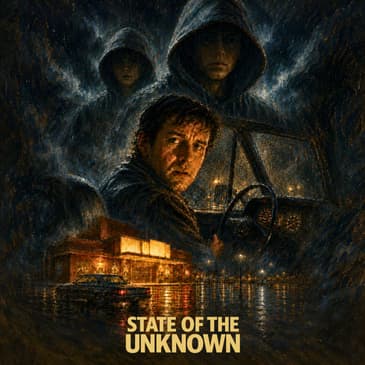
Join host Robert Barber as he examines one of the most unsettling modern paranormal phenomena: reports of Black Eyed Children, mysterious children whose alleged encounters have become a lasting part of modern ghost stories, supernatural folklore, and unexplained encounters.
The story begins with a reported paranormal encounter in Abilene, Texas, where journalist Brian Bethel claimed two mysterious boys approached his car late at night and repeatedly asked to be let inside. What happened next would become the foundation of the Black Eyed Children phenomenon, spreading through paranormal communities, online forums, and reported sightings across the United States.
In this episode of State of the Unknown, we explore the original Brian Bethel encounter, reported Black Eyed Children sightings from Portland and beyond, the recurring themes that appear throughout these strange encounters, and the evidence behind the claims.
Are Black Eyed Children examples of supernatural or paranormal encounters? Folklore evolving in the internet age? Misunderstood experiences? Or something stranger?
You’ll hear the reported stories, the documented origins of the phenomenon, and a breakdown of what holds up, what doesn’t, and why these unexplained paranormal reports continue to fascinate people decades later.
Topics in this episode include:
• Black Eyed Children
• Brian Bethel’s Abilene, Texas encounter
• Black Eyed Children sightings
• Reported paranormal and supernatural encounters
• Modern folklore and urban legends
• Witness testimony
• Internet-era paranormal phenomena
• Threshold and invitation folklore
• Unexplained encounters
• Paranormal investigation
Support State of the Unknown
If you enjoy the show and would like to help support it, you can become a Sasquatch Supporter for $3 a month. Your support helps cover the costs of researching and producing the show, website hosting, distribution, and helping more people discover State of the Unknown.
Membership is completely optional, and the show remains free for everyone.
Become a Sasquatch Supporter on Patreon
🔍 New episodes every Tuesday
🌐 Visit stateoftheunknown.com for show notes and to submit your own story.
📬 Questions, theories, or story ideas? Reach out at contact@stateoftheunknown.com or @stateoftheunknownpodcast.
Some stories don’t stay buried.
We go looking anyway.
Cold Open At The Window
Brian Bethel kept one hand near the steering wheel as he looked through the cracked window at the two boys standing beside his car. He was parked outside the movie theater in Abilene, close enough to the marquee light that he could use it to write a check. The car was still running. The lot around him was quiet in that late night way where every small sound seemed closer than it should. It should have been an ordinary stop. A few minutes in the car, then back on the road. But the boys were still there, standing close to the driver's side window. The older one did the talking. He said they needed a ride home. He said they wanted to get money so they could see the movie. His voice stayed calm, almost too calm. And every time Brian tried to make sense of the request, something about it didn't fit. The movie had already started, but the boys didn't look panicked, and they weren't acting like kids who had simply missed a ride. Brian kept the window cracked. He could hear them well enough, but there was still glass and metal between them. A cracked window made the conversation possible. It also kept the boys outside the car. For a moment, that distance felt important. The older boy leaned a little closer and told him it wouldn't take long. They just needed to get inside. Brian glanced toward the theater, then back toward the boys. He tried to place the feeling. Maybe it was the way they stood so still. Maybe it was the way the older one kept talking while the younger one said nothing. His mind was still looking for a normal explanation, but his body had already decided this was wrong. His chest tightened as the boy kept talking. Then Brian looked down and saw his fingers moving toward the door lock. Some paranormal stories begin in old houses, abandoned buildings, or places that already have a reputation. This one begins in a parking lot. A man sitting in his car trying to finish a normal errand when two children ask for something that should sound harmless. A ride, a little help, a quick favor. But in the accounts that followed, the fear wasn't only in what the children looked like. It was in the way they asked, and in how close they came to the line between outside and inside. A door, a window, a threshold. In the feeling that something was waiting for permission.
The Legend Behind The Reports
I'm your host, Robert Barber. Tonight, we're looking at one of the strangest reported encounter patterns to come out of the early internet era. It starts with the named witness in Texas, then moves through reports, retellings, and people who claimed they had seen the same kind of thing. Children with black eyes, quiet voices, simple requests, and witnesses who said they felt fear before they understood why. This is the story of the black-eyed children. The witness reports behind a modern fear. And this is State of the Unknown. According
Brian Bethel In Abilene Texas
to Brian Bethel, the night began with an errand he didn't expect to remember for the rest of his life. He was living in Abilene, Texas, and he needed to pay his internet bill. The office for his internet provider had moved, but there was still a drop box at the old location in a shopping center downtown. So he drove there that night, pulled into the lot, and stopped near a movie theater. The theater gave him enough light to write. Bethel said he parked close enough to the marquee that he could use the glow while he filled out the check. Inside the car, everything was normal. The engine was running. The bill was in front of him, and he had one small task to finish. It was the kind of thing people did all the time before online payments became normal. You'd drive somewhere after hours, fill out the payment, drop it in the box, and go home. Then came the knock. Bethel looked toward the driver's side window and saw two boys standing outside the car. They looked young, somewhere between childhood and early teenage years. One stood slightly forward and did almost all the talking, while the other stayed quieter, watching from beside him. At first, Bethel thought they probably wanted money. He cracked the window just enough to hear them. The car door stayed locked, the window stayed low. There was still a narrow space between him and the boys outside. The older boy told him they needed a ride home. They wanted to see a movie, but they had forgotten their money. If Bethel would drive them home, they could get it, come back, and make the show. On the surface, the request was ordinary enough. Two kids needed help. They were outside a theater and they said they had missed one step in an otherwise normal plan. But Bethel said something in him reacted before he could explain it. The boy's voice was calm, too calm. His words came out with a confidence that didn't fit the situation. He didn't sound embarrassed and he didn't sound nervous about asking a stranger for help. The younger boy barely said anything, which made the older one's control of the conversation feel even sharper. Bethel asked what movie they wanted to see. The boy said Mortal Kombat. Bethel looked toward the marquee and checked the time. The movie had already started, and according to his account, it had been playing for about an hour. It was also the last showing of the night, so the explanation didn't work. They didn't seem rushed or upset. They weren't acting like two kids who had just realized their night was falling apart. They were still standing there, pressing for the same thing. Bethel kept trying to make the scene normal. He had a request in front of him that sounded simple, and yet his body was responding as if he had already missed the real danger. He described a sudden fear that felt bigger than anything he could see. The older boy kept talking. He told Bethel
The Strange Pull Toward The Lock
it wouldn't take long. They just needed to get in. And with the window still barely open and the boys still outside, Bethel looked down and realized his hand was moving toward the lock. He hadn't decided to unlock the door and he hadn't chosen to let them in. But his hand was moving anyway. Bethel pulled his hand away. The boys were still outside the car, the engine was still running, the theater light was still reflecting across the glass. But now Bethel wasn't only watching what they were doing, he was watching himself. He had been trying to understand the fear through the parking lot, the movie theater, and the boys asking for a ride. Once he saw his own fingers moving toward the lock, the fear was no longer just a reaction to two strangers standing outside. Something about the moment had reached him inside the car. Then he looked at the boys again. In his account, that's when he saw their eyes. They were completely black. No visible whites, no iris, no ordinary place for his eyes to land, just dark eyes reflecting the light from the theater marquee. The older boy's manner changed. Bethel described him becoming angry or at least more forceful, as if he knew the moment was slipping away. The request stayed simple, but the pressure behind it was harder to ignore. They needed to come in. They couldn't come in unless Bethel said it was okay. The boys were close to the car, speaking through the opening in the window and asking for access. Bethel still had the wheel in front of him. He still had the lock beside him, and the older boy was still waiting for him to say yes. Bethel shifted the car into a reverse. After that, everything moved quickly. He backed out of the parking space and drove away from the theater. When he looked back, the boys were gone. He didn't describe it like a flash or a vanishing act. It was simpler than that. He left the space, looked back toward where they had been, and they weren't there anymore. He drove home shaken. Once he was inside, the fear was still on him. He'd gotten away from the parking lot, but the encounter had followed him home in another form. The boys weren't outside his window anymore, but the memory of that window was still there. The opening, the request, and his hand moving toward the lock. When Bethel told people what had happened, one early reaction connected
Permission Fear And The Aftershock
the encounter to something older. A friend reportedly suggested the boys seemed almost vampire-like because of the way they asked to be let in. That comparison stayed with the story. The boys weren't described with fangs or anything theatrical. The connection was about rules. In old vampire traditions, danger can stand outside and speak, but it needs invitation. People could picture that rule at Bethel's car window. Two children outside, a witness inside, a locked door between them, and one sentence that kept danger from crossing the line until Bethel allowed it. They needed permission. After the encounter, Bethel told the story. At first, that meant telling people he knew. He had an experience he couldn't make sense of, and he did what people often do after something frightening and strange. He tried to say it out loud to someone else. In one account, he described being on the phone with his friend Chad while other people were also on the line. Bethel said he began telling them what happened in Abilene, but he hadn't yet mentioned the boy's eyes. Before he got to that part, a woman on the call interrupted and asked whether the children had black eyes. For Bethel, that stopped the story in place. He hadn't said that detail yet. He hadn't described the moment when he looked back at the boys and saw the blackness in their eyes, but someone else had already named it. The woman reportedly told him she dreamed about children with black eyes outside her own home. In the dream, they wanted to be let in, and she believed that she had to keep the doors and windows closed. That wasn't another parking lot encounter. It was a dream. But the same shape was there: children outside, a protected space inside, and a closed door between them. Then
How The Internet Spreads The Story
Bethel's account moved into places stories were starting to move in the late 1990s and early 2000s. Someone read it online. Someone repeated it in a ghost story space. Someone else carried into another paranormal discussion. The account moved from screen to screen until the details became easier to recognize than the man who said he had lived through them. Bethel later wrote about people asking him whether he had heard the story of the man who saw black-eyed kids outside his car. They were asking the man from the story if he knew the story. The account had traveled far enough that it could come back to him as if it had belonged to someone else. And as it moved, certain parts stayed attached. The children, the black eyes, the request, and the need to be allowed in. There was no sheriff's office taking calls across one night, and no family gathered in one house while investigators walked through the rooms. The movement happened through people reading alone, telling friends, posting replies, and recognizing the same pressure in other reported encounters. The original parking lot stayed at the center, but the story no longer stopped there. In
Portland Garage And The Handle
another account from Portland, Oregon, the same fear appeared in a different physical space. A man named John Northwood reportedly described what happened after a software development seminar in downtown Portland. It was late, around the end of the evening, and John was in an above-ground parking garage. He had started his car, locked himself in, and was getting ready to leave. Then someone tapped on his window. This time it was a man from the seminar, identified in the account as Doug. He was scared and he wanted help. Doug said there were young people near his car. John let him in. Now there were two adults inside a locked car, looking toward another vehicle in the garage. John drove past Doug's car and saw three young people nearby. The girl seemed detached from the moment, while the two boys were focused. The boys moved towards John's car. John checked the locks. In Abilene, Bethel's hand had moved toward the lock before he fully understood the danger. In Portland, John reportedly made sure the locks were engaged because the danger was already close enough to name. The boys approached on both sides of the car. One asked for a ride home. Another said Doug had promised to help them. Doug denied knowing them. Inside the vehicle, the situation tightened. John had Doug in the passenger seat. The boys were outside, and the garage gave the whole scene a closed-in feeling, with concrete levels, parked cars, and limited space to maneuver. Then, Doug reportedly reached toward the car handle. John told him not to get out. The danger was outside, but the movement that might let it in began inside the car. Someone in the protected space reached toward the boundary. John then reported seeing the boy's eyes. They were black. He reversed the car away from them, moving backward through the garage as the boys came after the vehicle. According to the account, one of them appeared near the garage exit before John could fully get away, close enough that the movement through the structure seemed wrong. The account didn't end in the garage. After John and Doug left, the story attached one more claim to that night. Doug was later killed in a traffic collision. Even before that final claim, the Portland Garage Account had already repeated the shape: a locked car, young figures outside, a request for help, a door handle becoming the point of danger.
A Wet Street Outside The Hostel
A second Portland report placed the same fear on a wet street outside a hostel. This one came from a poster using the name Harvest Wind. In that account, the witness was staying at a hostel on Gleason Avenue with his girlfriend and other travelers. Around 2.30 in the morning, he left to retrieve wine from a parked car several blocks away. The scene was different from Bethel's parking lot, but the movement was familiar. A person alone, a normal errand, a young stranger appearing where he shouldn't quite be. The witness said he reached the car and put the key into the trunk when a voice called out behind him. Hey, mister, he turned and saw a boy a few feet away. The boy said he was lost and asked for a ride to his mother's house. The witness noticed that the words suggested fear, but the boy didn't look afraid. As the boy came closer, the witness saw the black eyes. He backed away. The boy said his friends were coming. Farther down the road, the witness saw two more figures, another boy and a girl, and he ran back toward the hostel. When he got back, he didn't tell the others what he had seen. He reportedly said thugs had tried to start a fight. Then he closed the window and the curtains and didn't sleep. That reaction feels human. He didn't return with proof, gather a crowd, or turn the moment into an investigation. He came back scared and gave people a more believable explanation than the one he believed himself. The stories kept moving through moments just like that. A person alone, someone young approaching, a request that sounded normal until it didn't. And afterward, a fear that sounded unreasonable once spoken aloud. As more black-eyed children's stories circulated, the places changed, but the pressure often stayed close to a threshold. A car
The Pattern Across Ordinary Places
window after dark, a front door at night, a quiet street where someone had only stepped outside for a few minutes. The details didn't always match and the strength of the reports varied, but the same basic movement kept appearing. Children or teenagers approach an adult. They ask for something simple. The witness feels something wrong before the situation becomes openly threatening. Then the eyes are noticed. Fully black, unreadable, wrong in a way that is hard to soften once the image has been named. The reports kept returning to ordinary American spaces. A shopping center after dark could become a place where a man refuses two boys a ride. A parking garage after a seminar could become the place where a locked car feels like the only safe room available. And a wet city street could become the place where someone leaves a hostel for a quick errand and comes back without telling the truth about why he ran. The black-eyed children didn't need an abandoned mansion or a hidden road with a local warning attached to it. They appeared in places people already knew how to imagine. Places with windows, locks, sidewalks, in a few seconds to decide whether someone should be allowed closer. The era mattered too. The early internet gave strange accounts a new kind of movement. A story could leave the person who told it and travel through message boards, mailing lists, and paranormal forums. Readers could encounter it late at night, remember the details, and pass it along to someone else. A person could read Bethel's account in one place, hear another version somewhere else, and later see the same details return in a new report from a different city. A child asks for help, the adult feels they should respond. The story turns that instinct against the witness. It makes kindness feel dangerous. Over time, people attach different explanations to the children. Some connected them to vampires because of the invitation rule. Others described them as demonic, ghost like, or something that only appeared human. But in the reports, people remembered the encounter itself. Stayed simple. Someone young appears. The request sounds normal. The feeling does not. Then the eyes change everything. By the time the black-eyed children had become a known phenomenon, the account no longer belonged only to one car window in Abilene. Other people were telling stories with the same pressure point, and the pressure point was always the same. The stranger is outside. The witness is inside. And the thing outside is waiting to be let in.
Evidence Problems And Legend Contamination
So what actually holds up? The strongest piece of this case is Brian Bethel's account as a traceable name starting point for the modern black-eyed children phenomenon. That doesn't prove the encounter happened exactly as described, and it doesn't give us physical evidence. But it gives the story a clearer foundation than many internet-era paranormal claims. We have a named person, a specific city, a physical setting, and a reported sequence of events. Bethel's account is detailed and memorable, and it contains the features that later became central to the phenomenon. The car, the request, the black eyes, and the need for permission. What weakens the case is the evidence around it. This isn't the Levelins incident from episode 55 where reports came in across one night it involved law enforcement response. It's not a haunting case where investigators keep returning to the same house and documenting claims over time. Black-eyed Children sits in a different lane. It's a reported encounter phenomenon, and after Bethel's account, much of the material moves through online spaces, paranormal discussions, interviews, and retellings. That makes the pattern interesting and it also makes the pattern hard to evaluate. The Portland Garage account has strong story value because it repeats the most important elements in a new setting. It has the locked car, young figures outside, the request for help, and the dangerous movement toward the handle from inside the vehicle. But it comes through a reproduced online transcript, and that transcript was edited for readability. It can be used as part of the reported tradition, but it shouldn't carry the same weight as a documented investigation. The reported traffic collision involving Doug is one of the most traumatic claims attached to that account. Without an independent crash record or a strong confirming source, it should be treated as part of the report rather than a verified consequence. The Harvest Wind account has the same issue in another form. It gives us a physical scene, a witness moving through Portland at night, and another young figure asking for a ride. But the witness is identified just by a screen name, which limits how much weight we can place on it. Then there's the larger problem of repetition. Repetition can make a paranormal case feel stronger because people in different places seem to be describing similar things. With Internet era legends, repetition can also create contamination. Once a story becomes known, later witnesses may shape their memories around the details they've already heard. Some reports may be sincere, some may be embellished, some may be fiction, some may be ordinary encounters remembered through the lens of a frightening story. That's the central difficulty with black-eyed children. The consistency gives the phenomenon power, and it also makes it hard to separate independent accounts from cultural spread. There are older story patterns underneath this one, too. The permission motif is not new. Stories about vampires, demons, and dangerous visitors at the threshold have existed in different forms for a long time. The boundary matters because it separates safety from danger, inside from outside, home from the world beyond it. Black-eyed children update that older fear for modern spaces. The threshold becomes a car door, the doorway becomes a cracked window. The stranger is a child asking for help. That may be the main reason the phenomenon lasted. The story turns normal moral instinct into a threat. Most people want to believe that they would help a child in trouble. These stories ask what happens when your instincts split in half. One part of you hears a child asking for help. Another part of you is already reaching for the lock or already holding it shut. The cleanest skeptical reading is that the black-eyed children grew from a compelling first-person account into an Internet age legend. The original story had the right ingredients to spread, a normal setting, a vivid image, a simple rule, and an unresolved fear. Once that image entered online paranormal culture, it became easy for other stories to form around it. The paranormal reading doesn't have the same evidentiary support, but Bethel's account is not only about seeing strange eyes, it's about feeling pulled toward the very decision that would make the situation dangerous. That's why the hand moving toward the door lock matters. It suggests the encounter wasn't only visual, it was behavioral. Something in the moment seemed to push the witness toward letting them in. That's the part that keeps the story from becoming just another creepy image. After everything is separated, the case lands in a strange place. It's not a hard-documented case file. It's also not just a random internet monster story with no origin. It has a named starting point, a repeated pattern, and a cultural life that grew around a very specific fear. The fear of opening the door.
Compassion Versus Instinct At The Threshold
There's no giant object over a highway. There's no house shaking apart. There's no crowd gathering outside while police try to understand what witnesses are saying. Most of these stories happen within a few feet. A car window, a front door, a person standing just close enough to speak. That's it. And I think that's why the idea works so well. It doesn't ask you to imagine some impossible scene. It asks you to imagine a choice you could actually face. Someone young comes up to you and asks for help, and for reasons you can't explain, every part of you says not to open the door. That's an ugly feeling. Because compassion has a voice. It tells you to help. It tells you not to be cruel. It tells you that a child outside in the dark shouldn't be left standing there alone. But fear has a voice too. And sometimes it speaks before reason can catch up. That's where this story lives. Not just in the black eyes or the strange requests or the question of what Brian Bethel saw in that parking lot. It lives in the moment when two instincts point in opposite directions. One says, help them. The other says, keep them outside. I don't know what Brian Bethel saw that night. I don't know what to make of these reports that followed. Some may be sincere, some may be shaped by the story itself. Some may belong more to folklore than to evidence. But the question the story leaves behind is sharper than the evidence. If something came to your window asking for help and everything in you said to keep it outside, would you trust the request? Or would you trust the fear? This has been State of the Unknown. The black-eyed children remain one of those cases where the pattern is stronger than the proof. And that's the part that makes the story so difficult to dismiss cleanly. Maybe Brian Bethel's account became the seed for a modern internet legend, repeated and reshaped until people started seeing the same details everywhere. Maybe the reports say more about fear, suggestion, and the strange way stories move from one person to another. Or maybe there's a reason so many of these accounts return to the same image. Someone young standing outside, asking to come in while the person on the other side of the glass feels every instinct telling them to keep that door locked. What's left is the moment Bethel described in that parking lot. Two boys at the window, a request that sounded simple, and his own hand moving toward the lock before he had decided to let them in.
Ratings Reviews And One Last Look
If you've been enjoying these stories, leaving a rating or review in your podcast app really does help more people find the show. On Spotify, it's just a tap of the stars. On Apple Podcasts, you can even leave a short written review. I read them and I appreciate everyone. And if you want to make sure you don't miss the next story, just hit follow in your podcast app so it shows up automatically when it drops. And until next time, stay curious. And who knows, maybe the next knock at the door is just a neighbor, a delivery, or someone who really does need help. Or maybe, before you reach for that lock, you should take one closer look at who's standing outside.