
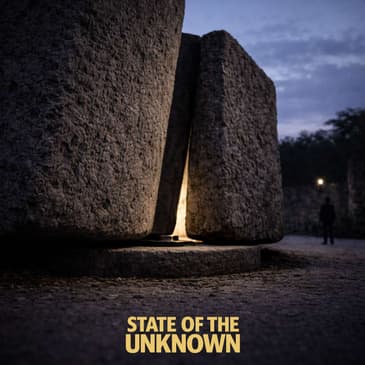
Coral Castle is one of the most enduring mysteries in American history.
In South Florida, a single man named Edward Leedskalnin spent decades building a massive stone monument entirely on his own. He worked at night, refused help, and left behind no clear explanation. The limestone blocks weigh several tons, yet no witnesses ever saw how they were moved.
Join host Robert Barber on State of the Unknown as he examines the documented history of Coral Castle, the life of its builder, and the engineering questions that continue to surround this strange landmark. This episode explores verified accounts, historical records, and firsthand observations while separating real evidence from speculation.
Often described as an unexplained engineering feat, Coral Castle has been linked to theories involving magnetism, lost knowledge, and paranormal encounters. But what can actually be proven? And what remains unresolved?
This is not a story about miracles or mythology. It is a grounded, documentary-style look at one of America’s most puzzling historical mysteries and the real unanswered questions it leaves behind.
Support State of the Unknown
If you enjoy the show and would like to help support it, you can become a Sasquatch Supporter for $3 a month. Your support helps cover the costs of researching and producing the show, website hosting, distribution, and helping more people discover State of the Unknown.
Membership is completely optional, and the show remains free for everyone.
Become a Sasquatch Supporter on Patreon
🔍 New episodes every Tuesday
🌐 Visit stateoftheunknown.com for show notes and to submit your own story.
📬 Questions, theories, or story ideas? Reach out at contact@stateoftheunknown.com or @stateoftheunknownpodcast.
Some stories don’t stay buried.
We go looking anyway.
A single man, barely five feet tall and just over a hundred pounds, works alone at night in South Florida. Around him, blocks of oolite limestone sit in the dark. Some of them weigh 30 tons, heavier than the stones at Stonehenge. He doesn't have heavy machinery, a crew, or even power tools. What he has are handbuilt levers and tripods assembled from salvaged parts and scrap metal. Neighbors live close enough to hear a truck start or metal strike stone. They hear nothing. Over time, massive stones appear, lifted and set with impossible precision. One block stands upright, so carefully set that a child can push it and watch it rotate on its axis. When people asked how he did it, he gave the same answer every time. He said he knew the secrets of the ancient builders. And he took those secrets to the grave. What makes this story endure isn't just the scale of what was built. It's the absence of an explanation that ever held up. No one saw the work happen, and nothing he left behind explains how he did it. What remains is the structure itself, standing exactly where he left it in a trail of claims, measurements, and unanswered questions that refuse to settle into something ordinary. To understand why this place still draws attention decades later, you have to look at who built it, what he left behind, and why no one has ever been able to explain how it was done. Today's episode takes us to South Florida, where a strange stone monument still stands, built by a man who never explained how he did it. For decades, Edward Leeds Callan, a man barely five feet tall, worked almost entirely alone. Mostly at night, he moved blocks of coral limestone that weighed up to 30 tons. He used no heavy machinery, had no crew, and left behind no clear plans. Still, the stones were set with a precision that continues to raise questions. When people asked how it was possible, he gave the same answer every time. He said he discovered the secrets of the pyramids. This is the story of Edward Leeds Skalman and Coral Castle. Let's get into it. Edward Leeds Skalman doesn't fit the profile of someone who should have been able to build Coral Castle. He was born in Latvia in 1887 and immigrated to the United States as a young adult. His formal education ended early, likely around the fourth grade. There's no record of engineering training, no background in architecture or construction, and no association with academic or industrial institutions that would later account for what he accomplished in South Florida. Physically, he was small. Most contemporary descriptions place him just under five feet tall, weighing a little over a hundred pounds. His lungs were scarred by tuberculosis, a condition that often leaves a person short of breath from minimal exertion. Yet the work he took on involved lifting and positioning mass that even modern machinery struggles to handle with precision. People who met him in Florida described him as quiet and deliberate. He spoke carefully and rarely volunteered personal details. What little is known about his private life centers on a failed engagement years earlier. Ed had been engaged to a young woman named Agnes Scuffs. She was 16 years old. The wedding was called off the day before it was supposed to take place. No public explanation was ever given, and Agnes never became part of the story that followed. When Ed referred to her at all, he used the same phrase every time. My sweet 16. By the early 1920s, Ed had settled in South Florida. In 1923, he purchased a small plot of land in Florida City. Instead of building a house or developing the property, he began cutting stone directly from the ground. The material was oolite limestone. Oolite is fossilized coral and shell, compacted over time into a dense abrasive stone. It resists clean cuts. It dulls tools quickly. Working it by hand tears at the skin and transfers vibration directly into the body. The blocks Ed extracted weighed several tons. Some of the stones he would later shape and position exceeded 30 tons. There's no documentation of anyone working alongside him. No assistants were identified. No labor crews were recorded. People living nearby never described seeing groups of workers or equipment being delivered. Ed controlled access to the property and discouraged visitors, especially while he was working. He preferred to work at night. Neighbors paid attention to what they could hear. They lived close enough to hear a truck start, tools being unloaded, or metal striking stone. None of that sound carried from the property. The nights remained quiet. The silence wasn't a byproduct of the work, it was the most confusing part of it. Over time, the land itself changed. Walls rose where open ground had been. Massive blocks stood upright, fitted together with deliberate precision. Furniture carved from solid limestone appeared inside the structure. The work looked finished, not experimental. It didn't suggest trial and error. It suggested a method already understood. By the time people began asking how any of it had been done, Coral Castle already existed as a completed structure. By the mid-1930s, Coral Castle was already standing in Florida City. The massive blocks were set, the walls were up, and the carvings were complete. Whatever methods Edleed Skalnen was using, they were no longer theoretical. They had already worked. Then the surroundings began to change. Developers began planning a subdivision near the property. More people, more noise, more attention. Ed didn't argue or protest. He didn't negotiate for privacy. He made a decision that, on its face, made no sense. He chose to move the entire structure, not rebuild it somewhere else or just abandon it and start over. He planned to take it apart and reassemble it ten miles away in homestead. What followed is one of the most documented and most difficult parts of the Coral Castle story to explain. Ed hired a local tractor driver with a flatbed trailer. The arrangement was specific. When the driver arrived, Ed asked him to leave the area or turn his back. When the driver returned, the trailer was already loaded. The driver later described what that looked like on his end. The flatbed would groan under the sudden weight, the tires compressed, the suspension sagged as if it had been dropped onto something massive all at once. But there was never any sound that matched the load. No engine noise, no clatter of chains, no impact that suggested how the stone had been placed there. The driver never saw the stones lifted. He never saw a system in motion. Each time he came back, the work was already done. The stones weren't small, some weighed several tons. Others approached 10 tons or more. Each one had to be raised, positioned, and balanced carefully enough to survive transport without cracking or shifting. This wasn't rubble dragged onto a truck. It was mass that modern equipment would struggle to stabilize without visible effort. Load by load, the driver hauled the stones to the new site in homestead. At the destination, the process reversed. Ed unloaded the stones alone. He reset them. He restored the structure with the same precision it had before the move, aligning walls and components as if they'd never been disturbed. Neighbors noticed the same pattern they'd seen years earlier. Ed worked almost entirely at night. The area stayed quiet. There was no machinery noise, no shouting, no metal striking stone. People woke up to the changes they hadn't heard being made. When the relocation was finished, Coral Castle stood again, intact, functional, and complete. That detail changes how the story reads. Moving the structure proved it wasn't a quirk of the Florida soil or a one-time accident of circumstance. The method survived distance. It survived disassembly. It worked somewhere else. Whatever Ed's secret was, it went with him. It wasn't about the location, it was about the man. By the time the structure stood complete in Homestead, Coral Castle had stopped being a curiosity and started looking like a mechanical problem. The most cited example sat near the entrance, a massive limestone gate, eight feet tall and weighing roughly nine tons. Despite that weight, visitors described opening it with one finger. A light push was enough to set it moving. Once in motion, it swung freely and settled back into place as if guided. What made that possible wasn't force, it was balance. At the center of the gate was a metal bearing, salvaged from an old truck axle and set vertically onto the stone. The limestone had been drilled with extreme precision so the entire weight of the gate rested on that narrow point. There was no grinding, no resistance. The mass stayed in motion because it had been centered perfectly. That level of precision would challenge a modern machine shop. Edley Skellen achieved it working alone, using hand tools. The gate remained functional for decades. It wasn't until 1986 that it finally failed. When it stopped turning, engineers brought in a 50-ton crane to lift it for repairs. They expected to find a complex mechanism hidden inside the stone. Instead, they found a rusted bearing in a carefully drilled cavity. Nothing else, nothing advanced, just accuracy so tight that there was almost no room for error. That discovery didn't close the case. It made it harder to explain. Throughout the property, the same principles appear again and again. Multiton stones rest on narrow points of contact. Walls align without mortar. Heavy blocks interlock in ways that distribute weight evenly enough to remain stable through decades of weather and erosion. Nearby were the tools Ed left behind. Wooden tripods made from telephone poles, simple pulleys, chains worn smooth from use. At the top of one tripod sat a box-like structure, often described as a black box. No one documented what it contained while Ed was alive, and it was gone by the time serious investigation began. There's no evidence the box held machinery. There's also no record of anyone opening it. That absence left room for speculation. Over the years, theories rushed in to fill the gap. Anti-gravity, acoustic levitation, magnetic fields, outside assistance. Most of those ideas would speak more to the mystery than to the evidence. Ed offered his own explanation, though it never crossed into instruction. He printed small pamphlets at his own expense, writing about magnetism, electricity, and what he called magnetic current. He claimed modern science misunderstood how energy moved through matter. He never described a lifting technique. He never explained how the stones left the ground. What he did repeat consistently was that he understood the principles used by ancient builders. Whether that meant leverage refined to its limit or something more abstract remains unclear. The stones don't reveal it. The tools don't explain it. The engineers who later examined the work couldn't reverse engineer a method from the finished result. What remains is a structure that behaves like it was built by someone who understood exactly where every pound of force needed to go, and a process that left no record of itself while it was happening. In December of 1951, Ed Leeds Kellnon placed a handwritten sign on the gate of Coral Castle. It read, Going to the Hospital. There was no announcement and no explanation, no indication that anything was wrong beyond what had already been true for years. Ed had been visibly ill for a long time. Tuberculosis had damaged his lungs decades earlier, leaving him thin, fragile, and easily winded. Visitors remembered a man who tired quickly from conversation, whose voice sometimes faded mid-sentence. Even so, his daily work had never slowed. After leaving the sign, Ed took a bus to Jackson Memorial Hospital in Miami. Three days later, he was dead. The cause was listed as kidney failure. He was 54 years old. When people entered his living quarters after his death, they didn't find answers. The room was sparse, a cot, a small table, personal papers, his pamphlets on magnetism and energy, printed cheaply and sold for pocket change. Tucked away were his savings, about thirty five hundred dollars, wrapped neatly in brown paper. There were no plans, no journals explaining his methods, no diagrams hidden in the walls, nothing that described how the stones had been lifted, balanced, or set in place. When Ed died, investigators were left with a finished structure, a clear timeline, and no record of how the work was actually done. The work stopped with him. The castle remained. The stones stayed exactly where he left them. What disappeared was how he did it. What we're left with are the results, the gates, the walls, the measurements, and the tools that he used to shape them. What's missing is the moment where those things came together. And no one has been able to recreate that moment since. Everything you've heard so far comes from physical evidence, first-hand accounts, and what still stands in Homestead today. Coral Castle isn't a story that survives on rumor. It survives on weight, on stone that's still standing exactly where it was placed. More than a thousand tons of stone were cut, lifted, positioned, and balanced by one man working alone. The measurements hold. The stones haven't shifted, and the gate still turns on its axis. Over the years, a few explanations have been proposed. Some claim Ed Leeds Skalman discovered a way to neutralize gravity using sound or vibration. It's an idea that fits the silence people remember, but there's no physical evidence to support it. No acoustic tools were found, no devices capable of producing force at that scale. What was found were his writings. Ed published small pamphlets describing something he called magnetic current. His ideas don't align with modern physics, but they do reveal how he thought in terms of balance, polarity, and controlled force. That mindset shows up in the castle itself, not as magic, but as precision. When the nine-ton gate failed in 1986, engineers discovered it was balanced on a salvaged truck bearing, drilled cleanly through the stone's center of mass. That detail confirms ordinary materials, extreme accuracy, and a deep understanding of balance. It still doesn't explain how one man achieved that alignment without help, machinery, or even noise. The most grounded explanation involves leverage, tripods, pulleys, and block and tackle systems, moving stones slowly, inches at a time. It fits the tools left behind, it fits the physics. What it doesn't fully explain is the silence. Even careful work leaves sound. Even slow lifts leaves traces. And no one ever saw the moment where effort became result. This isn't unique to Coral Castle. Throughout history, there are structures where we understand the materials, the weight, and even the basic tools, but not the exact sequence that made them come together. At Stonehenge, we know the stones were moved. We know where they came from. The final placements and the precision they show are still debated. At Pumapunku in Bolivia, stone blocks fit together so tightly that modern replicas struggle to match the tolerances even with power tools. In each case, the mystery isn't what was built. It's the missing moment, the technique, the rhythm, the order of operations that never made it onto the record. By the time Ed Leeds Skalnan died in 1951, the work itself was already finished. What remained wasn't a mystery in motion, it was a fixed result. The stones stayed where they were set, the gate kept turning and the measurements continued to hold. What never surfaced was the sequence that made those outcomes possible, not the materials, not the tools, the order of operations. That missing interval, the moment where effort became placement, is the only part of Coral Castle that never entered the record. And without that moment, every explanation stops just short of completion. When people talk about Coral Castle, they usually look for a trick, a hidden device, a missing equation, some lost secret that would suddenly make it all make sense. I don't think that's where the real weight of this story sits. In the end, maybe there wasn't a hidden law of physics at all. But there is a possibility that we've lost the frequency. We look at 30 ton blocks and think of brute force, of diesel engines and hydraulic pressure. We assume that to move something that heavy, you have to fight it. But Ed spoke about the ancient builders as if they had a different relationship with mass. He hinted at a technology. Technology not of electronics, but of alignment. A way to find the exact point where gravity stops being an anchor and starts being a tool. If that kind of method exists, it wouldn't look like a machine. It would look like a man working in silence, using nothing but the weight of the earth against itself. Maybe the secret was focus, sustained, patient, almost inhuman focus, applied over decades instead of minutes. We live in a world built on noise, machines, and speed. Ed Leed Skalnan worked in silence with levers and time. He didn't rush stone into place. He worked it into place. That's not magic, but it's not common either. Coral Castle is still there in Homestead. The stones haven't shifted, the gates still turn, and whatever understanding allowed one man to do that work alone was never passed on. Not because it was supernatural, but because it demanded a mastery of simple mechanics that most people don't have the patience to relearn. This has been State of the Unknown. What stays with me about Coral Castle isn't a theory or a legend. It's the fact that the structure doesn't argue back. The stones are still there, the measurements still hold, and the gate still turns on its axis. Whatever Ed Leed Skalnon understood, it was enough to move more than a thousand tons of stone quietly, repeatedly, and without ever showing his work. That silence is the part I can't shake. I want to take a moment to say thank you for the comments, ratings, and thoughtful reviews lately. Listening so closely to these stories means everything to me. If you're enjoying the show, leaving a rating or a short review is truly the best way to help. Whether it's a quick tap of the stars on Spotify or a few words on Apple Podcasts, I see all of them and I really love reading what you have to say. And sincerely, thank you for spending this time with me. If there's a story or a place you think would make a great episode, let me know. You can reach me anytime at state of the unknown dot com slash contact. Until next time, stay curious, stay unsettled, because some mysteries don't ask to be believed, they just exist.