
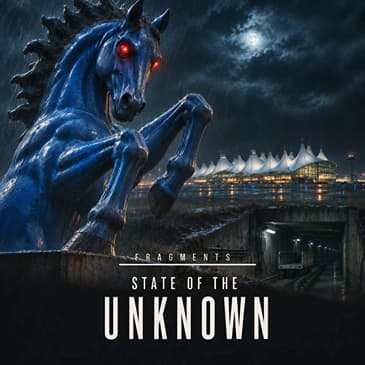
Denver International Airport occupies fifty-three square miles and sits above an extensive network of underground tunnels. Inside the terminal, a capstone bears a Masonic symbol and the name “New World Airport Commission.” Nearby murals depict war, death, and environmental destruction, while gargoyles watch over baggage claim.
For decades, those details have fueled claims that the airport is hiding something beneath Colorado: an underground city, a government command center, a secret prison, or something even stranger.
In this episode of Fragments, Robert traces the Denver airport conspiracy back to its beginnings. Which parts of the story are real? When did the underground rumors begin? And what is actually beneath Denver International Airport?
Follow or subscribe to State of the Unknown so you don’t miss the next story.
Support State of the Unknown
If you enjoy the show and would like to help support it, you can become a Sasquatch Supporter for $3 a month. Your support helps cover the costs of researching and producing the show, website hosting, distribution, and helping more people discover State of the Unknown.
Membership is completely optional, and the show remains free for everyone.
Become a Sasquatch Supporter on Patreon
🔍 New episodes every Tuesday
🌐 Visit stateoftheunknown.com for show notes and to submit your own story.
📬 Questions, theories, or story ideas? Reach out at contact@stateoftheunknown.com or @stateoftheunknownpodcast.
Some stories don’t stay buried.
We go looking anyway.
A Conspiracy Hiding In Plain Sight
SPEAKER_00I'm Robert Barber. Welcome to Fragments, the short form side of State of the Unknown. These are stories about one strange account, old legend, or unexplained detail that caught my attention. When you hear the words conspiracy theory, you probably picture a secret military base in the desert, a government facility hidden behind fences, or maybe a research lab where nobody will tell you exactly what's happening inside. You probably don't picture an airport, but Denver International Airport is different, because if you ask what lies beneath it, even the ordinary answer sounds suspicious. There are miles of tunnel under the airport, along with restricted corridors, utility rooms, abandoned machinery in parts of an enormously expensive baggage system that never worked the way that it was supposed to. Above those tunnels is a dedication stone bearing a Masonic symbol in the name of an organization called the New World Airport Commission. The murals inside the terminal contain the images of soldiers, weapons, grieving families, dead animals, and whole cities in ruin. Gargoyles watch over the baggage claim. From the air, some people believe that the runways form a swastika. Obviously, much emphasis has been placed on making it as family friendly an environment as they possibly can. Sarcasm has entered the chat. Over the years, people have claimed that the airport is hiding in underground city, a government command center, a prison camp, extraterrestrials, and even reptilian beings living beneath Colorado. Here's what caught my attention, though. Many of the details used to support those claims are real. The airport is enormous. The tunnels, they exist. The symbols are there, and the artwork really does contain some disturbing images. So how did all of those things become connected? And what's actually beneath Denver International Airport?
Why Denver Needed A New Airport
SPEAKER_00To understand why the conspiracy started, you have to go back to Denver's old airport. By the 1980s, Stapleton International Airport was struggling to keep up. It was close to the city, which made it convenient, but neighborhoods had grown around it. Residents complained about the noise. The property had little room to expand, and bad weather reduced the number of planes that could arrive and depart. Denver wanted a larger airport with enough open land to add more runways as the city grew. Voters approved the project in 1989, and the new airport would be built northeast of Denver on a site covering roughly 53 square miles. To put that into perspective, that's more than twice the land area of Manhattan. Most of that property doesn't contain terminals, parking garages, or runways. The open land creates distance between the airport and the surrounding neighborhoods, and it gives Denver room to expand in the future. That's the practical explanation. But when you look across all that empty land, the airport itself can seem like one visible piece of something much larger.
The Automated Baggage System Disaster
SPEAKER_00Construction began in 1989, and one of the airport's biggest ideas was something most passengers would never see. Denver wanted to automate nearly the entire process of moving luggage. Instead of baggage handlers driving carts between aircraft and terminals, computer controlled vehicles would carry bags through a network beneath the airport. The original design included more than 17 miles of track, thousands of motors and sensors, barcode scanners, conveyors, and roughly 4,000 automated carts. Those carts were supposed to race through underground tunnels and deliver luggage to the correct destination within minutes. It was an incredibly ambitious system. It was also a disaster. During testing, carts jammed and bags were sent to the wrong places. Luggage fell onto the tracks. Some bags were damaged while others were misrouted or thrown from the carts. The baggage system became one of the biggest obstacles preventing the airport from opening, and the opening date kept getting pushed back. Denver eventually had to build a conventional backup system while engineers tried to save whatever parts of the automated system they could. Denver International Airport finally opened on February 28, 1995, approximately 16 months late. Construction costs had climbed to slightly more than $3 billion, while the total cost of the project, including financing and related expenses, exceeded $4.8 billion. The airport opened, but much of the automated baggage system never worked as intended. So beneath the terminal was a real network of tunnels, machinery, and restricted spaces that had been built for one of the most expensive baggage systems ever attempted. That explains where the tunnels came from. It also explains why people found them so suspicious. The public had watched billions of dollars go into a project that opened late, and much of the work had taken place underground where almost no one could see it.
Capstone, Murals, And Gargoyles
SPEAKER_00Another strange part of the airport had appeared before it even opened. On March 19, 1994, officials dedicated a capstone inside the terminal. Beneath it was a time capsule containing items connected to the airport and the people who built it. The capsule was intended to remain sealed for 100 years until 2094. The stone displays the Masonic Square and compasses. Now the Freemasons are a centuries-old fraternal organization whose private ceremonies and use of symbols have made them a regular subject of conspiracy theories. Beside that symbol are the words New World Airport Commission. You can probably understand why people noticed it. There was a sealed container that wasn't supposed to be opened for a century. Above it was a symbol associated with a private brotherhood, and beside that was the name of an organization that sounded like it might have something to do with creating a new world or a new world order. The New World Airport Commission wasn't the agency that built or operated the airport. Most people had never heard of it, and after the airport opened, there didn't seem to be much information about it. So who were they? The rest of the airport didn't exactly make that question go away. Two of its best known paintings were created by Leo Tanguma, a Texas-born artist known for large public murals dealing with war, inequality, violence, and humanity's relationship with nature. One of those murals is called the Children of the World Dream of Peace. It contains a towering soldier wearing a gas mask. He carries a rifle and a sword while frightened families gather beneath them. Women hold dead children. Buildings burn in the background, and people from different cultures appear trapped in the same scene of destruction. Another mural, in peace and harmony with nature, shows dead animals, damaged environments, and children grieving over a world being destroyed around them. If the only images you saw were photographs of those sections, you might wonder why they were hanging inside an airport. Now, as strange as that might seem, that's not all. There were also gargoyles overlooking the baggage claim. Gargoyles have traditionally been placed on buildings as guardians, meant to frighten evil away. Denver's version sits inside open suitcases above the place where passengers wait for their luggage. They were created as protectors with a joke built into them. They're watching over the bags. Under normal circumstances, that might be all anyone saw. But once people were already talking about underground tunnels, a Masonic capstone, the New World Airport Commission, and murals filled with death, even a joke could start looking like another clue. I don't think I would have ever picked up that joke myself, but it is what it is. Kind of creepy, if you ask me. Airport officials later said they were receiving questions about hidden bunkers in a coming New World Order before Denver International had even opened.
How The Underground City Story Spread
SPEAKER_00The phrase New World Order has been used in several political and historical contexts. In conspiracy culture, it usually refers to the belief that a hidden group of powerful people is working to replace independent governments with a single authoritarian system. During the 1990s, those beliefs were spreading through books, radio programs, conferences, and the early internet. Denver's new airport gave them a real physical location. In April 1996, conspiracy author Alex Christopher discussed the airport during an interview on KSEO Radio. A transcript circulated afterward, and Christopher also published a book called Pandora's Box 2, the Denver International Airport story. Christopher said she had toured underground areas with people who knew the airport. She described enormous corridors, thick concrete construction, lower levels, and spaces that seemed far larger than anything needed to move luggage. She also claimed that five large buildings had been constructed during the early years of the project, some of them reportedly reaching as high as 150 feet. According to Christopher, officials later said the buildings had been placed in the wrong location. But instead of demolishing them, she said they were covered with earth, leaving the structures and their connecting tunnels buried beneath the airport. Christopher believed the airport passengers could see was only one part of a much larger underground facility connected to secret societies and plans for global control. There's no independent documentation confirming the tour or the buried building she described. But her version brought the scattered pieces together. The rising cost was no longer just the result of an enormous project gone badly. The missing money had been spent underground. The delayed opening wasn't only about a failed baggage system, it allowed more time to complete the hidden facility. The tunnels hadn't been built for luggage. They connected different parts of an underground city. The murals weren't warnings about war and environmental destruction. They showed what the people behind the airport intended to do. And the capstone wasn't commemorating a public construction project, it was announcing who controlled it. Those ideas gave the conspiracy a structure, and later storytellers kept adding to it. Some claimed the underground facility was a command center for the New World Order. Others said it contained holding areas where large numbers of people could be imprisoned during a future national emergency. Eventually, people began claiming the tunnels reached the Cheyenne Mountain Complex near Colorado Springs. Cheyenne Mountain is a real military facility built inside a mountain. It became closely associated with NORAD, the joint American and Canadian command that monitors aerospace threats over North America. There's no verified evidence of a tunnel connecting Denver International Airport with Cheyenne Mountain. The two locations are separated by a considerable distance, but the addition gave the conspiracy something else that was real. A secret government installation inside a Colorado mountain. As the story spread online, almost anything could be placed beneath the airport. Some versions added extraterrestrials, while others included reptilian beings, especially after conspiracy writer David Icky popularized the belief that shape-shifting reptiles secretly controlled governments and powerful institutions. The physical airport remained the same, but the world people imagined underneath it kept growing. Another commonly shared piece of evidence came from looking down at the airport from above. Denver has six runways extending in different directions around the terminal complex. From certain angles, some people believe the layout resembles a swastika. There's no evidence that airport planners intended to create that symbol. Runways are positioned according to prevailing winds, aircraft separation, traffic capacity, and the ability to use several runways safely at the same time. Still, the resemblance is close enough for the image to circulate without any explanation. If someone already knows about the tunnels, murals, and capstone, the runway pattern seems to fit. It doesn't have to prove anything, it only has to look as though it belongs with the rest. The strange details that helped create the conspiracy do have explanations. Most of those explanations just never traveled as far as the claims.
What The Records Actually Show
SPEAKER_00The New World Airport Commission really existed. It was connected to Charles Ansbacher, a conductor who had also served as chairman of the Colorado Council on the Arts. The Commission was a nonprofit group created to promote the airport and plan events surrounding its opening, including a gala and an air show. Its records still exist in the Denver Public Library and the Colorado State Archives. Newspapers discussed the group before the airport opened and reported that it would dissolve after it completed its work. Ansbacher later recalled that its name was probably inspired by Antonin Dwarak's New World Symphony, one of the best known orchestral works associated with America. That's why the commission disappeared. It had been created for a temporary purpose, and once the airport opened, that job was over. But imagine someone searching for it years later. The name appears on a stone beside a Masonic symbol, yet the organization itself no longer seems to exist. Without the original context, that can look less like a civic committee closing and more like a secret organization covering its tracks. The Masonic symbol had a direct explanation too. The Grand Lodge of Colorado participated in the ceremonial placement of the capstone and the time capsule. Their involvement wasn't uncovered through leaked documents or a hidden investigation. It was acknowledged publicly on the stone. The murals also tell a different story when you see them in full. Tanguma's paintings begin with violence and destruction, but they don't end there. Later sections show children returning weapons, people from different nations coming together, and the natural world being restored. The soldier in the gas mask isn't being celebrated. He represents the forces of war that the children eventually overcome. The paintings are still unsettling. They're supposed to be, but they don't announce a plan for global destruction. They show destruction being rejected.
Blucifer, Anubis, And Marketing The Myth
SPEAKER_00Some of the airport's most famous details weren't there when the original conspiracy began. The enormous blue horse outside the airport is officially called Mustang. It was created by artist Luis Yimenez, and its bright blue body and glowing red eyes eventually earned it the nickname Blucifer. In 2006, while Yimenez was working on the sculpture, part of it fell in his studio and severed an artery in his leg. He died from the injury. The sculpture was completed after his death and installed at the airport in 2008. That really happened, and knowing it makes the horse feel even more disturbing. But it wasn't part of the original airport conspiracy because it didn't arrive until more than a decade after the airport opened. The red eyes weren't meant to suggest anything demonic. They were reportedly a tribute to the neon signs Jiménez had watched his father create when he was young. Another image, often included in collections of Denver's supposed occult artwork, shows an enormous statue of Anubis, the ancient Egyptian god associated with funerary rites and guiding the dead into the afterlife. That statue was also real, but it wasn't a permanent part of the airport. It appeared in 2010 to promote a traveling exhibition about King Tutankhamun at the Denver Art Museum. The statue left. The photographs did not. Eventually, Denver International stopped trying to distance itself from the conspiracy and began having fun with it. The airport created exhibits about the different theories. Construction signs joked about secret societies and underground facilities. Advertisements featured aliens and lizard people, and a talking gargoyle surprised passengers by answering questions about what might be hidden beneath them. At some point, the conspiracy became part of the airport's identity. That also made the story harder to untangle. Someone discovering those images years later might not know whether they came from a conspiracy website or from the airport itself.
Staying Curious Without Buying Everything
SPEAKER_00Several of the details surrounding Denver International Airport have documented explanations. The size of the property, the underground baggage system, the New World Airport Commission, the Masonic symbol, and the murals didn't come from nowhere. But knowing where those details came from hasn't ended the questions. The documented tunnels carried luggage, utilities, equipment, and airport workers. Some areas were abandoned or repurposed after the automated baggage system failed. That accounts for much of the infrastructure known to exist beneath the airport. The larger claims remain unverified. No publicly available evidence is confirmed an underground city, a secret prison, a command center, or a tunnel reaching NORAD. But that isn't the same as allowing the public to see and account for every restricted space beneath a 53-square mile airport. For some people, the documented explanations are enough. For others, the scale of the property, the delays, the cost overruns, the restricted tunnels and the symbols inside the terminal still leave too many questions. And maybe that's why this story has lasted. Every day, thousands of travelers pass through Denver International Airport with miles of infrastructure beneath their feet. Most of them will never see it. What we know explains part of the story. Whether it explains all of it is something each listener will have to decide for themselves. Now you may be wondering, what do I think? I believe there are things in this world that we don't fully understand. If I didn't, I wouldn't be doing this show. But believing that the unknown exists doesn't mean I have to accept every theory or assume every unusual detail must be connected. That's really the premise of State of the Unknown. We can take these mysteries seriously without deciding in advance what the answer has to be. Permission to be curious without being required to believe. When it comes to Denver International Airport, I think the documented explanations account for a lot. They tell us why the tunnels were built, where the name New World Airport Commission came from, why the Masonic symbol appears on the capstone, and what the murals were intended to mean. But do I think there could be more beneath the airport than the public record shows? Yes, I do. That doesn't mean I'm prepared to say there's an underground city, a secret prison or a command center full of reptilians beneath the runways. I don't know what, if anything, might be there, but I also don't think explaining several parts of the story necessarily accounts for everything beneath the property that large. That's honestly where I land. I'm open to the possibility that there's more to the airport than we know, but I'm not willing to decide what the more is without stronger evidence. And maybe that's why this story has lasted. The mystery grew around things that are actually there. Miles of tunnels, restricted underground spaces, abandoned machinery, strange artwork, and symbols that most travelers pass without ever noticing. Every day, thousands of people move through Denver International Airport while another layer of it exists beneath their feet. Some of those spaces are still being used, while others were abandoned years ago. Most passengers will never see any of them. The airport above the ground is familiar. What lies beneath is where the questions remain.
Closing Thoughts And Subscribe
SPEAKER_00This has been Fragments, a short form series from State of the Unknown. If you enjoyed this story, follow or subscribe. Subscribe is the next one. Until next time. Until next time. Stay curious. Stay curious. And if you ever find yourself changing planes in Denver, Airport you can see. Airport you can see part is only what was built there. What was built there.