
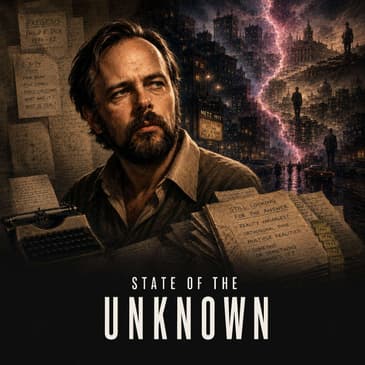
Philip K. Dick spent his career writing about false memories, alternate worlds, and people discovering that reality wasn’t quite what they thought it was.
Then, in 1974, something happened to him.
Join host Robert Barber as we follow Philip K. Dick’s 2-3-74 experiences — a series of strange events that left him questioning memory, time, and the nature of reality itself.
Three years later, at a science-fiction festival in Metz, France, Dick would tell an audience:
“We are living in a computer-programmed reality…”
What happened to Philip K. Dick in 1974?
And how did those experiences lead him toward ideas that would later be compared to simulation theory?
This episode of State of the Unknown explores one of the strangest chapters in Philip K. Dick’s life and the mystery behind his belief that reality might not be as fixed as it appears.
Support State of the Unknown
If you enjoy the show and would like to help support it, you can become a Sasquatch Supporter for $3 a month. Your support helps cover the costs of researching and producing the show, website hosting, distribution, and helping more people discover State of the Unknown.
Membership is completely optional, and the show remains free for everyone.
Become a Sasquatch Supporter on Patreon
🔍 New episodes every Tuesday
🌐 Visit stateoftheunknown.com for show notes and to submit your own story.
📬 Questions, theories, or story ideas? Reach out at contact@stateoftheunknown.com or @stateoftheunknownpodcast.
Some stories don’t stay buried.
We go looking anyway.
Metz 1977 And A Shocking Claim
SPEAKER_00It's September 24th, 1977. Author Philip K. Dick is sitting behind a table at the second international science fiction festival in Metz, France. He's the guest of honor. In front of him is an audience that knows exactly who he is. The writer behind stories filled with false memories, artificial worlds, and people discovering that the reality around them may not be as solid as it appears. Dick checks the microphones. Then he tells the room he's just been informed that he'll have to cut about two-thirds of his speech. People laugh. For just a moment, it feels like what everyone came to see. A famous science fiction writer talking about strange ideas. And then Dick begins describing something he calls orthogonal time, another direction in which reality might move. A way for different versions of events, different versions of the world to exist simultaneously. Well, at first it still sounds like science fiction. Except it keeps going. He starts talking about realities being changed, variables being altered, a world that could be reprogrammed without most of us realizing it had happened. And slowly something becomes clear. Philip K. Dick isn't pitching a story. He believes this. Then he tells the room, we're living in a computer programmed reality. Three years earlier, Dick believed something had happened to him. And this speech wasn't an attempt to imagine what that experience might mean. It was an attempt to explain it. What began with a series of strange experiences in California had grown into thousands of pages of notes, changing explanations, and questions about whether the reality around him was as fixed as it seemed. To understand why he was willing to say something like that in public, we have to go back to where those questions began.
The Dental Visit That Starts 2-3-74
SPEAKER_00In early 1974, Philip K. Dick was already one of science fiction's most imaginative writers, known for stories about alternate worlds, unreliable memories, and people discovering that reality wasn't quite what they thought it was. Then, after a routine dental procedure, Dick began having experiences he couldn't explain. Over the next several weeks, he would report strange visions, apparent information entering his mind, and moments when the world around him seemed somehow different. What followed would reshape his writing and send him on a search for answers that lasted the rest of his life. This is the story of Philip K. Dick, the experiences he called 2374, and how they eventually led him to wonder whether reality itself could be rewritten. And this is State of the Unknown. In February of 1974, Dick had an impacted wisdom tooth removed. He was given sodium pentathal during the procedure, and afterward, he went home in pain. Medication was ordered from a pharmacy, and a young woman came to the house to deliver it. Around her neck was a gold fish pendant. Dick asked her about it, and according to his later account, she told him it was a symbol used by the early Christians. And something happened. Dick would later use a Greek word for it, anamnesis. The easiest way to understand what he meant is that it didn't feel like he'd just learned something. It felt like he had remembered something he already knew. That became important to him because it didn't feel like an ordinary memory either. Dick began to have the sense that the woman standing in front of him wasn't simply a pharmacy employee wearing a Christian symbol. Somehow he felt that the both of them were connected to early Christianity, almost as if that fish meant something to both of them beyond the conversation they were having. And over time the idea got stranger. Dick started wondering whether the ancient world he seemed to remember was really gone at all. Maybe Rome wasn't simply 2,000 years in the past. Maybe in some way he didn't understand yet, it was still there. Over the next several weeks, Dick began seeing things. Sometimes he described vivid geometric images, shapes, colors, long sequences of abstract forms that seemed to go on for hours. In some of his accounts, these weren't quick flashes. They could continue through the night, one image giving way to another. At other times, he believed information was being transmitted directly into his mind.
Pink Light And Rome Bleeding Through
SPEAKER_00A pink light became one of the recurring parts of his account. Dick sometimes described it almost as if it carried information. Whatever was happening didn't seem to him like it was simply showing him something. It seemed to be telling him something, and he began to wonder whether the source of that information might be something outside his own conscious mind. There were times when Dick described another intelligence operating through him, or somehow within him. He could find himself thinking differently, noticing things differently, as though another mind was looking at the world through him. Over the years, he would come up with different names and different explanations for what that intelligence might be. But in 1974, he was still trying to understand what was happening. And the way he saw the world around him started to change. At times, California no longer seemed entirely like California. Dick said the contemporary world could appear almost transparent, as though another reality were underneath it. He connected that other reality with ancient Rome and the early Christians, and he began entertaining the idea that another personality or consciousness might somehow be present with him. He called that figure Thomas. Dick never settled on one clear explanation for what Thomas was. At times the idea was less like remembering a past life and more like two lives somehow occupying the same moment. Dick was in California in 1974, but Thomas belonged to the world of the early Christians. And somehow Dick wondered whether both could be there at once. Thomas became part of this growing sense that the reality everyone else seemed to move through normally wasn't the only thing Dick was experiencing. Then, during March, things became even more direct. In a summary he wrote later, Dick singled out several days in particular. On March 16th, he said an extraordinary presence appeared to him. On March 18th, he described an intelligence within him looking at the world around him and rejecting it as somehow unreal. And on March 20th, he said he experienced the world as false, almost as if ordinary reality were something he could see through. By this point, Dick wasn't simply reporting unusual images anymore. He was beginning to question whether the everyday world itself was what it appeared to be. Those were Dick's descriptions of what happened to him. Nobody else could stand inside those experiences with him. But there was one event from that same period that became especially important to Dick because he believed it had consequences outside his own mind. It involved his son. Christopher was still an infant, and according to Dick, information came to him telling him that something was medically wrong with the child. Dick took it seriously. He and his wife Tessa had Christopher examined. And accounts of the story say doctors found a medical problem, usually described as an inguinal hernia. For Dick, that changed things. A strange visual experience was one thing. Feeling connected to ancient Rome was one thing. Even believing that some intelligence might be communicating with him could, at least in theory, be something happening entirely inside his own mind. But Dick believed this was different. If the information had actually led him to a medical problem
The Warning About His Infant Son
SPEAKER_00in his son, then whatever was happening seemed to be doing more than just giving him strange perceptions. To Dick, it seemed to know something. And that gave him a reason, at least in his own mind, not to simply dismiss the whole experience and move on. So Dick started trying to explain what had happened. And he didn't settle on one answer and stick with it. He kept changing his mind. He considered religious explanations. Maybe what he'd encountered really was God or some kind of divine intelligence. Then he would question that. Maybe it was neurological. Maybe something had happened inside his brain. Maybe the experience was psychological. Maybe technology was involved somehow. At times he even considered extraterrestrial possibilities. He also entertained what he called a minimum hypothesis. Maybe the whole thing was self-delusion. And then he would keep going. He wrote about the experience constantly, in letters, in notes, and in long stretches where he would work through one explanation, find problems with it, and then move on to another. That body of writing eventually became known as the exegesis of Philip K. Dick. It grew to thousands of pages, roughly 8,000, depending on how you count them. And that gives you some idea of what this became for him. Dick wasn't simply writing down a strange thing that had happened in 1974 so he wouldn't forget it. He was trying to understand it. Sometimes an explanation would seem to fit for a while. Then he would notice something it couldn't account for or come up with another possibility that seemed to work better. So he would start again. The names and concepts changed as he went. Zebra, the programmer, the reprogrammer. Vallis, which stood for vast active living intelligence system. Those names can make it sound like Dick was steadily building one enormous theory, but that really isn't what he was doing. They were different attempts to give some shape to an experience that kept slipping out of whatever explanations he put around it. And his fiction became part of that process too. In the 1981 novel Vallice, Dick essentially
Exegesis And Explanations That Keep Changing
SPEAKER_00split himself in two. There's a character named Philip K. Dick, and then there's Horse Lover Fat, another version of Dick who has experiences very similar to his own. That gave Dick a way to take what happened seriously while also questioning the conclusions he was drawing from it. He could put forward an extraordinary theory and then turn around and challenge it. In other words, the argument he had been having with himself in thousands of pages of private writing made its way into the fiction, too. And as years went by, he started looking back at books he had written before 1974. That created another problem for him. Some of those books already seemed, at least from his point of view, to contain pieces of the world he now thought he had glimpsed. The man in the high castle had imagined another history, one where the Axis powers won the Second World War. His book, Flow My Tears, the policeman said, had imagined an authoritarian version of America. And Dick started wondering whether he had really invented all of it. What if some of his fiction was memory? Not memory the way we normally think of it, but information left over from another version of reality. That idea gave Dick an entirely new way to look at work he had written before any of this had happened. And by 1977, after three years of turning these experiences over from every direction he could think of, he was ready to talk about some of it in public. And that brings us back to Metz. Dick had been invited to France as the guest of honor at the second international science fiction festival. Even the people arranging the appearance weren't completely sure he would come. He didn't travel much, and by then he had a reputation for being unpredictable. But he came. On September 24th, he sat down in front of that audience to give a speech called, If you find this world bad, you should see some of the others. He checked the microphones, joked about being asked to shorten a speech, and began talking about something he called orthogonal time. We've already heard the moment when he told the room that he believed reality might be computer programmed. What came after gives us a better idea of what he meant. Dick asked the audience to imagine that time didn't only move in the direction we normally experience it, from past to present to future. Maybe reality could also move sideways. He used the example of a painting. Imagine that servants are supposed to take down one painting and replace it with another. But this time they don't have the replacement ready. So instead, they quietly change the painting that's already hanging there. Anyone looking at it afterwards sees the altered version. And unless they somehow remember what it looked like before, they might never know that anything had changed. That was close to what Dick was proposing about reality. A variable could be changed. One version of the world could become another, and the people living inside it might simply keep going without realizing anything had happened. Except Dick thought maybe once in a while something would remain. A strange memory, a dream, a feeling that something happened differently. The sense that you've already lived through a moment that, according to everything around you, should be happening for the first time. Dick wondered whether experiences like that might be leftovers from another version of events. And somewhere behind those changes, he proposed there was a programmer, or a programmer reprogrammer. For Dick, the programmer was closely connected with God, and he imagined something else working against it. A dark counterplayer, almost like two players moving pieces through different versions of reality. Each change would create another version of events, another move. Dick even wondered whether people themselves could be moved from one version into another and carry something with them, some trace of the world that they had occupied before. And
Orthogonal Time And The Reality Edit
SPEAKER_00then he brought all of this back to what he thought happened to him in 1974. He told the audience that during the period when he believed he had been, in his words, resynthesized, he had perceived the presence of the programmer. He described something like moving colored energy, a presence that could collect and disperse and perhaps even hide itself inside ordinary objects and ordinary processes. And then he went further. Maybe some of the worlds he had written about weren't entirely imaginary. Maybe the man in the high castle represented one of those other versions. Maybe Flow My Tears did too. He had spent his career inventing realities, and now he was sitting in front of an audience suggesting that at least some of those realities might actually have existed, or might still exist. Not everyone in Metz knew what to make of this. The speech was being translated into French as he went, so the presentation had a stop and start rhythm. And the further Dick moved from science fiction into his own experiences and beliefs, the harder some of the people seemed to have found it to follow him. Later recollections describe an audience that became increasingly confused. Some people reportedly left. Dick kept talking, and the speech was filmed. That becomes important now because we don't have to rely completely on someone remembering years later that Philip K. Dick once said something strange at a science fiction festival. We can watch him say it. We can see that this wasn't a stray remark pulled out of a much more conventional talk. He spent the speech trying to explain an entire way of looking at reality that had grown out of what he believed happened to him three years earlier. And even then, Mets wasn't the end of it. Dick went home and kept writing. He kept revising. He kept coming up with new possibilities and finding reasons to question them. The experience made its way into his later fiction while the exegesis continued to grow alongside it. And he never settled it. Philip K. Dick died in 1982. The exegesis was still unfinished. So what can we actually say happened to Philip K. Dick? The part we can establish pretty confidently is that something happened to him in early 1974 that he considered one of the most important experiences of his life. He wrote about it for years. It reshaped his later fiction. And in Metz, he publicly connected his ideas about programmed reality directly to what he believed he had experienced. What's much harder is reconstructing exactly what happened during those first few weeks. Dick's exegesis is enormous, but it isn't a diary where every event was written down neatly as it happened. A lot of the time, Dick was already trying to explain an experience by the time he recorded it. That makes the chronology messy. The pharmacy encounter is a good example. The woman, the fish pendant, the early Christian connection, the anamnesis, and the later pink light experiences all come from Dick's accounts. But the familiar version where everything happens in one perfectly timed moment at the front door is cleaner than the surviving record really allows. Christopher's medical problem is harder to evaluate for the same reason. There are repeated accounts that Dick became convinced something was wrong with his son, and that doctors then found a genuine medical condition. But we don't know precisely what Dick believed he knew beforehand, what Dick or Tessa may have already observed, or enough about the diagnosis to say that the information could only have come from somewhere extraordinary. And then there are the more ordinary possibilities. The experience began around the time of dental surgery. Dick had received sodium pentathol. He was in pain. Medication was involved, and sleep disruption may have also played a role. The experience continued well beyond the immediate effects of the procedure, so the dental surgery by itself doesn't account neatly for everything Dick later described. Neurological and psychological explanations have also been suggested. What I think is important here is that Dick himself considered those possibilities. He wondered whether something had happened in his brain. He considered whether he had fooled himself. He could spend pages developing an extraordinary explanation and then start finding reasons not to trust it. So the exegesis isn't 8,000 pages of Dick becoming more certain. In a lot of ways, it's 8,000 pages of him failing to become certain. And then there's the line from Metz. We are living in a computer-programmed reality. It sounds remarkably modern, but Dick wasn't really describing
What We Can And Cannot Prove
SPEAKER_00simulation theory as we usually understand it today. The modern simulation argument associated with philosopher Nick Bostrom came decades later and is based on the possibility that advanced civilizations might someday create simulated conscious beings in enormous numbers. Dick's idea came from somewhere very different. His programmer was connected with God. His thinking included Christianity, alternate realities, spiritual conflict, orthogonal time, and his own experiences in 1974. But there's enough overlap that the language can sound uncanny now. But calling Dick the man who predicted the matrix or training his ideas as an early version of the modern simulation argument makes his thinking much cleaner than it actually was. What happened to him in 1974 remains harder to define. And Philip K. Dick knew that better than anyone. I think that's what stays with me about this story. Philip K. Dick spent most of his career imagining people who discovered that the world they trusted wasn't quite what they thought it was. Then something happened in his own life that put him in almost exactly that position, and he couldn't write his way out of it. He could turn it into a novel. He could build theories around it. He could call the intelligence God, zebra, valice, or the programmer. He could stand in front of an audience in France and try to explain orthogonal time. But none of that gave him the one thing he seemed to be looking for. An answer he finally could live with. What I find interesting is that he never seems to have protected himself from that uncertainty by choosing one explanation and refusing to question it. He could believe something extraordinary one day and spend the next pulling holes in his own argument. That had to be frustrating, but there's something very human about it, too. Most of us want an experience to fit somewhere. We want to be able to say, this happened because of this, and now I understand it. Dick never got that. For almost eight years he kept circling the same few weeks in 1974, looking at them from different directions, trying one explanation after another. And the result wasn't certainty. It was thousands of pages of questions. Whatever actually happened to Philip K. Dick, whether it came from somewhere outside him or entirely from within him, it changed the course of the life that followed. His later books carried it. His private writing carried it. And three years after it began, he carried it all the way to Metz and tried to explain it to a room full of strangers. He died five years after that speech, still working
Living With The Question
SPEAKER_00on the same question. And maybe that's the part of his story worth remembering. Not that Philip K. Dick knew what reality was, but that after something happened that made him question it, he was willing to spend the rest of his life admitting that he didn't. This has been State of the Unknown. Philip K. Dick left behind novels, stories, that filmed speech in Mets and thousands of pages of an unfinished attempt to understand a few weeks in 1974. He never found the answer he was looking for, but he never stopped looking for it either. If you've been enjoying these stories, leaving a rating or review in your podcast app really does help more people find the show. On Spotify, it's just a tap of
Support The Show And Stay Curious
SPEAKER_00the stars. On Apple Podcasts, you can leave a short written review. And I also want to say thank you to everyone who's been commenting on the episodes and sending me email. I read them and I really appreciate hearing from you. It's meant a lot to see how many of you have been connecting with these stories. If you'd like to support the show beyond listening, you can also join the State of the Unknown Patreon. You'll find the link in the show notes. And if you want to make sure you don't miss the next story, just hit follow in your podcast app so it shows up automatically when it drops. Until next time, stay curious. And if reality ever does change sideways, maybe the strangest part would be remembering that it used to be different.